You send someone a quick message, talk about calling later, or simply want to say “I’m on my phone,” and there it is: the cellphone emoji 📱. It looks simple, but people use it in more ways than just talking about an actual mobile phone.
The cellphone emoji usually represents a mobile phone, smartphone, calling, texting, communication, or something happening through a device. In texting, it can help make a message feel more visual and casual. On WhatsApp, it may appear in conversations about calls, messages, apps, or staying connected. On Instagram and TikTok, it can also fit captions and comments about phones, selfies, digital life, or communication.
Like other emoji symbols, its meaning can change with context. A 📱 from a friend may simply mean “text me,” while the same symbol in a work conversation might refer to a phone call or mobile device. The words around it, your relationship with the sender, and the platform all matter.
Sometimes 📱 says “call me,” “text me,” and “I’m on my phone” without needing a full sentence.
What Does the Cellphone Emoji 📱 Mean?
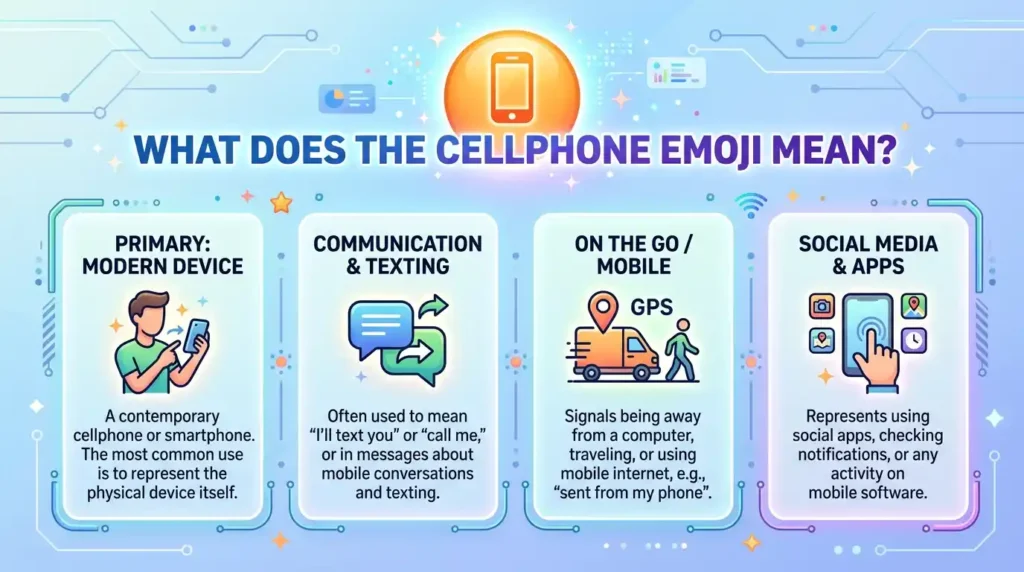
The cellphone emoji 📱 primarily represents a mobile phone or smartphone. Its most direct meaning is simple: something related to using, carrying, buying, checking, or talking about a phone. In texting, however, it can communicate a wider idea of digital communication.
Someone might send 📱 after saying, “I’ll message you later,” to reinforce the idea of staying in touch. In another conversation, “Where are you? 📱” could suggest calling or checking a phone. A person discussing a new device may use 📱 to represent a smartphone without naming a particular brand.
The emoji can also have an emotional meaning when communication itself is important. For example, “Waiting for your message 📱” can express anticipation without necessarily being romantic. A friend could use “Call me when you’re free 📱” as a straightforward request. In social media posts, the emoji may represent modern digital life, mobile photography, apps, texting, or being constantly connected.
Context is especially important. A message such as “My phone is dead 📱” is about a physical device, while “You never text me 📱” is about communication. The same symbol therefore does not have one fixed interpretation.
The surrounding words, relationship between people, conversation topic, culture, and platform can all influence how 📱 feels. It is usually neutral and practical, but the tone can become friendly, urgent, playful, or personal depending on the message.
Other related symbols can make the intended idea clearer. ☎️ and 📞 can emphasize calling, while 📲 can suggest receiving or making a mobile call. 🔋 and 🔌 can connect the phone to charging or battery issues. 💬 can make the communication aspect more obvious.
Meaning Table:
| Emoji | Core meaning | Possible misread | Best used when |
|---|---|---|---|
| 📱 | Mobile phone, smartphone | Could seem overly literal | Talking about phones or mobile communication |
| ☎️ | Telephone or phone call | May feel old-fashioned | Referring to calling or telephone contact |
| 📞 | Phone call, calling | Could imply an immediate call | Asking someone to call |
| 📲 | Mobile call or phone communication | May be read as a specific call action | Talking about mobile calls |
| 🔋 | Battery or power level | May seem unrelated without context | Discussing phone battery |
| 🔌 | Charging or power | Could suggest any electronic device | Talking about charging a phone |
| 💬 | Message or conversation | May imply text rather than phone | Referring to chatting |
| 💻 | Computer or digital work | Can shift attention away from mobile | Comparing devices or digital communication |
| ⌨️ | Keyboard or typing | May imply computer typing | Discussing typing or messages |
| 📳 | Vibration or phone alert | May suggest notification mode | Talking about phone alerts or silent mode |
📱 Cellphone
Meaning: A mobile phone, smartphone, or everyday phone use.
Example 1: I left my 📱 at home today.
Example 2: My 📱 is always beside me.
☎️ Telephone
Meaning: A telephone, calling, or traditional phone communication.
Example 1: Please give me a call ☎️
Example 2: The office asked me to call back ☎️.
📞 Phone Call
Meaning: Calling someone or asking for a phone conversation.
Example 1: 📞 me when you arrive.
Example 2: I need to make a quick 📞 before dinner.
📲 Mobile Call
Meaning: Mobile calling or an incoming or outgoing phone communication.
Example 1: I just got a call 📲
Example 2: Send me a message after you call 📲.
🔋 Battery
Meaning: Phone power, battery level, or needing more charge.
Example 1: My battery is almost empty 🔋.
Example 2: I need to save some power 🔋.
🔌 Charging
Meaning: Plugging in or powering an electronic device.
Example 1: My phone is charging 🔌.
Example 2: I forgot my charger 🔌.
💬 Chat
Meaning: Messages, conversation, or digital communication.
Example 1: Let’s talk about it in chat 💬.
Example 2: I saw your message 💬.
💻 Computer
Meaning: Computers, online work, or digital technology.
Example 1: I’ll finish it on my 💻.
Example 2: My phone works better for this than my 💻.
⌨️ Keyboard
Meaning: Typing, keyboards, or writing digitally.
Example 1: I’m typing the reply now ⌨️.
Example 2: My ⌨️ is finally working again.
📳 Vibration
Meaning: Phone vibration, alerts, or a vibrating notification.
Example 1: My phone was on 📳 during the meeting.
Example 2: I felt the notification 📳.
How to Use the Cellphone Emoji 📱 the Right Way?
The cellphone emoji works best when the surrounding message makes its purpose clear. It can be literal, conversational, or simply a visual reference to mobile communication.
WhatsApp 💬
On WhatsApp, 📱 naturally fits personal chats, family conversations, friendships, and everyday messages. You can use it when discussing a phone, asking someone to call, or saying that you’ll respond from your mobile.
For example:
“I’ll text you when I get home 📱”
“Can you call me when you’re free? 📱”
“I’m checking the message on my phone 📱”
It can also work in a WhatsApp status when the subject involves digital communication or mobile life. Because WhatsApp is heavily centered on messaging and calls, the symbol usually feels natural rather than decorative.
Instagram 📱
Instagram users can use 📱 in captions, comments, bios, and posts involving smartphones, mobile photography, apps, communication, or digital habits.
For example:
“Everything happens from this little screen 📱”
“Phone in hand, ideas everywhere 📱”
In comments, the emoji can provide a simple reaction to a phone-related post. It may also fit content about smartphone photography, mobile apps, new devices, or everyday screen time.
TikTok 📱
On TikTok, 📱 can work in captions and comments where the phone itself is part of the joke, story, trend, or situation. A creator might use it when describing a late-night texting habit or an amusing phone-related moment.
For example:
“Me checking my 📱 every five minutes.”
The emoji can also add a visual cue to casual humor without changing the main meaning of the caption.
On Facebook, 📱 can fit posts, comments, and Messenger conversations. It is useful for straightforward messages such as asking someone to call, discussing a new phone, or explaining that you’re currently using your mobile.
Because the emoji is generally neutral, it works in both casual conversations and practical posts.
Do’s and Don’ts:
Do:
- Use 📱 when your message involves a phone or mobile communication.
- Consider your relationship with the receiver.
- Let the surrounding words establish the tone.
- Use related symbols such as 💬 when you specifically mean messaging.
- Check how the emoji appears on different devices.
Don’t:
- Use 📱 randomly when the message has nothing to do with phones.
- Assume everyone interprets it in exactly the same way.
- Add too many device-related emojis to a serious message.
- Combine unrelated emoji symbols without a clear purpose.
- Assume 📱 automatically has a romantic meaning.
Why Does the Cellphone Emoji 📱 Look Different on iPhone and Android?
You may notice that the cellphone emoji looks slightly different when someone sends it from an iPhone, Android phone, computer, or another device. That does not necessarily mean the sender used a different emoji.
Emoji characters are standardized through Unicode, which provides the underlying character information that devices and software use to identify an emoji. Companies can then create their own visual designs for those characters.
Apple, Google, Samsung, Microsoft, and other technology companies may therefore display 📱 with differences in shape, proportions, shading, screen appearance, or overall style. One version might look more like a modern smartphone, while another may have slightly different details.
These differences can also affect how an emoji feels visually. The size, color treatment, perspective, and design style may vary depending on the operating system, app, browser, or font.
The important point is that the underlying Unicode character can remain the same even when the artwork changes.
For example, if you send 📱 from an iPhone to a friend using Android, the receiver may see a different-looking phone illustration. They are still receiving the same basic emoji character.
This is why there is no single platform design that should automatically be considered the “correct” version. The visual appearance belongs to the company or software displaying the Unicode character.
Best Cellphone Emoji 📱 Combos, Copy & Paste
Romantic ❤️
1.👉 📱💬 — Use this for a sweet message about staying connected.
2.👉 📱📞 — Use this when you want to suggest a personal call.
3.👉 📱💬📱 — Use this for a playful “let’s keep talking” message.
Cute 🥰
1.👉 📱💬 — Use this for a cute everyday chat.
2.👉 📱📳 — Use this when you’re waiting for a notification.
3.👉 📱💬📳 — Use this for a playful message about waiting for a reply.
Flirty 😉
1.👉 📱📞 — Use this when hinting that someone should call you.
2.👉 📲💬 — Use this for a casual invitation to continue chatting.
3.👉 📱📳💬 — Use this when you’re waiting for their message.
Missing Someone 💭
1.👉 📱💬 — Use this when you want to say you miss talking to someone.
2.👉 📱📞 — Use this when you wish you could hear their voice.
3.👉 📱💬📳 — Use this when you’re hoping to see their message.
Good Night 🌙
1.👉 📱💬 — Use this after finishing a late-night conversation.
2.👉 📱📞 — Use this when saying good night after a call.
3.👉 📱📳💬 — Use this for a playful late-night texting message.
Trending Cellphone Emoji 📱 in 2026:
The cellphone emoji continues to fit naturally into digital conversations because phones are closely connected with messaging, calls, social media, notifications, and everyday online activity. Rather than having one fixed trend, its usefulness comes from how easily it represents mobile communication.
In 2026, 📱 is commonly seen alongside related symbols when people talk about texting, calling, notifications, charging, or staying connected. It can appear in casual WhatsApp conversations, Instagram captions, TikTok comments, Facebook posts, and everyday messages.
📲 is useful when the focus is specifically on mobile communication or a call action. 💬 shifts the focus toward conversation, while 📳 can suggest notifications or vibration. 🔋 is especially useful when the conversation is about battery life or needing to charge a phone.
| Emoji | Why trending | Who uses it | Platform |
|---|---|---|---|
| 📱 | Represents everyday mobile communication | General users and creators | WhatsApp, Instagram, TikTok |
| 📲 | Highlights mobile calling or communication | Casual chat users | Messaging and social media |
| 💬 | Clearly represents digital conversation | Friends, creators, brands | Comments, chats, captions |
| 📳 | Adds a notification or alert idea | Casual mobile users | Messaging and social platforms |
Emoji usage continues to evolve as people find new ways to combine familiar symbols with changing online habits.
Cellphone Emoji Meaning in Different Contexts:
The meaning of 📱 becomes clearer when you consider the conversation around it.
Romantic conversations
In a romantic conversation, 📱 can represent staying connected, waiting for a message, or wanting to call someone. It does not automatically mean love or attraction. The words around it provide the emotional context.
“I’ll call you later 📱” is mainly about communication.
“I wish we could talk all night 📱” feels more personal because of the wording.
Friendship
Among friends, 📱 is often casual and practical. It might mean “message me,” “call me,” or simply refer to someone’s phone.
“Send me the address on your 📱” has a completely different purpose from “Why aren’t you answering your 📱?”
Family
Family conversations can use 📱 for reminders, calls, and everyday coordination. A parent might use it while asking someone to call home, while siblings may use it casually when arranging plans.
Professional and casual communication
In a professional context, 📱 can refer to a mobile device, phone contact, or mobile work. It usually remains neutral.
In casual communication, the same symbol can feel more playful or personal.
Texting
The emoji meaning in texting is often direct. 📱 can mean phone, texting, calling, or being connected through a mobile device.
Social media comments
On social media, 📱 may refer to a phone-related post, mobile photography, digital habits, or communication. The post itself usually determines the intended meaning.
Captions
In captions, 📱 can work as a visual shorthand. It can make a phone-related idea immediately recognizable without adding a long explanation.
How to Copy and Paste the Cellphone Emoji 📱
Copying the cellphone emoji is simple. Select the symbol below, copy it, and paste it wherever you want:
📱
You can paste it into WhatsApp chats, Instagram captions, TikTok comments, Facebook posts, Messenger conversations, text messages, notes, or other apps that support emoji.
On most phones, you can also open your emoji keyboard and search for terms such as “cellphone” or “phone.” On computers, the exact emoji input method depends on the operating system and application.
If you are creating copy paste emojis for a caption or message, it is usually best to place 📱 where it naturally supports the words instead of adding it simply for decoration.
FAQs:
1. What is the most popular cellphone emoji?
The most recognizable cellphone-related emoji is 📱 because it directly represents a mobile phone or smartphone. People commonly use it for phones, texting, mobile communication, and digital life.
2. What does 📱 mean when someone sends it?
It usually refers to a phone, calling, texting, or mobile communication. The exact meaning depends on the surrounding message and the relationship between the people chatting, rather than gender-based assumptions.
3. Why do emojis look different on iPhone vs Android?
Emoji artwork is created by individual platforms and companies, while Unicode provides the underlying character standard. As a result, 📱 can have a slightly different visual design on Apple, Google, Samsung, Microsoft, and other systems.
4. Are cellphone emojis used differently in other countries?
They can be interpreted differently depending on local communication habits, communities, platforms, and context. However, 📱 generally retains its basic association with mobile phones and digital communication.
Conclusion:
The cellphone emoji 📱 is a simple, flexible symbol for phones, calls, texting, and staying connected.
Its exact tone depends on the words around it and the relationship between the people communicating.
Use it naturally, choose related emoji combinations carefully, and remember that its appearance may vary across devices. 📱

Nasrullah — Emoji Strategist & Content Writer
Nasrullah is a passionate emoji enthusiast and content writer who loves exploring the meanings, uses, and cultural context behind emojis. He creates simple, helpful, and easy-to-understand guides that help readers choose the right emoji for WhatsApp, Instagram, Facebook, texting, and everyday conversations.
With a focus on emoji meanings, combinations, social media usage, and modern digital communication, Nasrullah aims to make every emoji easier to understand and use with confidence. His content combines practical examples with clear explanations so readers can quickly find the meaning and usage they are looking for.
When he’s not researching emojis, Nasrullah enjoys exploring digital trends, writing useful online content, and learning about how people communicate in the digital world. 😊