Sometimes a simple hand symbol can carry an entire hip-hop identity.
You may have seen someone type “Wu Tang” and follow it with 👐, 🎤, or 🎶, especially in a music discussion, caption, meme, or fan post. Then comes the obvious question: is there actually a Wu Tang emoji?
The short answer is not as an official Unicode emoji. The phrase Wu Tang emoji usually refers to a custom Wu-Tang-inspired graphic, sticker, logo image, or a combination of standard emojis that communicates the same idea. The standard 👐 emoji is officially called “open hands,” but fans may use it alongside music and hand emojis to create a Wu-Tang-related message.
That distinction matters when you are trying to copy and paste the symbol. A custom Wu-Tang logo image is not the same thing as a normal Unicode emoji. Your device may therefore display one as an image or sticker rather than as a regular text character. Context also matters. A message from a longtime fan can feel very different from a casual music reference.
The Wu Tang emoji is less about one official character and more about expressing Wu-Tang energy through symbols, stickers, and music-related emojis. 👐🎤
What Does Wu Tang Emoji Mean?
The Wu Tang emoji generally represents Wu-Tang Clan fandom, hip-hop culture, lyrical energy, group identity, or appreciation for the group and its music. However, there is no official Unicode character named “Wu Tang emoji.” Unicode’s current emoji list includes standard symbols such as 👐 open hands, 👊 oncoming fist, 🎤 microphone, 🎧 headphones, and 🎶 musical notes, but not a dedicated Wu-Tang symbol.
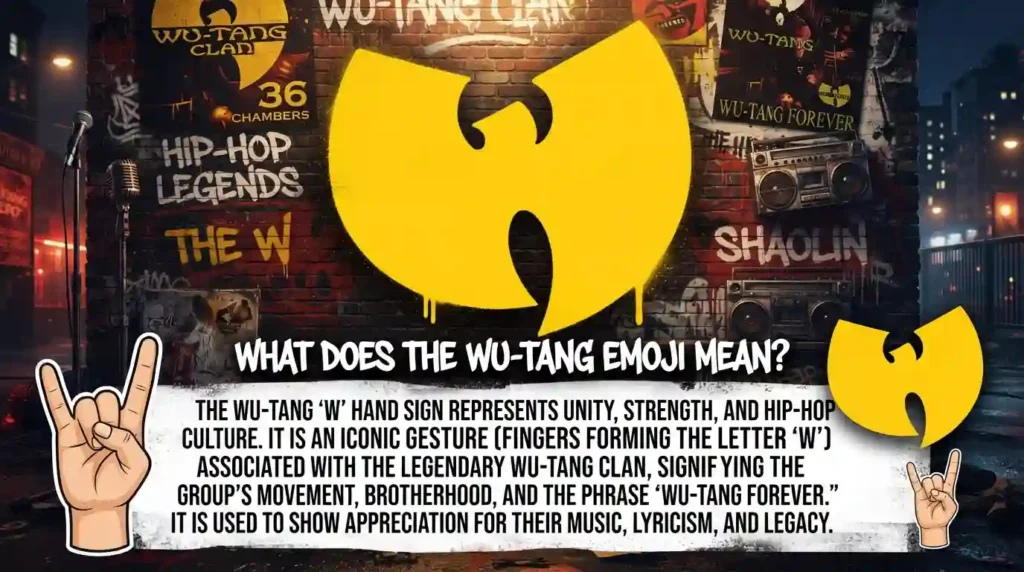
When people search for this term, they may actually be looking for a Wu-Tang logo emoji, a custom sticker, Wu-Tang emoji art, or a copy-paste combination. Some online emoji resources provide Wu-Tang-inspired artwork rather than a standardized Unicode character.
In texting, a Wu-Tang-related emoji combination can communicate that someone is a fan, is listening to the group, is discussing classic hip-hop, or simply wants a recognizable music-culture reference. 👐🎤🎶
Context changes the message. For example, “Wu Tang forever 👐” is clearly a fan-style statement, while “This track is crazy 🔥🎤” could simply express excitement about music. A hand emoji can also have its normal Unicode meaning rather than being a Wu-Tang reference. The relationship between sender and receiver matters too. Friends who already understand the reference may immediately recognize the intended meaning, while another person may see only a normal hand gesture. 👐
Meaning Table:
| Emoji | Core meaning | Possible misread | Best used when |
|---|---|---|---|
| 👐 | Open hands, fan gesture, expressive support | Simple greeting or openness | Wu-Tang references and fan messages |
| 👊 | Fist, energy, solidarity | Aggressive gesture | Strong hip-hop or hype messages |
| ✊ | Raised fist, strength, solidarity | Political or activist meaning | Powerful statements and solidarity |
| 🎤 | Music, rap, vocals | General singing | Hip-hop and music posts |
| 🎧 | Listening to music | Headphones only | Music recommendations or listening |
| 🎶 | Music and rhythm | General musical decoration | Songs, lyrics, playlists |
| 🔥 | Excitement, quality, hype | Literal fire | Great tracks and performances |
| 🐝 | Bee, wordplay, fan creativity | Literal bee | Creative custom combinations |
| 🖤 | Dark aesthetic, appreciation | Sadness | Black-and-yellow or hip-hop aesthetics |
| ⭐ | Recognition, favorite, standout | Generic decoration | Favorite artist or classic track |
👐 Open Hands:
Meaning: A flexible hand gesture that can support an expressive fan or celebration message.
Example 1: Wu Tang forever 👐
Example 2: That classic sound still hits 👐
👊 Oncoming Fist:
Meaning: Energy, strength, agreement, or a powerful greeting.
Example 1: That beat goes hard 👊
Example 2: Respect for the classics 👊
✊ Raised Fist:
Meaning: Strength, solidarity, or determination.
Example 1: Stand strong ✊
Example 2: Respect the culture ✊
🎤 Microphone:
Meaning: Rap, vocals, performance, or music.
Example 1: Mic check 🎤
Example 2: Hip-hop night 🎤
🎧 Headphones:
Meaning: Listening to music or getting immersed in a track.
Example 1: Back to the playlist 🎧
Example 2: Listening session tonight 🎧
🎶 Musical Notes:
Meaning: Music, rhythm, songs, or a musical mood.
Example 1: Old-school sounds 🎶
Example 2: This one stays on repeat 🎶
🔥 Fire:
Meaning: Something impressive, exciting, or exceptionally good.
Example 1: That track is 🔥
Example 2: The whole playlist is fire 🔥
🐝 Bee:
Meaning: A creative visual element sometimes used for wordplay or fan-made designs.
Example 1: Keeping the design playful 🐝
Example 2: Made my own fan combo 🐝
🖤 Black Heart:
Meaning: Appreciation, dark aesthetic, or a strong visual mood.
Example 1: Classic hip-hop forever 🖤
Example 2: Black and gold aesthetic 🖤
⭐ Star:
Meaning: A favorite, standout artist, song, or moment.
Example 1: One of the classics ⭐
Example 2: That verse deserves a star ⭐
How to Use Wu Tang Emoji the Right Way?
WhatsApp 💬
On WhatsApp, a Wu Tang-related emoji works naturally in personal chats, music discussions, group conversations, and status updates. If a friend sends you a classic hip-hop track, you might reply with “Still a classic 👐🎤”.
For a playlist conversation, “This is going straight on repeat 🎧🎶” feels natural. If your friends already understand the reference, a simple 👐 may be enough.
For a WhatsApp Status, a short phrase such as “Wu Tang forever 👐” makes the reference clear without needing a long explanation.
Instagram 📸
Instagram is especially useful for custom Wu-Tang emoji artwork because captions and comments can combine text, standard emojis, stickers, and images.
A music post could use “Classic sounds, timeless energy 🎤🎶”. A fan-made graphic might use 👐🔥 to create a stronger visual connection.
In comments, keep it simple. “🔥🎤” can show appreciation for a track, performance, or edit without pretending that the emojis themselves are an official Wu-Tang logo.
TikTok 🎵
On TikTok, the same symbols can work with music clips, edits, nostalgic posts, jokes, and fan content. A caption such as “When the classics come on 🎧🔥” gives the viewer a clear musical context.
The meaning can also become playful. A creator might use 👐 as a recognizable fan reference while the video provides the real context.
Facebook posts and comments can use Wu-Tang-related emojis for music memories, fan discussions, throwback content, and Messenger conversations. A simple comment such as “Still legendary 🎤🔥” can express appreciation without needing a custom sticker.
Do’s and Don’ts:
Do:
- Use emojis to support the message.
- Consider whether the other person understands the Wu-Tang reference.
- Use 👐 when the surrounding text makes the intended meaning clear.
- Combine music symbols with a relevant message.
- Remember that custom stickers and Unicode emojis are different things.
Don’t:
- Assume 👐 automatically means Wu-Tang.
- Present a custom Wu-Tang logo as an official Unicode emoji.
- Overload a serious conversation with music symbols.
- Assume every person will recognize the reference.
- Treat one emoji combination as having one universal meaning.
Why Does Wu Tang Emoji Look Different on iPhone and Android?
There is an important distinction here. Standard Unicode emojis have a shared underlying character, but each platform can draw that character differently. Unicode’s emoji charts identify characters such as 👐 as “open hands,” and the same Unicode character can receive different artwork from different companies.
This means Apple’s design, Google’s design, Samsung’s design, Microsoft’s design, and other platform designs can differ in shape, color, proportions, shading, or facial details.
For the Wu Tang emoji, there is an extra layer because many results are actually custom graphics, stickers, or emoji-style images rather than Unicode characters. A custom Wu-Tang logo may therefore look completely different depending on the website, sticker pack, image creator, or messaging platform.
For example, 👐 remains the Unicode open-hands character, but a custom Wu-Tang image might show the famous logo in yellow and black. These are technically different types of digital content.
So if you copy 👐, you are copying a standard Unicode emoji. If you copy a Wu-Tang logo PNG or sticker, you are copying an image. That distinction explains why one can behave like ordinary text while the other may behave like a picture.
Best Wu Tang Emoji Combos, Copy & Paste
Romantic ❤️
👐🖤 — Use this for affectionate fan-style appreciation.
🎤🖤 — Use this when music is part of a personal message.
🎶👐 — Use this for a shared favorite song or music memory.
Cute 🥰
👐⭐ — Use this for a playful favorite-artist message.
🎧🎶 — Use this for a cute music-listening mood.
👐🐝 — Use this for a playful custom fan combination.
Flirty 😉
🔥🎤 — Use this for a confident music-related compliment.
🖤👐 — Use this for a cool, understated fan vibe.
🎶🔥 — Use this when a song or playlist has serious energy.
Missing Someone 💭
🎧🖤 — Use this when a familiar song reminds you of someone.
🎶👐 — Use this for a shared music memory.
🎤⭐ — Use this when a favorite artist or track brings back memories.
Good Night 🌙
🎧🖤 — Use this for a late-night listening message.
🎶⭐ — Use this for ending the night with a favorite song.
👐🎶 — Use this as a relaxed good-night music sign-off.
Trending Wu Tang Emoji in 2026:
In 2026, it is useful to think of the Wu Tang emoji as a search and fan-art category, rather than a single standardized emoji. Current search results include custom Wu-Tang emoji artwork, logo graphics, sticker-style designs, and combinations involving the Wu-Tang symbol.
The standard Unicode options remain useful because they can be typed directly into ordinary messages. 👐 is especially relevant because Unicode officially defines it as open hands, while users can give it a Wu-Tang meaning through surrounding text and context.
| Emoji | Why trending | Who uses it | Platform |
|---|---|---|---|
| 👐 | Easy hand-based fan reference | Music fans | WhatsApp, Instagram |
| 🎤 | Clear connection to rap and performance | Hip-hop listeners | TikTok, Instagram |
| 🎶 | General music context | Everyday users | WhatsApp, Facebook |
| 🔥 | Adds hype and excitement | Fans and creators | TikTok, Instagram |
Custom Wu-Tang emoji graphics also continue to appear in emoji-style searches and fan-created designs, showing how people often adapt standard emoji concepts into more specific visual references.
The broader lesson is that emoji usage keeps evolving through combinations, memes, fan communities, stickers, and platform-specific visual culture rather than relying only on official Unicode names.
Wu Tang Emoji Meaning in Different Contexts
The same symbol can communicate different things depending on the conversation.
Romantic conversations:
A Wu-Tang reference is usually more about shared taste than romance itself. “Our playlist 👐🖤” could feel affectionate because of the words around it, not because 👐 is inherently romantic.
Friendship:
Among friends, “Wu Tang forever 👐” can act as a shared cultural reference or inside joke.
Family:
A family member might use music emojis to show that they enjoyed a song. In this setting, the symbols are usually casual rather than flirtatious.
Professional or casual communication:
In a professional conversation, custom Wu-Tang symbols may be less appropriate unless the discussion is directly related to music, entertainment, design, or culture. A casual group chat gives you much more freedom.
Texting:
Short combinations work particularly well because the surrounding words provide context. “That track still goes hard 🎤🔥” is clearer than sending 🔥 alone.
Social media comments:
A few symbols can function as quick reactions. 👐🎶 may communicate appreciation when the post is already clearly about music.
Captions:
Captions give you more space to establish meaning. You can write the reference in words and use the emoji as visual support.
How to Copy and Paste Wu Tang Emoji
If you want a standard emoji that can support a Wu-Tang reference, copy this:
👐
Select the emoji, choose Copy, and paste it into WhatsApp, Instagram, TikTok, Facebook, Messenger, a comment, or a caption.
You can also copy a combination:
👐🎤🎶🔥
Remember that this is an emoji combination, not an official Wu-Tang Unicode character.
If you specifically want the Wu-Tang Clan logo, look for a legitimate custom sticker, image, or emoji-style graphic. Those files are different from Unicode emojis and may need to be shared as images or stickers instead of pasted as ordinary text.
FAQs:
1. What is the most popular Wu Tang emoji?
There is no single official Wu Tang emoji in Unicode. 👐 is one standard emoji that can be used as part of a Wu-Tang-related message, while custom logo images and stickers are separate forms of artwork.
2. What does 👐 mean when someone sends it?
Its official Unicode name is “open hands.” In a Wu-Tang conversation, the sender may use it as a fan reference, but its meaning depends on the surrounding words and context.
3. Why do emojis look different on iPhone vs Android?
Unicode provides the underlying character, while companies create their own visual designs. That is why the same emoji can have slightly different shapes, colors, and styles across platforms.
4. Are Wu Tang emojis used differently in other countries?
Interpretations can vary between communities and cultures, especially when a symbol has a music, fan, meme, or local-community meaning. The safest approach is to consider the surrounding conversation rather than assuming one universal interpretation.
Conclusion:
The Wu Tang emoji is best understood as a fan-created digital expression rather than one official Unicode emoji. 👐🎤
Use standard emojis for easy copy-and-paste messages, and use custom stickers or logo artwork when you want the actual Wu-Tang visual identity.
Most importantly, let the surrounding words establish the meaning, because context is what turns a simple emoji into a clear message.

Nasrullah — Emoji Strategist & Content Writer
Nasrullah is a passionate emoji enthusiast and content writer who loves exploring the meanings, uses, and cultural context behind emojis. He creates simple, helpful, and easy-to-understand guides that help readers choose the right emoji for WhatsApp, Instagram, Facebook, texting, and everyday conversations.
With a focus on emoji meanings, combinations, social media usage, and modern digital communication, Nasrullah aims to make every emoji easier to understand and use with confidence. His content combines practical examples with clear explanations so readers can quickly find the meaning and usage they are looking for.
When he’s not researching emojis, Nasrullah enjoys exploring digital trends, writing useful online content, and learning about how people communicate in the digital world. 😊