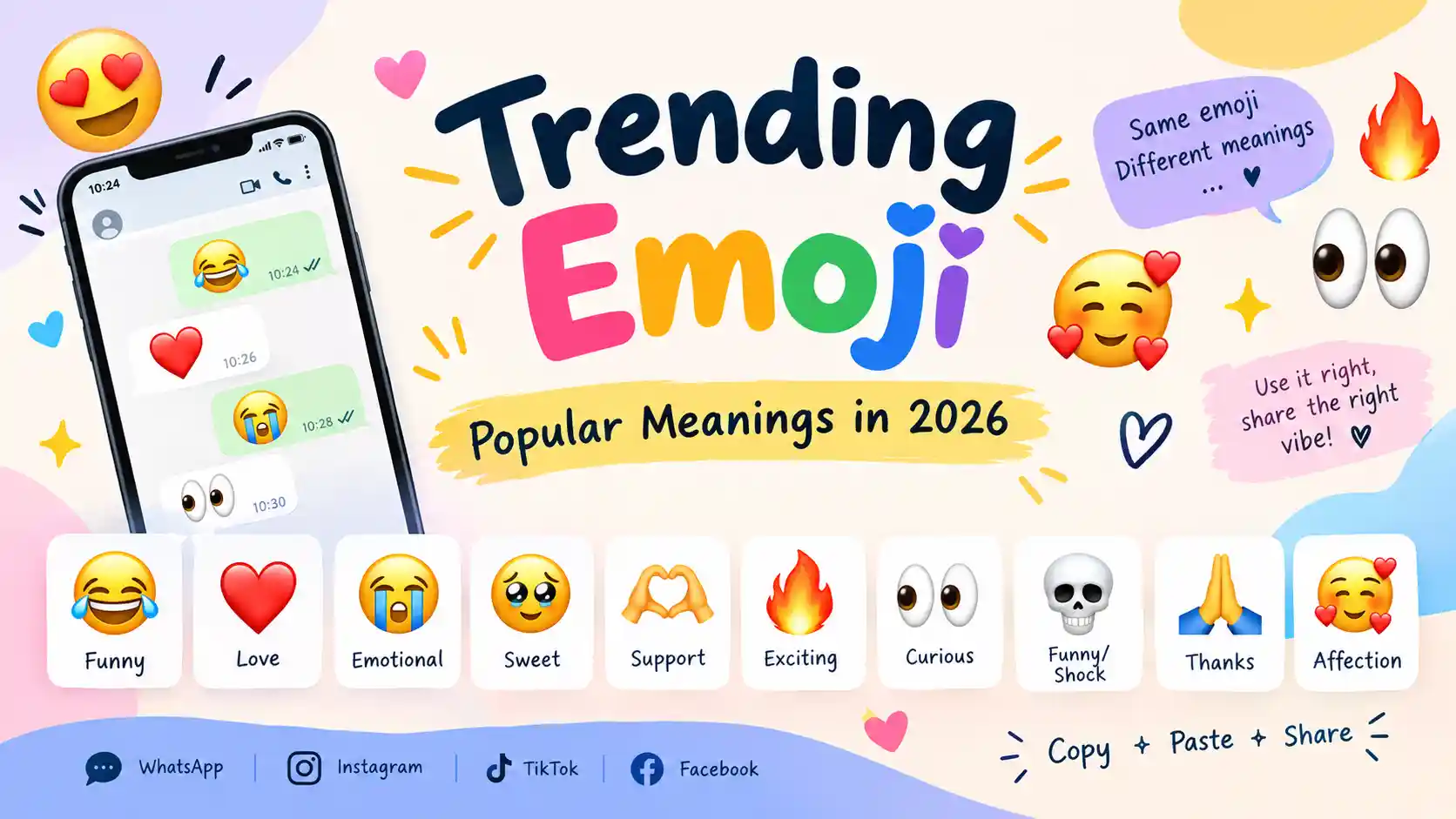
You are texting a friend, writing an Instagram caption, or replying to a TikTok comment, and suddenly you need the right emoji. You might choose 😂 for a joke, ❤️ for affection, 👀 for curiosity, or 🫶 for a warm reaction. That is where the idea of a trending emoji becomes useful. People often search for trending emojis because they want to know which symbols are commonly appearing in chats, captions, comments, memes, and everyday online conversations.
There is no single emoji that stays popular everywhere or means exactly the same thing to everyone. Usage changes with the conversation, relationship, platform, culture, and even the age or community of the people communicating. An emoji that feels playful in a TikTok comment may feel more affectionate in a private WhatsApp chat.
This guide explains common trending emoji choices, what they can communicate, how people use them on social media, and how to combine or copy them without making your message feel forced. 😊
What Does Trending Emoji Mean?
A trending emoji is an emoji that is currently appearing frequently or gaining attention in online conversations, captions, comments, memes, and messaging. It does not have one permanent meaning. Instead, its meaning depends heavily on the words around it and the relationship between the people using it.
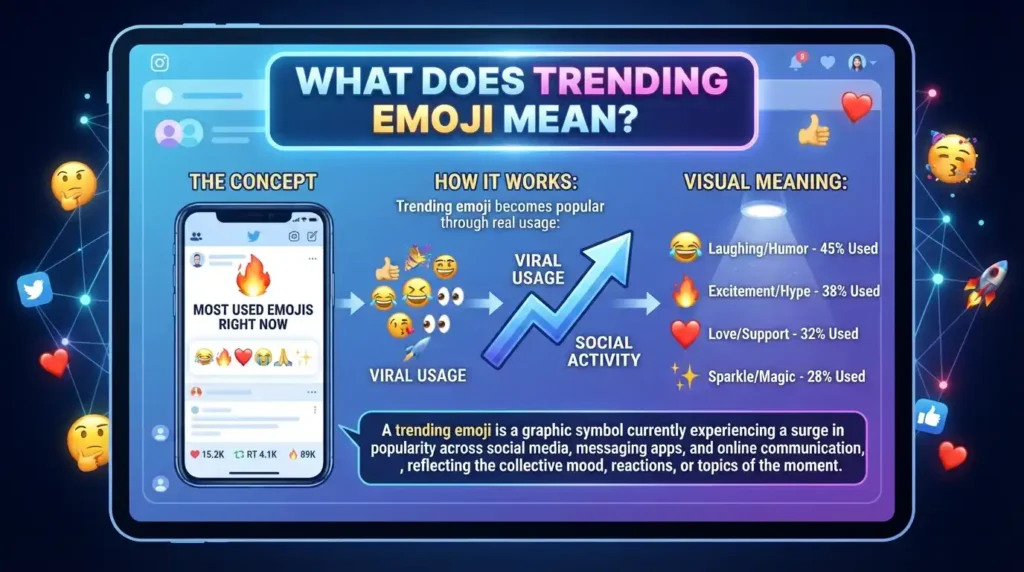
For example, 😂 can show genuine laughter, while 😭 may express sadness, overwhelming laughter, or dramatic disbelief. ❤️ can communicate affection, appreciation, support, or romance. Meanwhile, 👀 can suggest curiosity, interest, or a playful reaction to something unexpected.
The phrase “trending emoji” can therefore describe both familiar favorites and newer emojis that are receiving attention. Unicode Emoji 17.0 added new emoji characters and sequences, with different devices expected to support new additions at different times.
In texting, a trending emoji can make a short reply feel more expressive. On Instagram, it may help a caption communicate mood. On TikTok, the same symbol can become part of a joke, reaction, or community-specific expression.
Context matters most. A friend sending 👀 after you mention a surprise may be showing curiosity. A romantic partner using ❤️ may communicate affection. A coworker using 👍 may simply acknowledge a message.
Some commonly seen choices include 😂, ❤️, 😭, 🥹, 🫶, 🔥, 👀, 💀, 🙏, and 🥰. These symbols can overlap in meaning, but they are not interchangeable in every situation.
The safest approach is simple: look at the words, the relationship, and the surrounding conversation before deciding what an emoji means. Emoji meanings in chat are flexible, and personal usage can be just as important as common usage.
Meaning Table:
| Emoji | Core meaning | Possible misread | Best used when |
|---|---|---|---|
| 😂 | Strong laughter | Forced laughter | Funny messages and jokes |
| ❤️ | Love or affection | Romantic interest | Affection, support, appreciation |
| 😭 | Strong emotion | Literal sadness | Drama, laughter, emotional reactions |
| 🥹 | Touched or emotional | Sadness | Sweet or heartfelt moments |
| 🫶 | Warmth and support | Romantic affection | Friendship, appreciation, support |
| 🔥 | Excitement or praise | Literal fire | Compliments, achievements, trends |
| 👀 | Interest or curiosity | Suspicion | Teasing, gossip, surprises |
| 💀 | Extreme amusement or shock | Actual death | Internet humor and dramatic reactions |
| 🙏 | Thanks, hope, or prayer | One fixed religious meaning | Gratitude, requests, support |
| 🥰 | Affection and happiness | Romantic intent | Sweet messages and appreciation |
Emoji Cards:
😂 Face with Tears of Joy
Meaning: Laughter, amusement, or finding something extremely funny.
Example 1: That video was too funny 😂
Example 2: You really said that in front of everyone 😂
❤️ Red Heart
Meaning: Love, affection, care, appreciation, or emotional support.
Example 1: Thanks for always being there for me ❤️
Example 2: This song still has my heart ❤️
😭 Loudly Crying Face
Meaning: Strong emotion that can include sadness, laughter, shock, or dramatic disbelief.
Example 1: I cannot believe that ending 😭
Example 2: That was so funny I am crying 😭
🥹 Face Holding Back Tears
Meaning: Feeling touched, grateful, proud, or emotionally overwhelmed.
Example 1: You remembered my birthday 🥹
Example 2: This message honestly made my day 🥹
🫶 Heart Hands
Meaning: Love, appreciation, warmth, encouragement, or support.
Example 1: Sending you lots of love 🫶
Example 2: Thank you for supporting my work 🫶
🔥 Fire
Meaning: Excitement, praise, energy, or something considered impressive.
Example 1: Your new outfit is 🔥
Example 2: That performance was absolutely 🔥
👀 Eyes
Meaning: Curiosity, attention, interest, or playful observation.
Example 1: Wait, what happened next? 👀
Example 2: I saw that comment 👀
💀 Skull
Meaning: Extreme amusement, shock, embarrassment, or being overwhelmed by something funny.
Example 1: That comeback finished me 💀
Example 2: I was not ready for that ending 💀
🙏 Folded Hands
Meaning: Gratitude, hope, a request, support, or prayer depending on context.
Example 1: Thank you so much 🙏
Example 2: Please let this plan work 🙏
🥰 Smiling Face with Hearts
Meaning: Warm affection, happiness, fondness, or feeling especially sweet toward someone.
Example 1: That was such a thoughtful message 🥰
Example 2: Look at those cute pictures 🥰
How to Use Trending Emoji the Right Way
WhatsApp 💬
WhatsApp emojis work especially well because conversations are usually personal and informal. A trending emoji can add emotion to a short reply without requiring a long explanation.
In a friendship chat, 😂 can make a joke feel more playful. A family member might use ❤️ to show affection or appreciation. Someone sending 🥹 after receiving good news may be expressing genuine emotion rather than sadness.
Status updates also give emojis a slightly different role. A short phrase with 🔥 may suggest excitement, while 👀 can make a mysterious status feel more playful.
The key is to match the emoji to the relationship. A warm symbol can feel natural between close friends but unnecessarily intimate in a formal conversation.
Instagram 📸
Instagram emojis often appear in captions, comments, bios, Stories, and Reels. Here, they can help communicate the mood of visual content.
A creator might use 🔥 after sharing a new outfit, project, performance, or achievement. A follower might comment 🫶 to show support. The 👀 emoji can work well when reacting to an unexpected announcement or intriguing post.
In captions, one or two relevant emojis can provide visual breaks without overwhelming the text. Emoji symbols can also make a short caption easier to scan.
TikTok
TikTok has a particularly flexible emoji culture because comments often depend on humor, trends, memes, and community language. 😂 and 💀 can both appear in funny reactions, while 👀 can suggest curiosity or playful attention.
The same emoji can become more ironic in a short-form video community. That is why reading the surrounding comments is often helpful before interpreting a reaction literally.
Facebook uses emojis across posts, comments, Messenger conversations, and reactions. ❤️ may communicate support, while 🙏 can express thanks or encouragement. Funny posts may attract 😂 or 😭 depending on the user’s personal style.
Overall, social media emojis work best when they strengthen the message instead of replacing it completely.
Do’s and Don’ts:
Do:
- Use emojis to support your message. ❤️
- Consider your relationship with the receiver.
- Pay attention to the surrounding conversation.
- Match the emoji with the tone.
- Check how an emoji appears on different devices.
Don’t:
- Use emojis randomly.
- Assume everyone interprets them identically.
- Overload a serious message with emojis.
- Combine unrelated emojis without a purpose.
- Assume an emoji automatically has a romantic meaning.
Why Do Trending Emoji Look Different on iPhone and Android?
Have you ever sent an emoji from an iPhone and noticed that it looks slightly different on an Android phone? That is normal.
Emoji characters are standardized through Unicode, which helps different systems represent the same underlying character. However, companies such as Apple, Google, Samsung, Microsoft, and others can design their own visual artwork for those characters. Unicode itself provides the standard for digital text and emoji interchange, rather than forcing every company to use identical artwork.
That means the same emoji can have differences in:
- Shape
- Color
- Facial expression
- Details
- Size
- Overall visual style
For example, a smiling face may look slightly more rounded on one device and have different eyes or shading on another. The underlying emoji can still be the same Unicode character.
New emoji additions can also take time to appear consistently across platforms. Unicode Emoji 17.0 contains new characters and sequences, while device and software support can arrive at different times.
So if an emoji looks different from what you expected, that does not necessarily mean the sender used a different symbol. It may simply be the platform’s design.
Best Trending Emoji Combos: Copy & Paste
Romantic ❤️
👉 ❤️🥰 : Use this for a sweet affectionate message.
👉 ❤️🫶 : Use this to show warmth and appreciation.
👉 🥰❤️ : Use this when a message feels especially loving.
Cute 🥰
👉 🥹🫶 : Use this for a heartfelt, adorable reaction.
👉 🥰✨ : Use this for a sweet and happy moment.
👉 🫶🥰 : Use this when showing warm appreciation.
Flirty 😉
👉 👀🥰 : Use this for playful interest.
👉 👀❤️ : Use this when teasing someone you like.
👉 🥰👀 : Use this for a subtle affectionate reaction.
Missing Someone 💭
👉 😭❤️ : Use this for an emotional “I miss you” message.
👉 🥹🫶 : Use this when missing someone’s warmth or support.
👉 ❤️👀 : Use this for a playful way to say you are thinking about someone.
Good Night 🌙
👉 🥰❤️ : Use this for a sweet good-night message.
👉 🫶❤️ : Use this for a warm good-night wish.
👉 🥹❤️ : Use this for an emotional good-night message.
Trending Emoji in 2026
Trending emoji usage in 2026 is not limited to brand-new characters. Familiar emojis continue to appear heavily in everyday chats and social media because people already understand their basic visual signals. At the same time, newly approved emoji can attract attention as platforms gradually add support.
Unicode Emoji 17.0 introduced 163 new emoji, and Emojipedia notes that these additions are expected to reach different devices throughout 2026. New additions include symbols such as Distorted Face, Fight Cloud, Orca, Hairy Creature, Trombone, Treasure Chest, and 🧑🩰 Ballet Dancer.
For everyday communication, however, familiar choices such as 😂, ❤️, 😭, and 🫶 remain useful because they can quickly express reactions without much explanation.
| Emoji | Why trending | Who uses it | Platform |
|---|---|---|---|
| 😂 | Quick expression of laughter | Friends, creators, commenters | WhatsApp, TikTok, Instagram |
| ❤️ | Simple affection and support | General users and communities | WhatsApp, Instagram, Facebook |
| 😭 | Flexible emotional reaction | Meme and casual chat users | TikTok, Instagram, messaging |
| 🫶 | Warm support and appreciation | Friends, fans, creators | Instagram, TikTok, WhatsApp |
New emoji can also become part of online culture as people experiment with their visual meaning. Unicode’s 2025 release included new expressive symbols such as Distorted Face and Fight Cloud, while platforms continue implementing the standard at their own pace.
The broader pattern is that emoji usage keeps evolving through a mixture of established symbols, new Unicode additions, memes, communities, and everyday personal communication.
Trending Emoji Meaning in Different Contexts
Romantic Conversations
In romantic chats, ❤️, 🥰, and 🫶 can communicate affection, but context matters. A heart from a partner may feel naturally intimate, while the same heart from a friend can simply show appreciation.
Friendship
Friends often use 😂, 😭, 💀, and 👀 in playful conversations. Here, exaggerated emotional emojis may be humorous rather than literal.
For example, “You actually did it 😭” could express excitement or disbelief rather than sadness.
Family
Family chats often use ❤️, 🫶, and 🙏 for affection, thanks, encouragement, or support. The exact meaning depends on the conversation.
Professional or Casual Communication
Emoji use is more dependent on workplace culture in professional communication. A simple emoji can soften a casual message, but serious or formal communication may call for fewer symbols.
Texting
In private texting, emoji meaning can become highly personal. Two friends may develop their own repeated meanings for certain symbols that differ from common internet usage.
Social Media Comments
Comments are often shorter and more reactive. 👀 can show curiosity, while 😂 or 💀 may signal that someone found a post extremely funny.
Captions
Captions usually use emojis as mood markers or visual accents. A creator might choose 🔥 for an energetic post or 🫶 for a supportive, community-focused message.
The important point is that an emoji does not communicate in isolation. Words, timing, relationship, platform, and shared context all influence how the receiver understands it.
How to Copy and Paste Trending Emoji:
Copying a trending emoji is simple.
Copy-paste line: 😂 ❤️ 😭 🥹 🫶 🔥 👀 💀 🙏 🥰
On a phone or computer, select the emoji you want, copy it, and paste it into WhatsApp, Instagram, TikTok, Facebook, a text message, or a comment.
You can also copy an emoji combination directly from this guide. For example:
❤️🫶
Paste it into a message when you want a short expression of warmth or appreciation.
Remember that the visual appearance may change after pasting because the receiving platform can use its own emoji artwork.
FAQs:
1. What is the most popular trending emoji?
There is no single emoji that is permanently the most popular across every platform and community. Familiar symbols such as 😂 and ❤️ are widely recognized, while usage can vary by audience, platform, and current online trends.
2. What does an emoji mean when someone sends it?
The meaning depends on the emoji, the words around it, the relationship between the people, and the context. The same symbol can communicate affection, humor, support, irony, or another emotion in different conversations.
3. Why do emojis look different on iPhone vs Android?
Unicode helps standardize the underlying emoji characters, but Apple, Google, Samsung, Microsoft, and other companies create their own visual designs. As a result, the same emoji can look different across devices.
4. Are trending emojis used differently in other countries?
Emoji interpretation can vary between communities and cultures. Local online habits, language, humor, and personal experience can influence how a symbol is understood, so broad assumptions are best avoided.
Conclusion:
Trending emojis are constantly shaped by everyday chats, social media, memes, communities, and new Unicode additions. ✨
The most useful approach is to choose an emoji that matches your words, relationship, and intended tone.
When in doubt, keep it simple, check the context, and let the message lead.

Nasrullah — Emoji Strategist & Content Writer
Nasrullah is a passionate emoji enthusiast and content writer who loves exploring the meanings, uses, and cultural context behind emojis. He creates simple, helpful, and easy-to-understand guides that help readers choose the right emoji for WhatsApp, Instagram, Facebook, texting, and everyday conversations.
With a focus on emoji meanings, combinations, social media usage, and modern digital communication, Nasrullah aims to make every emoji easier to understand and use with confidence. His content combines practical examples with clear explanations so readers can quickly find the meaning and usage they are looking for.
When he’s not researching emojis, Nasrullah enjoys exploring digital trends, writing useful online content, and learning about how people communicate in the digital world. 😊