One tiny airplane can instantly make a simple message feel like a trip is about to begin. ✈️
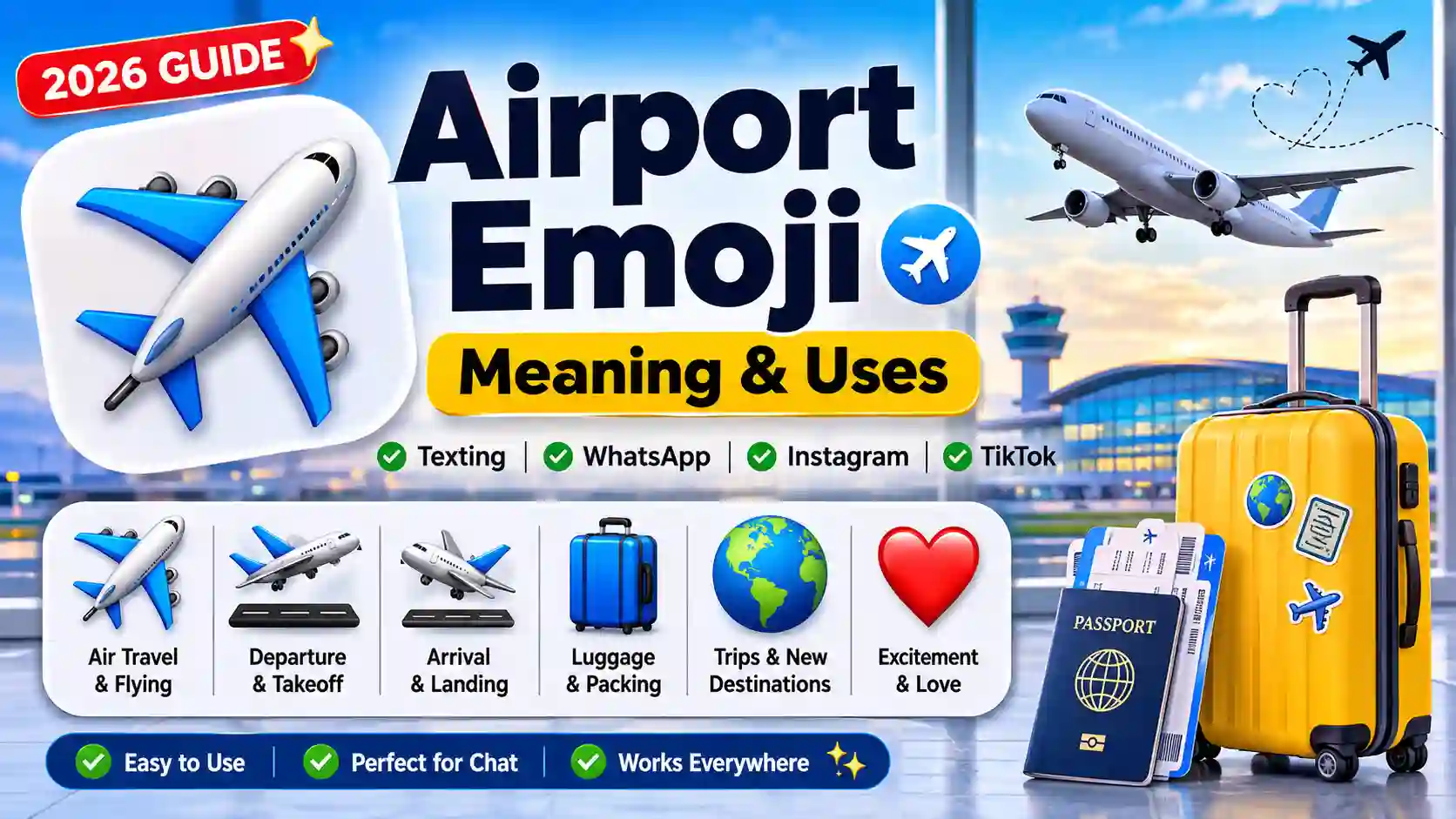
When someone sends an airport emoji, they are usually talking about flying, traveling, leaving, arriving, or simply having travel plans. Depending on the exact symbol and the conversation, it can suggest a flight, vacation, business trip, airport arrival, departure, or excitement about going somewhere new. 🛫 🛬
The meaning can also become more personal in texting. A friend might use it to say they are heading to the airport, while someone you like could use it to hint at a romantic getaway or say they are traveling to see you. On Instagram and TikTok, airport-related emojis often appear in travel captions, vacation posts, reels, and departure updates. 🧳 🌍
So, what does the airport emoji really mean? The answer depends on the specific emoji, the words around it, and your relationship with the person sending it.
Sometimes an airport emoji is simply a little symbol for a big journey. ✈️
What Does the Airport Emoji Mean? 🛫
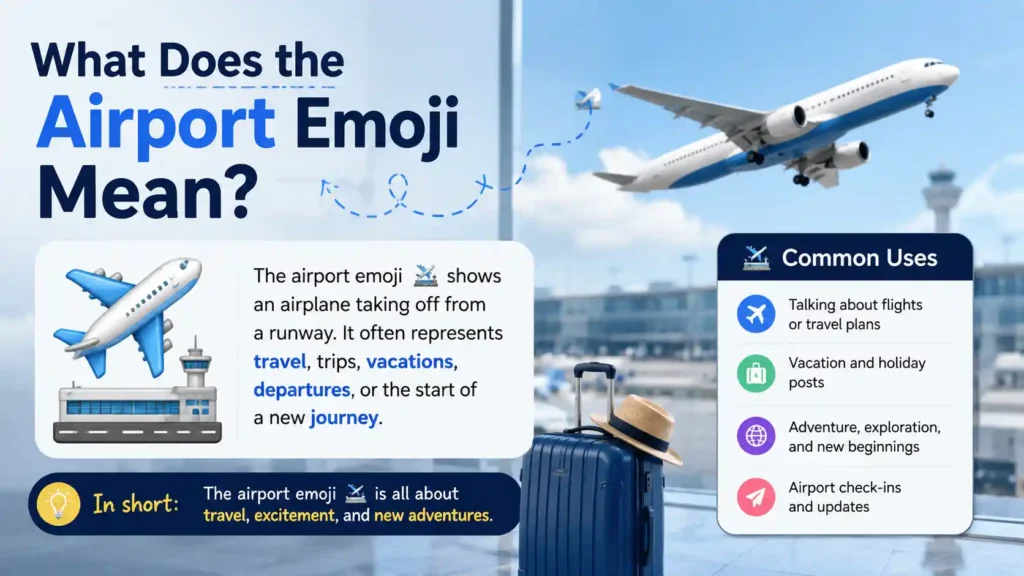
The phrase airport emoji can refer to several travel-related symbols, but the most recognizable choices are ✈️, 🛫, and 🛬. ✈️ generally represents an airplane or air travel, 🛫 specifically suggests departure, and 🛬 commonly suggests arrival or landing. Together, they can describe the complete airport experience. 🧳
In texting, these emojis are often practical. Someone might write, “Heading to the airport ✈️” to let you know they are traveling. A person leaving for a trip may send “See you soon 🛫,” while someone who has reached their destination could say “Finally landed 🛬.” The surrounding words usually make the intended meaning clear.
On WhatsApp, the airport emoji can also express excitement. “Vacation starts tomorrow ✈️🌍” feels more enthusiastic than simply saying “I am traveling.” On Instagram, it can make a travel caption feel instantly recognizable, especially when paired with a suitcase or globe. TikTok users may use it in captions about airport routines, travel humor, trips, or destination videos.
Context matters most. The same ✈️ can mean a literal flight, a dream vacation, a business trip, or simply a desire to travel. It does not automatically mean romance, excitement, or a specific destination.
| Emoji | Core meaning | Possible misread | Best used when |
|---|---|---|---|
| ✈️ | Air travel or airplane | Could seem like a trip announcement | Talking about flying |
| 🛫 | Departure or taking off | Could be read as simply an airplane | Leaving or starting a flight |
| 🛬 | Arrival or landing | Could look like general travel | Reaching a destination |
| 🧳 | Travel luggage | May suggest a long trip | Packing or traveling |
| 🛄 | Baggage claim | Can look very specific | Talking about airport luggage |
| 🛂 | Passport control | May feel formal | Immigration or airport procedures |
| 🎫 | Ticket or admission | Not always a flight ticket | Referring to tickets |
| 🌍 | World or global travel | May mean general international topics | International trips |
| 🗺️ | Map or exploring | Could suggest road travel | Planning destinations |
| ❤️ | Love or affection | Can make travel sound romantic | Trips with someone special |
✈️ Airplane:
Meaning: Air travel, flying, or a journey by plane.
Example 1: Finally booked the trip ✈️
Example 2: My flight leaves tonight ✈️
🛫 Airplane Departure:
Meaning: Leaving, taking off, or beginning a flight.
Example 1: Off to my next adventure 🛫
Example 2: Boarding time, see you soon 🛫
🛬 Airplane Arrival:
Meaning: Landing, arriving, or reaching a destination.
Example 1: Just landed safely 🛬
Example 2: Made it to the city 🛬
🛄 Baggage Claim:
Meaning: Collecting luggage after a flight.
Example 1: Waiting for my suitcase 🛄
Example 2: Meet me after baggage claim 🛄
🛂 Passport Control:
Meaning: Immigration, passport checks, or border control.
Example 1: Made it through passport control 🛂
Example 2: Immigration line is moving slowly 🛂
🧳 Luggage:
Meaning: Packing, traveling, or getting ready for a journey.
Example 1: Bags are packed and ready 🧳
Example 2: One suitcase for a whole week 🧳
🎫 Ticket:
Meaning: A ticket, travel pass, or entry document.
Example 1: Got my ticket at last 🎫
Example 2: Everything is booked 🎫
🌍 Globe:
Meaning: International travel, worldwide experiences, or exploring.
Example 1: Time to see another part of the world 🌍
Example 2: Another country added to the list 🌍
🗺️ World Map:
Meaning: Exploring, planning destinations, or choosing where to go.
Example 1: Planning the next adventure 🗺️
Example 2: Where should we travel next? 🗺️
❤️ Red Heart:
Meaning: Love or affection connected with a journey or person.
Example 1: Flying to see my favorite person ✈️❤️
Example 2: Can’t wait to be with you ❤️
😉 Winking Face:
Meaning: Playfulness, teasing, or a subtly flirty travel message.
Example 1: Guess where I’m flying next 😉
Example 2: Save me a seat 😉✈️
How to Use the Airport Emoji the Right Way:
WhatsApp 💬
On WhatsApp, airport emojis work especially well in personal conversations because they quickly communicate travel plans without requiring a long explanation. If you are leaving, 🛫 can accompany “Heading out now.” If you have arrived, 🛬 works naturally with “Just landed.”
Friends may use ✈️ when discussing vacations, while family members may use 🧳 when talking about packing. In a group chat, a simple “Airport tomorrow ✈️” can tell everyone that your trip is coming up.
They can also add emotion. “Wish you were coming too ✈️❤️” sounds affectionate, while “Have a safe flight 🛫” feels supportive.
Instagram 📸
Instagram is a natural home for airport and travel emojis. They fit captions about vacations, airport selfies, boarding moments, destination photos, and travel reels. A caption such as “Next stop: somewhere beautiful ✈️🌍” immediately establishes a travel theme.
You can also use 🧳 for packing posts, 🗺️ for destination planning, and 🛬 when sharing an arrival update.
TikTok 🎵
On TikTok, these emojis often appear alongside travel stories, airport humor, packing videos, flight-day routines, and destination content. A creator might use 🧳 in a caption about overpacking or 🛫 in a video showing the beginning of a trip.
Because TikTok communication is highly contextual, the same emoji can be sincere, humorous, dramatic, or ironic depending on the video.
On Facebook, airport emojis work well in travel announcements, vacation posts, family updates, and Messenger conversations. A simple “Off on vacation 🛫” can communicate the news clearly without making the post feel formal.
Do and Don’t:
Do:
- Use the emoji to support your message.
- Choose 🛫 when departure is the important detail.
- Choose 🛬 when arrival or landing matters.
- Consider your relationship with the receiver.
- Match the emoji with the tone of the message.
- Check how the symbol appears on different devices.
Don’t:
- Assume every airplane emoji means the same thing.
- Use travel emojis randomly in serious conversations.
- Assume ✈️ automatically has a romantic meaning.
- Combine many unrelated symbols just for decoration.
- Forget that context can completely change the tone.
Why Does the Airport Emoji Look Different on iPhone and Android?
If an airport emoji looks slightly different on your iPhone, Android phone, computer, or another device, that does not necessarily mean you received a different emoji. Emojis are represented through Unicode standards, while individual technology companies create their own visual designs.
Apple, Google, Samsung, Microsoft, and other platforms can draw the same Unicode emoji in different ways. One version might use a slightly different airplane angle, shape, outline, or level of detail. Colors, proportions, and overall visual style can also vary.
For airport-related symbols, the differences can be particularly noticeable because airplanes, luggage, tickets, and airport signs contain recognizable shapes. One device might make an airplane look more detailed, while another may use a flatter or simpler design.
The important point is that the underlying character can remain the same even when the artwork changes. If you send ✈️ from one device to another, the receiver may see a different design, but the intended Unicode character is still the airplane emoji.
This is why there is no single platform that owns the “correct” visual version. The design belongs to the platform’s emoji font and artwork. Your message’s surrounding words remain important if the visual difference creates confusion.
Best Airport Emoji Combos: Copy & Paste:
Romantic ❤️
1.👉 ✈️❤️ | Use this when traveling to see someone you love.
2.👉 🛫❤️ | Use this for a romantic departure message.
3.👉 🧳❤️ | Use this when packing for a trip with someone special.
Cute 🥰
1.👉 ✈️🥰 | Use this for excitement about a sweet getaway.
2.👉 🧳❤️ | Use this for an adorable travel announcement.
3.👉 🛬❤️ | Use this when happily arriving to see someone.
Flirty 😉
1.👉 ✈️😉 | Use this when teasing someone about a trip.
2.👉 🛫😉 | Use this for a playful “I’m on my way” message.
3.👉 🧳😉 | Use this when hinting at a fun travel plan.
Missing Someone 💭
1.👉 ✈️❤️ | Use this when traveling because you miss someone.
2.👉 🛬❤️ | Use this when finally arriving to see them.
3.👉 🧳✈️❤️ | Use this when packing for a meaningful visit.
Good Night 🌙
1.👉 ✈️🌙 | Use this for a nighttime flight or travel update.
2.👉 🛫🌙 | Use this when leaving on an evening flight.
3.👉 🛬🌙 | Use this when landing late at night.
Trending Airport Emoji in 2026:
Airport and travel emojis remain commonly seen in casual digital communication because they provide a quick visual way to talk about trips, flights, destinations, and travel plans. In 2026, people can encounter them in WhatsApp messages, Instagram captions, TikTok videos, Facebook updates, comments, and travel-focused posts.
✈️ is especially versatile because it can represent almost any kind of air travel without specifying whether someone is leaving or arriving. 🛫 is more specific and works naturally for departure announcements. 🛬 can make an arrival update feel immediately clear.
🧳 is also useful outside the airport itself. It can represent packing, vacations, weekend trips, moving around, or the general feeling of getting ready to go somewhere.
These emojis are not necessarily “trending” because of an official ranking. Their continued usefulness comes from how easily they fit everyday travel conversations and visual social media content.
| Emoji | Why trending | Who uses it | Platform |
| ✈️ | Simple symbol for flying | Travelers and creators | |
| 🛫 | Clearly signals departure | Travelers and friends | |
| 🛬 | Clearly signals arrival | Travelers and families | |
| 🧳 | Represents packing and trips | Casual users and creators | TikTok |
Emoji usage continues to evolve as people find new ways to combine simple symbols with captions, jokes, reactions, and personal messages.
Airport Emoji Meaning in Different Contexts:
The airport emoji can sound quite different depending on who sends it and why. In a romantic conversation, ✈️ may suggest traveling to see someone, especially when the message mentions distance or a planned visit. Adding ❤️ can make that intention clearer, but the airplane itself is not automatically romantic.
Between friends, the same symbol is usually practical or excited. “Our trip is finally happening ✈️” may simply celebrate a vacation. Family members might use 🛬 to announce that they have landed safely, while 🧳 can signal that packing has started.
In professional or casual communication, ✈️ often stays literal. A coworker might write, “Flying to Lahore tomorrow ✈️,” where the emoji simply makes the travel information friendlier.
In social media comments, interpretation becomes more flexible. A follower might leave ✈️ under a travel photograph to show excitement or appreciation. In captions, several travel symbols can establish a destination-focused mood without needing much text.
Texting is usually the most context-dependent setting. If someone says “Wish you were here ✈️❤️,” the emotional meaning comes from the entire message, not from the airplane alone. If they say “Flight delayed again ✈️,” the same symbol is purely practical.
How to Copy and Paste the Airport Emoji:
Copying an airport emoji is simple. Select the symbol below, copy it, and paste it wherever you want:
✈️
You can paste it into WhatsApp messages, Instagram captions, TikTok descriptions, Facebook posts, comments, Messenger chats, or other apps that support emojis.
If you want to show departure or arrival more specifically, you can also copy these:
🛫 🛬
On most phones, you can also find the symbols through the built-in emoji keyboard. Search for terms such as “airplane” or browse the travel category, depending on your device.
FAQs:
1. What is the most popular airport emoji?
The most recognizable airport-related choice is usually ✈️ because it can represent flying, an airplane, or air travel generally. 🛫 and 🛬 are useful when you want to communicate departure or arrival more specifically.
2. What does ✈️ mean when someone sends it?
It usually refers to flying, travel, a flight, or a trip. The exact meaning depends on the conversation. It can be practical, excited, playful, or romantic without being tied to any particular gender.
3. Why do airport emojis look different on iPhone vs Android?
Unicode defines the underlying emoji character, but Apple, Google, Samsung, Microsoft, and other platforms create their own artwork. As a result, the same emoji can have different shapes, colors, and visual details.
4. Are airport emojis used differently in other countries?
Emoji interpretation can vary with language, culture, community, and individual communication habits. However, travel symbols such as ✈️ are generally easy to understand because airplanes and airports have widely recognizable associations.
Conclusion:
The airport emoji is a simple way to communicate flying, departure, arrival, travel plans, or excitement about a journey. ✈️
Choose 🛫 when leaving, 🛬 when arriving, and related travel symbols when you want to add more detail.
Most importantly, let the surrounding message and relationship guide the tone. A small emoji can make a travel update feel much more personal. 🧳

Nasrullah — Emoji Strategist & Content Writer
Nasrullah is a passionate emoji enthusiast and content writer who loves exploring the meanings, uses, and cultural context behind emojis. He creates simple, helpful, and easy-to-understand guides that help readers choose the right emoji for WhatsApp, Instagram, Facebook, texting, and everyday conversations.
With a focus on emoji meanings, combinations, social media usage, and modern digital communication, Nasrullah aims to make every emoji easier to understand and use with confidence. His content combines practical examples with clear explanations so readers can quickly find the meaning and usage they are looking for.
When he’s not researching emojis, Nasrullah enjoys exploring digital trends, writing useful online content, and learning about how people communicate in the digital world. 😊