One masked emoji can give a message a whole different attitude. 🥷
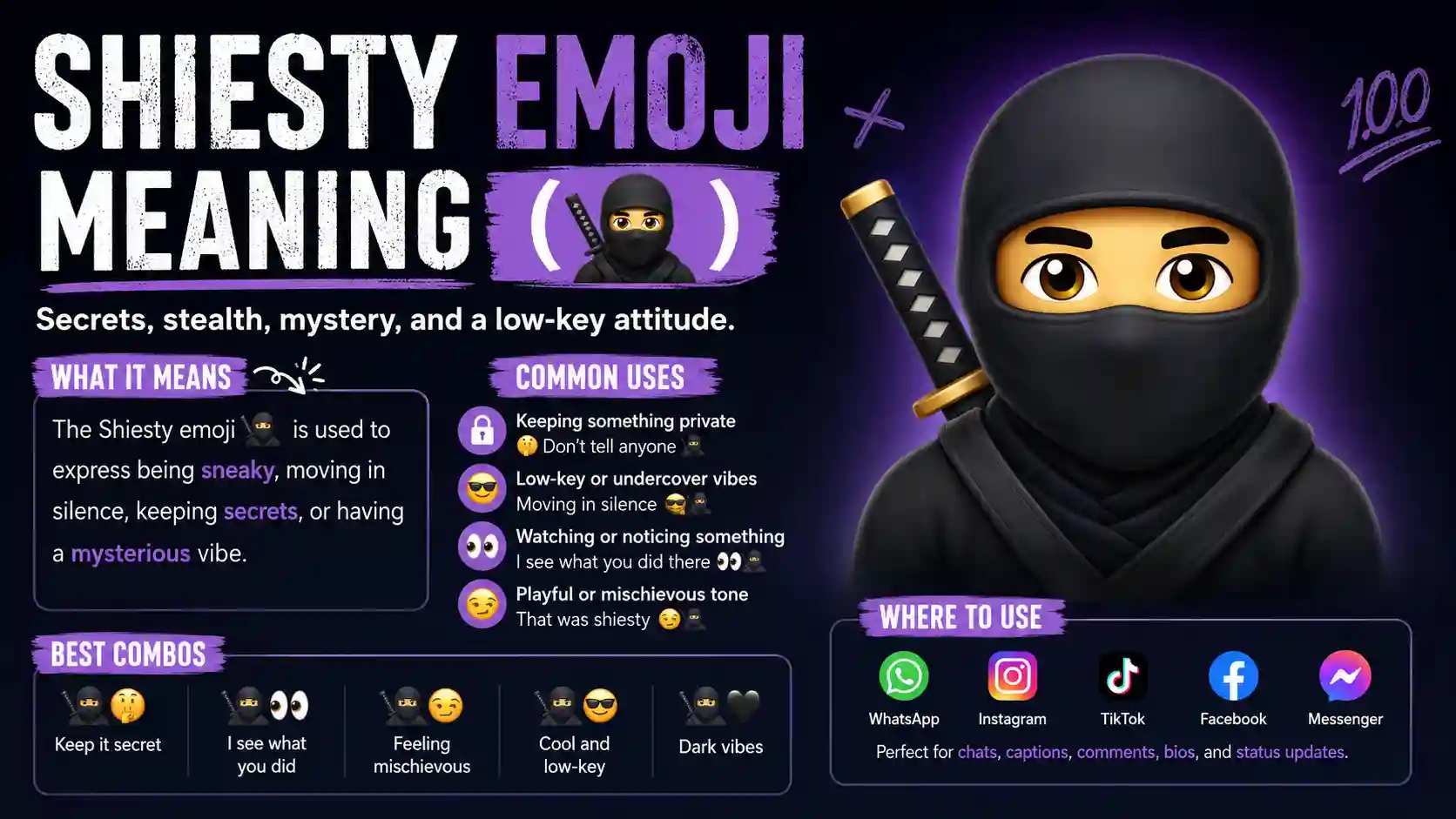
When someone searches for the Shiesty emoji, they are usually looking for the masked or sneaky vibe represented by 🥷. There is not an official Unicode character called the “Shiesty emoji,” so the phrase is generally a slang-based description rather than the formal name of one emoji. The ninja emoji 🥷 is the closest visual match because it represents a masked ninja and can suggest secrecy, stealth, mystery, or a low-key attitude.
The word “shiesty” itself usually describes someone or something as shady, sneaky, dishonest, or difficult to trust. It can also be connected with the slang use of “a shiesty” for a ski mask or balaclava.
In everyday texting, though, 🥷 does not automatically mean that someone is actually dishonest. Friends may use it jokingly to suggest “I’m moving quietly,” “Nobody needs to know,” or “I’m being low-key.” On TikTok, Instagram, WhatsApp, and other social platforms, the surrounding words matter just as much as the emoji itself. A message such as “You really did that 🥷” can sound playful, suspicious, impressed, or shady depending on the conversation. 🕶️👀
Sometimes 🥷 says “I’m keeping it low-key” without spelling out the whole story.
What Does the Shiesty Emoji Mean?
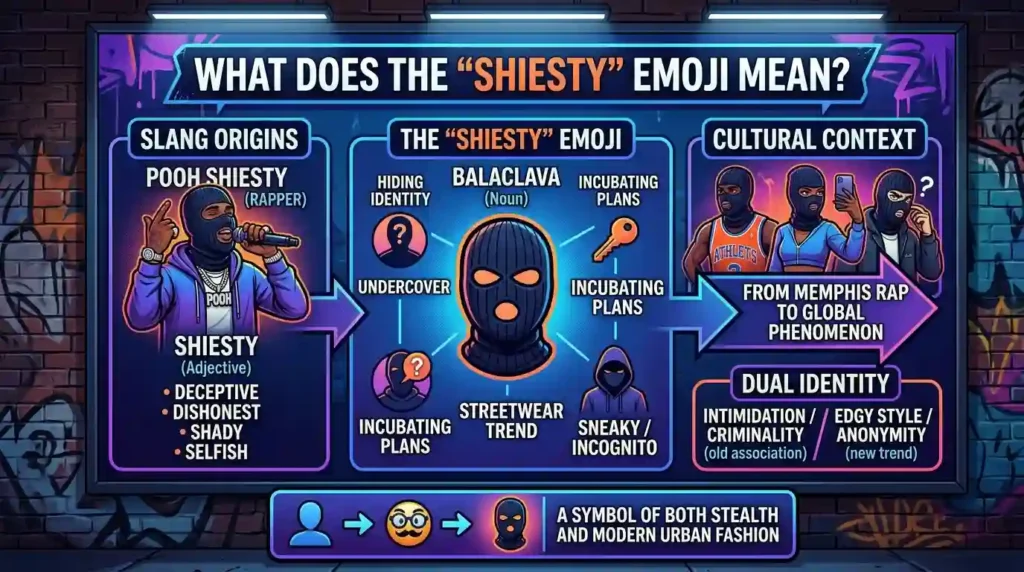
The Shiesty emoji usually points to 🥷, the ninja emoji, when people want a visual way to express a masked, sneaky, secretive, or low-key vibe. It is important to separate the emoji from the slang word itself. “Shiesty” commonly means shady, sneaky, or untrustworthy, while 🥷 is officially a ninja character.
In texting, 🥷 can suggest that someone is moving quietly, hiding something, avoiding attention, or acting mysterious. For example, “I left before anyone noticed 🥷” gives the message a playful stealth feeling. A friend might also write “You knew about this the whole time 🥷” as a joking accusation.
On social media, the emoji can become even more flexible. Someone might use 🥷 in a TikTok comment when a person makes a surprisingly slick move. On Instagram, it can add a mysterious or street-inspired tone to a caption. On WhatsApp, it may simply mean “keep this between us” or “I’m staying low-key.”
Other nearby emojis can strengthen different shades of the same idea. 😏 can make the message feel knowingly mischievous, 🤫 emphasizes secrecy, 👀 suggests watching or noticing something, while 🕶️ can give the message a cool or undercover feeling. 🐍 may make the tone more openly suspicious because snakes are often used metaphorically for betrayal or someone who cannot be trusted.
Context is essential. If your best friend sends “You’re shiesty 🥷😂,” they may be teasing you about something harmless. If someone says “That was shiesty 🥷” after describing a betrayal, the tone is much more serious. Romantic conversations can also change the meaning. “Sneaking away with you 🥷🖤” could be playful and secretive rather than accusing someone of being dishonest.
The relationship between sender and receiver matters too. A close friend may understand the joke immediately, while someone you barely know might interpret 🥷 as a reference to secrecy or suspicious behavior. There is no single universal interpretation, so read the words around the emoji before deciding what the sender means.
Meaning Table:
| Emoji | Core meaning | Possible misread | Best used when |
|---|---|---|---|
| 🥷 | Stealth, mystery, masked vibe | Actual dishonesty | You want a low-key or sneaky tone |
| 😏 | Mischievous confidence | Flirting | Teasing or knowing jokes |
| 🤫 | Keep quiet, secrecy | Serious secrecy | Asking someone to keep something private |
| 👀 | Watching, noticing | Suspicion | Reacting to interesting information |
| 🕶️ | Cool, undercover attitude | Trying too hard | Stylish or mysterious posts |
| 🐍 | Betrayal, shady behavior | Personal insult | Calling out genuinely questionable behavior |
| 🖤 | Dark affection or loyalty | Sadness | Moody or understated messages |
| 💀 | Extreme humor or disbelief | Literal death | Funny or shocking reactions |
| 😂 | Strong laughter | Not taking something seriously | Clearly playful situations |
| 🤐 | Keeping quiet | Refusal to speak | Joking about staying silent |
🥷 Ninja Emoji:
Meaning: Stealth, mystery, secrecy, or a masked low-key attitude.
Example 1: Slipped out before anybody noticed 🥷
Example 2: Nobody saw me coming 🥷
😏 Smirking Face:
Meaning: Mischievous confidence, teasing, or knowing attitude.
Example 1: You already knew what I was planning 😏
Example 2: Don’t act innocent now 😏
🤫 Shushing Face:
Meaning: Keeping quiet, secrecy, or asking someone not to reveal something.
Example 1: Don’t tell them yet 🤫
Example 2: Keep this between us 🤫
👀 Eyes:
Meaning: Watching, noticing, curiosity, or interest in what is happening.
Example 1: Okay, I see what you’re doing 👀
Example 2: Now this story gets interesting 👀
🕶️ Sunglasses:
Meaning: Coolness, confidence, mystery, or an undercover vibe.
Example 1: Just staying out of the drama 🕶️
Example 2: Smooth move, honestly 🕶️
🐍 Snake:
Meaning: A suspicious, deceptive, or betraying person or situation.
Example 1: He switched sides again 🐍
Example 2: That was a cold move 🐍
🖤 Black Heart:
Meaning: Dark affection, understated emotion, or a moody aesthetic.
Example 1: You know I got your back 🖤
Example 2: Keeping it quiet tonight 🖤
💀 Skull:
Meaning: Extreme amusement, shock, disbelief, or “I can’t believe this.”
Example 1: You actually said that 💀
Example 2: That comeback finished me 💀
😂 Face with Tears of Joy:
Meaning: Strong laughter and obvious amusement.
Example 1: You are actually ridiculous 😂
Example 2: I cannot stop laughing at this 😂
🤐 Zipper-Mouth Face:
Meaning: Staying silent, keeping a secret, or refusing to reveal information.
Example 1: I know what happened, but I’m saying nothing 🤐
Example 2: Your secret is safe with me 🤐
How to Use the Shiesty Emoji the Right Way:
WhatsApp 💬
On WhatsApp, 🥷 works best when the conversation is casual. With friends, it can turn a simple statement into a playful “sneaky” reaction.
For example, if your friend says they quietly left a party before everyone else, you could reply, “You really disappeared like that 🥷.” If someone tells you about a surprise plan, 🥷🤫 can suggest that you understand the need for secrecy.
It can also work in a WhatsApp status when you want a mysterious or low-key mood. “Moving quietly these days 🥷” sounds more playful than making a serious accusation.
Instagram 📸
Instagram users can use 🥷 in captions, comments, bios, and Reels. It fits posts with a mysterious, confident, undercover, or streetwear-inspired aesthetic.
A caption such as “Low-key and out of sight 🥷🕶️” creates a cool, understated mood. In comments, it can react to somebody making a clever or unexpected move.
Because Instagram is highly visual, the surrounding image matters. A fashion photo, night-time picture, or humorous Reel may make 🥷 feel stylish or playful, while a post about betrayal can make it feel more negative.
TikTok 🎵
TikTok gives 🥷 plenty of room for humor and irony. Users can place it in captions or comments when someone appears to be moving secretly, making a clever move, or avoiding attention.
For example, “Bro thought nobody noticed 🥷👀” can work as a playful comment. The same emoji can also appear in a meme where the joke involves disappearing, sneaking around, or keeping information hidden.
On Facebook, 🥷 can appear in casual posts, comments, Messenger conversations, and reactions. It is less about a fixed definition and more about matching the tone of the post.
If a friend quietly leaves a group event, “The great escape 🥷” feels humorous. In a serious conversation about trust, however, the emoji could make the message sound more accusatory, so choose it carefully.
Do and Don’t:
Do:
- Use 🥷 to support a clearly playful or mysterious message.
- Consider your relationship with the receiver.
- Read the surrounding conversation before interpreting it.
- Pair it with 👀 or 🤫 when the context involves watching or secrecy.
- Check how the emoji appears on your device.
Don’t:
- Assume 🥷 automatically means someone is dishonest.
- Use it randomly in a serious professional message.
- Treat “shiesty” as a universal insult in every conversation.
- Overload a message with unrelated symbols.
- Assume the emoji has a romantic meaning.
Why Does the Shiesty Emoji Look Different on iPhone and Android?
The 🥷 character is based on Unicode, which provides a common standard for emoji characters across digital systems. However, Unicode does not force every company to draw an emoji exactly the same way. Apple, Google, Samsung, Microsoft, and other platforms can create their own visual designs.
That means the same 🥷 character can look slightly different depending on where you view it. The mask, face, clothing, colors, proportions, and overall illustration style may change.
One person might send 🥷 from an iPhone, while another person views it on an Android phone and notices a slightly different design. Neither version is automatically the “correct” one. They are different visual interpretations of the same underlying Unicode emoji.
This matters for the Shiesty emoji because its visual appearance helps create the slang association. A masked ninja naturally supports ideas such as secrecy, stealth, and staying hidden. Yet the character itself remains the ninja emoji, not an officially defined “shiesty” symbol.
The same principle applies to many emoji meanings. People often develop slang interpretations around familiar visual designs. Over time, communities may use an emoji in ways that go beyond its official Unicode name.
Best Shiesty Emoji Combos: Copy & Paste
Romantic ❤️
1.👉 🥷🖤 — Use this for a private, mysterious romantic vibe.
2.👉 😏🥷🖤 — Use this for playful secret flirting.
3.👉 🕶️🥷❤️ — Use this for a cool, low-key romantic message.
Cute 🥰
1.👉 🥷🥰 — Use this when teasing someone in a cute way.
2.👉 🥷😂 — Use this for a funny, harmless sneaky moment.
3.👉 🥷🖤 — Use this for a cute but slightly mysterious mood.
Flirty 😉
1.👉 😏🥷 — Use this when you are teasing someone about a secret plan.
2.👉 👀🥷😏 — Use this when the flirting is intentionally subtle.
3.👉 🥷🖤😏 — Use this for a confident, mysterious flirt.
Missing Someone 💭
1.👉 🥷🖤👀 — Use this when quietly checking on someone you miss.
2.👉 🥷🤫🖤 — Use this for a private “thinking of you” message.
3.👉 👀🥷🖤 — Use this when you want to hint without saying too much.
Good Night 🌙
1.👉 🥷🤫🖤 — Use this for a quiet good-night message.
2.👉 🕶️🥷🖤 — Use this for a cool, low-key night mood.
3.👉 🥷😂🖤 — Use this after a funny late-night conversation.
Trending Shiesty Emoji in 2026:
The 🥷 emoji continues to fit casual online conversations because its visual idea is easy to understand: a masked figure suggests stealth, mystery, or staying out of sight. Its meaning can become more playful when combined with emojis such as 😏, 👀, 🤫, and 🕶️.
The broader slang around “shiesty” also remains connected with ideas of being shady, slick, sneaky, or untrustworthy. Contemporary slang references describe the word in those terms, while dictionary material also records its association with a ski mask or balaclava.
| Emoji | Why trending | Who uses it | Platform |
|---|---|---|---|
| 🥷 | Strong stealth and mystery vibe | Casual users and creators | TikTok, Instagram, WhatsApp |
| 😏 | Easy way to signal teasing | Friends and couples | Messaging, comments |
| 👀 | Quick reaction to interesting content | Social media users | TikTok, Instagram, Facebook |
| 🤫 | Clear visual signal for secrecy | Friends and creators | WhatsApp, comments, captions |
Creators may use these symbols in memes, captions, reaction comments, and short messages because they communicate tone quickly. A single 🥷 can make a sentence feel more playful or mysterious without adding another explanation.
However, “trending” should not be confused with an official ranking. Emoji popularity changes by community, platform, age group, topic, and current online culture. There is no universal ranking that makes 🥷 the official “number one shiesty emoji.”
Overall, emoji usage continues to evolve as users give familiar characters new slang meanings and combine them with words, memes, and community-specific humor.
Shiesty Emoji Meaning in Different Contexts:
The same 🥷 can communicate noticeably different things depending on who sends it and what comes before it.
Romantic conversations:
In a relationship or flirtatious chat, 🥷 can suggest a private plan, secret meeting, or playful mystery. “Come see me later 🥷🖤” may feel intentionally secretive rather than dishonest.
Friendship:
Among friends, it often works as a joke. “You ate the last slice and said nothing 🥷😂” is more likely playful teasing than a serious accusation.
Family:
Family members may use it humorously when someone sneaks away from a responsibility. “You disappeared when it was time to clean 🥷” gives the message a teasing tone.
Professional or casual communication:
In casual work-related chats, 🥷 may be understood as playful, but it can be risky if the relationship is formal. A manager or client may not understand the slang association.
Texting:
Text messages provide little visual context, so the words around 🥷 are especially important. “Keep this quiet 🥷🤫” is clearly about secrecy, while “That was shiesty 🥷” may be criticizing someone’s behavior.
Social media comments:
In comments, 🥷 can react to someone being slick, disappearing, hiding information, or making a clever move.
Captions:
A caption such as “Moving different these days 🥷🕶️” creates a mysterious, independent mood without necessarily accusing anyone of anything.
The key is not to treat the emoji as a dictionary definition. Emoji meaning in texting is often negotiated between people. The words, relationship, timing, and surrounding symbols all contribute to the final interpretation.
How to Copy and Paste the Shiesty Emoji:
If you want to use the primary Shiesty emoji, simply copy this character:
🥷
You can select it, copy it, and paste it into WhatsApp messages, Instagram captions, TikTok comments, Facebook posts, Messenger chats, or other apps that support emojis.
For example:
🥷
You can also combine it with nearby symbols to create different tones:
🥷👀
🥷🤫
🥷🖤
🥷😏
🥷🕶️
Remember that the exact visual design may change across phones and operating systems, but the underlying emoji character remains the same.
FAQ
1. What is the most popular Shiesty emoji?
There is no official Unicode emoji named “Shiesty.” 🥷 is the closest visual match because its masked ninja design naturally connects with stealth, secrecy, and the ski-mask association sometimes attached to the slang.
2. What does 🥷 mean when someone sends it?
It depends on context. Someone may use 🥷 to mean sneaky, mysterious, low-key, masked, or simply playful. It does not automatically mean the sender is accusing someone of being dishonest.
3. Why do emojis look different on iPhone vs Android?
Unicode provides the underlying character standard, while individual companies create their own emoji artwork. As a result, 🥷 can have different shapes, colors, and design details across devices while still representing the same emoji.
4. Are Shiesty emojis used differently in other countries?
Emoji interpretation can vary between communities and cultures. Online slang can also spread internationally while keeping slightly different local meanings, so context is more reliable than assuming one universal interpretation.
Conclusion
The Shiesty emoji usually refers to 🥷, the ninja emoji, because its masked appearance fits ideas of stealth, secrecy, and a low-key attitude. The slang word “shiesty” itself can suggest shady or untrustworthy behavior, so the surrounding message matters.
Use 🥷 thoughtfully, especially when the tone could be misunderstood. A little context can turn a mysterious emoji into exactly the reaction you intended. 🥷🖤

Nasrullah — Emoji Strategist & Content Writer
Nasrullah is a passionate emoji enthusiast and content writer who loves exploring the meanings, uses, and cultural context behind emojis. He creates simple, helpful, and easy-to-understand guides that help readers choose the right emoji for WhatsApp, Instagram, Facebook, texting, and everyday conversations.
With a focus on emoji meanings, combinations, social media usage, and modern digital communication, Nasrullah aims to make every emoji easier to understand and use with confidence. His content combines practical examples with clear explanations so readers can quickly find the meaning and usage they are looking for.
When he’s not researching emojis, Nasrullah enjoys exploring digital trends, writing useful online content, and learning about how people communicate in the digital world. 😊