A tiny feather can make your message feel like it belongs on a handwritten page.
You may have seen the 🪶 quill emoji in a caption, writing post, book-related message, or creative conversation and wondered what the sender actually meant. Is it simply a feather? Does it mean writing? Could it suggest creativity, literature, old-fashioned communication, or even something more personal?
The answer depends on context. Technically, 🪶 is the Feather emoji in Unicode, but it can also represent a quill in writing-related conversations. Unicode documentation specifically notes its use as an object such as a quill, including combinations with paper, notebooks, scrolls, and books.
In texting, the quill emoji can add a literary, thoughtful, artistic, or nostalgic feeling. Writers may use it to talk about creating stories, while readers may use it around books and poetry. On WhatsApp, Instagram, TikTok, Facebook, and other platforms, its meaning can shift with the words around it.
The 🪶 quill emoji gives ordinary messages a creative, literary, and timeless touch.
What Does the Quill Emoji Mean?
The 🪶 quill emoji most commonly represents a feather, writing, creativity, literature, or old-fashioned communication. When people search for the quill emoji, they often mean this feather symbol because it can visually suggest a traditional quill pen.
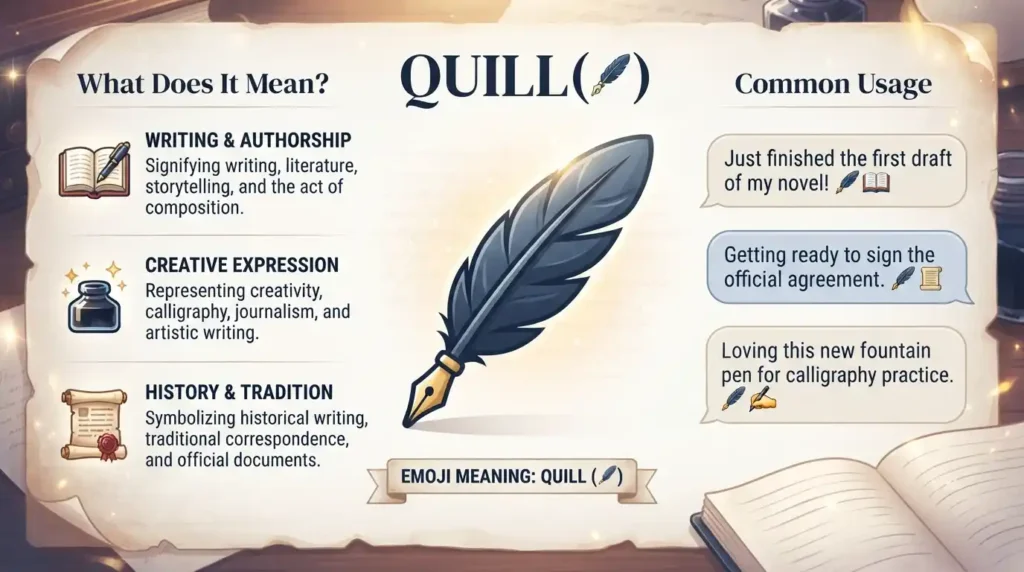
In a writing conversation, 🪶 may suggest putting thoughts into words. A writer might use it beside a comment about a new story, poem, journal entry, or novel. In a book-related post, it can create a literary mood without requiring a long explanation. It can also suggest imagination or artistic expression.
The emoji can carry a nostalgic feeling too. A quill reminds people of handwritten letters and historical writing, so 🪶 can make a message feel classic or elegant. For example, “Back to writing tonight 🪶” has a more artistic tone than simply saying “I am writing tonight.”
In texting, the meaning depends heavily on the surrounding message. “Working on my novel 🪶” clearly points toward writing. “A beautiful thought 🪶” may make the symbol feel more poetic. Someone posting “Words matter 🪶” could be emphasizing writing, storytelling, or self-expression.
There is also an important distinction between the official Unicode name and everyday descriptions. Unicode identifies 🪶 as FEATHER, not as a separate “Quill” emoji. However, the Unicode proposal for the feather emoji explicitly discussed its use as a quill and gave writing-related sequences as examples.
That means calling it the “quill emoji” is understandable in casual searches, even though its standardized name is Feather.
The sender’s relationship with you matters as well. From a friend, 🪶 might simply mean writing or creativity. From a poet, author, or reader, it may feel more literary. In a romantic message, it can add a soft, poetic atmosphere, but it does not automatically mean love or flirting.
As with other emoji meanings, language, culture, platform design, and context can affect interpretation. Unicode itself notes that emoji do not have one universal meaning and that meanings can vary with language, culture, and context.
Meaning Table:
| Emoji | Core meaning | Possible misread | Best used when |
|---|---|---|---|
| 🪶 | Feather, quill, writing | Just a bird feather | Writing or creative posts |
| ✍️ | Writing, taking notes | Formal schoolwork | Talking about writing |
| 🖋️ | Pen, written work | General office work | Journaling or writing |
| ✒️ | Traditional pen, literature | Decorative symbol only | Literary content |
| 📝 | Notes, drafting | Homework | Notes and written ideas |
| 📜 | Scroll, historical writing | History only | Classic or historical themes |
| 📖 | Open book, reading | School-related content | Books and reading |
| 📚 | Books, learning | Academic work | Libraries and reading |
| 💭 | Thought, idea | Daydreaming | Thoughts and creative ideas |
| 🧠 | Thinking, knowledge | Intelligence only | Ideas and learning |
10 Emoji Cards
🪶 Feather / Quill
Meaning: Writing, creativity, literature, or a traditional feather.
Example 1: Starting a fresh chapter tonight 🪶
Example 2: Let the words flow 🪶
✍️ Writing Hand
Meaning: Writing, composing, recording, or taking notes.
Example 1: I finally finished the first draft ✍️
Example 2: Give me a minute to write this down ✍️
🖋️ Pen
Meaning: Writing, journaling, editing, or putting ideas on paper.
Example 1: New ideas are waiting in my notebook 🖋️
Example 2: Time to work on the manuscript 🖋️
✒️ Black Nib
Meaning: Traditional writing, literature, or an elegant writing style.
Example 1: A quiet evening with poetry ✒️
Example 2: Writing feels different tonight ✒️
📝 Memo
Meaning: Notes, drafts, lists, or written thoughts.
Example 1: I have a few ideas to remember 📝
Example 2: Drafting the plan now 📝
📜 Scroll
Meaning: Historical documents, old writing, stories, or tradition.
Example 1: This story feels centuries old 📜
Example 2: A little history behind the words 📜
📖 Open Book
Meaning: Reading, stories, knowledge, or literature.
Example 1: This book has me hooked 📖
Example 2: Quiet night, good book 📖
📚 Books
Meaning: Reading, study, literature, or a collection of books.
Example 1: My weekend plans are simple: books 📚
Example 2: Adding another one to the reading list 📚
💭 Thought Balloon
Meaning: Thoughts, ideas, reflection, or imagination.
Example 1: I keep thinking about that idea 💭
Example 2: A thousand thoughts tonight 💭
🧠 Brain
Meaning: Thinking, knowledge, ideas, and mental creativity.
Example 1: Time to put my thinking cap on 🧠
Example 2: That idea changed everything 🧠
How to Use the Quill Emoji the Right Way?
WhatsApp 💬
On WhatsApp, 🪶 works especially well when the conversation involves writing, books, poetry, journaling, letters, or creative projects.
A writer might send, “Finally working on chapter three 🪶.” A friend could reply with the same emoji to acknowledge the creative mood. It can also work in a WhatsApp Status when you want to signal that you are writing or reflecting.
In family or friendship chats, its meaning is usually straightforward when the words provide context. “Writing you a proper letter tonight 🪶” makes the intended idea clear.
Instagram 📸
Instagram gives the quill emoji a strong visual role. It can fit naturally into captions about books, poetry, journaling, writing desks, stationery, creative work, or aesthetic photography.
For example, a book photo might have a caption such as “Lost between pages and thoughts 🪶.” A writer could use it beside a short announcement about a new story.
In comments, it can act as a compact reaction to someone’s writing or poetry. It can also work in a profile bio when writing is an important part of someone’s identity.
TikTok 🎵
On TikTok, 🪶 can appear in captions or comments around writing videos, storytelling, poetry, reading content, journaling, or creative trends.
Its tone can also become playful or ironic. Someone making a dramatic joke about writing a very long message might add 🪶 to emphasize the mock-serious literary mood.
The surrounding caption matters more than the symbol by itself.
Facebook posts and comments often give 🪶 a reflective or literary feeling. It can work with book recommendations, personal writing, inspirational thoughts, poetry, historical subjects, and creative announcements.
On Messenger, it can be a simple way to signal that a conversation involves writing or a thoughtful idea.
Do’s and Don’ts:
Do:
- Use 🪶 when writing or creativity is genuinely part of the message.
- Consider your relationship with the receiver.
- Let the surrounding words provide context.
- Pair it with writing-related symbols when appropriate.
- Remember that different devices may render emoji differently.
Don’t:
- Assume 🪶 automatically means romance.
- Use it randomly in a serious conversation.
- Assume everyone will interpret it as a quill.
- Overload a message with writing symbols.
- Treat one platform’s appearance as the universal design.
Why Does the Quill Emoji Look Different on iPhone and Android?
If 🪶 looks slightly different on an iPhone, Android phone, computer, or social media app, that does not necessarily mean you received a different emoji.
Unicode provides the underlying character standard, while technology companies create their own visual designs for emoji. Apple, Google, Samsung, Microsoft, and other platforms can therefore draw the same Unicode emoji differently.
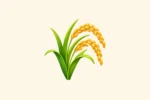
The Feather emoji is identified by the Unicode code point U+1FAB6. Unicode’s character charts list it as 🪶 FEATHER.
One platform might show a feather with a particular curve, shading, or color treatment, while another might make it look slightly more like a traditional writing quill. The basic character remains the same.
This is why one person might describe 🪶 as a feather while another immediately sees a quill. Both interpretations can make sense depending on the visual design and conversation.
Unicode also explains that it does not control the actual emoji artwork. It standardizes the character and related technical information, while platform vendors create their own glyph designs.
So if your friend sends 🪶 from an iPhone and you view it on Android, the appearance can change without changing the underlying message.
Best Quill Emoji Combos, Copy & Paste
Romantic ❤️
🪶✍️📜 Use this for a poetic love note.
🪶📖💭 Use this for a thoughtful romantic message.
✍️🪶📜 Use this when writing something heartfelt.
Cute 🥰
🪶📝📖 Use this for a sweet little writing moment.
🪶💭📚 Use this for a cozy reading or daydreaming mood.
📝🪶✍️ Use this for a cute creative-project message.
Flirty 😉
🪶💭✍️ Use this for a playful message about having something to say.
✒️🪶📜 Use this for an intentionally dramatic literary vibe.
🪶📝💭 Use this when teasing someone about a long message.
Missing Someone 💭
🪶📜💭 Use this for a nostalgic message about someone far away.
📝🪶📖 Use this when writing down memories.
✍️🪶💭 Use this for thoughts you want to put into words.
Good Night 🌙
🪶📖💭 Use this for a quiet bedtime reading mood.
📝🪶📜 Use this for a thoughtful end-of-day message.
🪶✍️📖 Use this when ending the night with writing or reading.
Trending Quill Emoji in 2026
In 2026, 🪶 fits naturally into several types of online content, especially where writing, reading, storytelling, and personal creativity overlap. It is not necessary to describe it as the number-one trending emoji, because there is no reason to assign it an unsupported ranking.
The symbol is particularly useful in communities built around books, poetry, journaling, creative writing, and storytelling. Instagram captions can use it to create a literary mood, while TikTok creators may use it around writing-related videos or storytelling content.
The emoji also benefits from being visually distinctive. A single feather can immediately suggest writing without requiring several words. Its connection to the traditional quill gives it an old-world quality that can work well with historical, elegant, or nostalgic content.
Unicode’s own feather proposal highlighted the quill interpretation and specifically discussed writing combinations involving paper, notebooks, scrolls, and books.
| Emoji | Why trending | Who uses it | Platform |
|---|---|---|---|
| 🪶 | Literary and creative mood | Writers and readers | Instagram, TikTok |
| ✍️ | Clear writing signal | Students and creators | WhatsApp, TikTok |
| 📖 | Reading and book content | Readers and book creators | Instagram, Facebook |
| 📚 | Books and reading communities | Readers and learners | Instagram, Facebook |
A useful way to think about current emoji usage is that symbols increasingly work as visual shortcuts. Their meaning can evolve as communities reuse them in different conversations, captions, and creative formats.
Quill Emoji Meaning in Different Contexts
Romantic Conversations
In a romantic conversation, 🪶 can give a message a poetic or thoughtful tone. It may suggest that someone is writing something heartfelt, but it does not independently prove romantic interest.
For example, “I have something I want to write to you 🪶” feels more literary than a plain message.
Friendship
Between friends, the emoji can signal creativity, writing, storytelling, or a long message. A friend who is working on a novel might use it simply as a personal writing symbol.
Family
Family members may use 🪶 around letters, memories, stories, journaling, or creative hobbies. Its meaning is usually shaped by the surrounding words rather than by the emoji alone.
Professional or Casual Communication
In professional settings, 🪶 can fit creative industries, publishing, writing, editing, journalism, education, or literary projects. In a casual chat, it can simply mean “I am writing.”
Texting
In texting, context is especially important because the emoji has several possible interpretations. “Writing now 🪶” is straightforward, while “You made me think 🪶” gives it a more reflective feeling.
Social Media Comments
As a comment, 🪶 can compliment someone’s writing, poetry, storytelling, or creative style. A single symbol can also work as an aesthetic response when the post already makes the meaning obvious.
Captions
In captions, it can create a classic or creative atmosphere. It works especially naturally with books, handwritten notes, journals, poetry, stationery, and storytelling.
How to Copy and Paste the Quill Emoji
Here is the primary emoji ready to copy:
🪶
To use it, select the symbol, copy it, and paste it wherever you want. You can place it in WhatsApp messages, Instagram captions, TikTok comments, Facebook posts, Messenger chats, bios, or ordinary text messages.
If your device has an emoji keyboard, you can also search for the Feather emoji and insert it directly. Because 🪶 is a Unicode emoji, the exact artwork may look different after you paste it into another app or onto another device.
The easiest option is simply to copy this character:
🪶
FAQs:
1. What is the most popular quill emoji?
The symbol most commonly used when people search for a quill emoji is 🪶, officially named Feather in Unicode. It can represent a feather or a traditional quill depending on context.
2. What does 🪶 mean when someone sends it?
It can mean writing, creativity, literature, a feather, storytelling, or a thoughtful idea. The surrounding message and relationship between the people are important, so it does not automatically indicate romance or any particular emotion.
3. Why do emojis look different on iPhone vs Android?
Unicode standardizes the underlying character, while companies such as Apple, Google, Samsung, and Microsoft design their own emoji artwork. The same 🪶 character can therefore have a slightly different shape, color, or style on different devices.
4. Are quill emojis used differently in other countries?
Emoji interpretation can vary between languages, cultures, online communities, and individual users. A symbol such as 🪶 may have a literary meaning in one conversation and simply represent a feather in another, so context is more useful than assuming one universal interpretation.
Conclusion:
The 🪶 quill emoji is a simple way to add a writing, literary, creative, or nostalgic feeling to digital communication.
Although Unicode officially calls it Feather, it can naturally represent a traditional quill in writing-related contexts.
Use it with words that make your intended meaning clear, especially when the conversation could be interpreted in more than one way.
A thoughtful little symbol can make an ordinary message feel a bit more personal. 🪶

Nasrullah — Emoji Strategist & Content Writer
Nasrullah is a passionate emoji enthusiast and content writer who loves exploring the meanings, uses, and cultural context behind emojis. He creates simple, helpful, and easy-to-understand guides that help readers choose the right emoji for WhatsApp, Instagram, Facebook, texting, and everyday conversations.
With a focus on emoji meanings, combinations, social media usage, and modern digital communication, Nasrullah aims to make every emoji easier to understand and use with confidence. His content combines practical examples with clear explanations so readers can quickly find the meaning and usage they are looking for.
When he’s not researching emojis, Nasrullah enjoys exploring digital trends, writing useful online content, and learning about how people communicate in the digital world. 😊