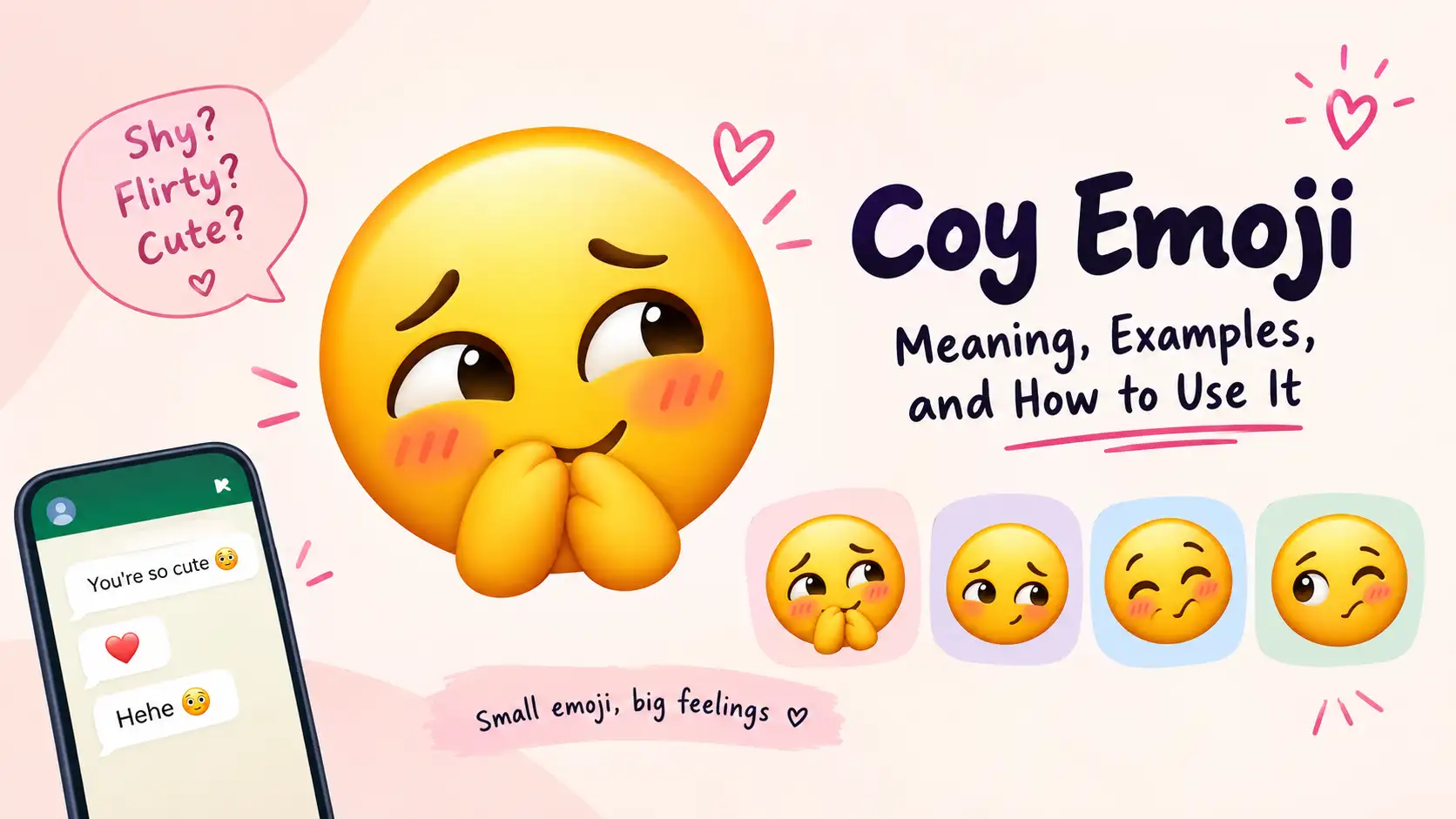
You are chatting with someone, and suddenly they send a shy-looking smile. Are they feeling embarrassed, being playful, or trying to flirt? That is exactly why people search for the coy emoji. A small facial expression can change the feeling of an entire message, especially when you are texting someone you like.
The coy emoji is commonly associated with shyness, bashfulness, playful embarrassment, and subtle flirtation. However, there is no single official emoji named “Coy.” People may use different emojis to express a coy mood, particularly 😊, ☺️, 😉, and 🫣. The best choice depends on the expression you want to communicate.
In WhatsApp chats, Instagram comments, TikTok captions, and everyday text messages, these emoji symbols can make your words feel warmer or more teasing. 😊 Sometimes, they help soften an awkward moment. Other times, they suggest a little romantic interest without saying it directly. Understanding the conversation, the sender, and the surrounding words helps you interpret the intended tone more accurately.
The coy emoji adds a touch of shyness, sweetness, or playful flirtation to an ordinary message. 😊
What Does the Coy Emoji Mean?
The coy emoji usually represents a shy, bashful, or playfully self-conscious mood. It can suggest that someone feels a little embarrassed, enjoys receiving attention, or wants to communicate something sweet without being too direct. In some conversations, it can also hint at romantic interest.
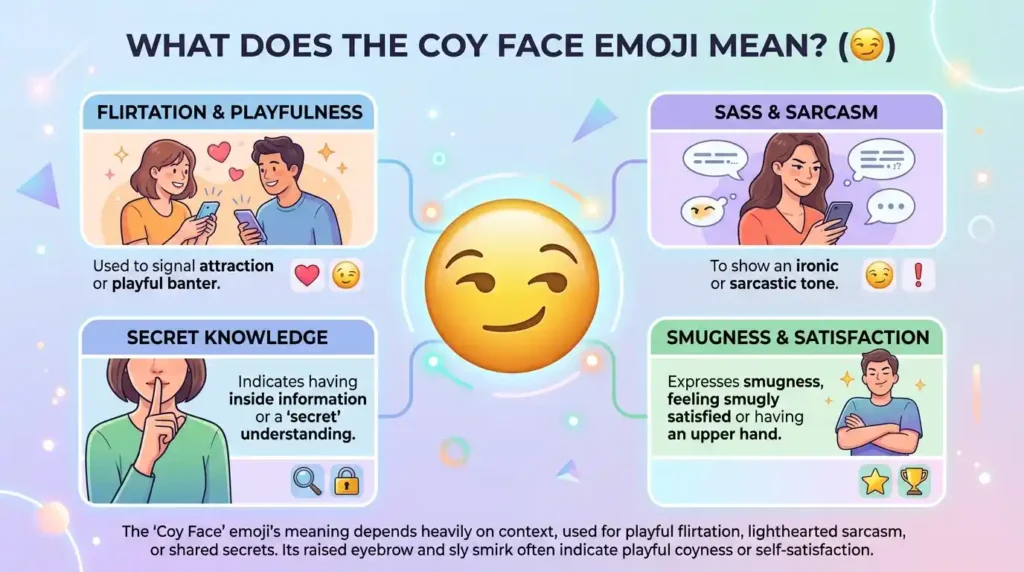
However, there is no single official Unicode emoji called the coy emoji. Instead, people use several facial emojis to express this feeling. The smiling face with smiling eyes 😊 can communicate gentle happiness and warmth. The smiling face ☺️ often gives a softer, more reserved impression. The winking face 😉 may suggest teasing or flirtation, while 🫣 can convey nervous curiosity or embarrassment.
The coy emoji in texting
In text messages, a coy-looking emoji can soften a statement that might otherwise sound serious or overly confident.
For example:
- “You remembered my birthday 😊” sounds warm and pleased.
- “Maybe I do like you 😉” feels teasing and potentially flirtatious.
- “Stop, you’re making me blush ☺️” communicates bashfulness.
- “I want to look, but I’m embarrassed 🫣” expresses nervous curiosity.
These examples show how wording changes the emotional effect. A wink after a playful compliment may suggest flirting, but the same emoji between close friends can simply mean joking around.
The coy emoji on social media
On Instagram and TikTok, coy expressions often accompany selfies, playful captions, compliments, and comments. Someone might post a picture with “Just a little surprise 😊” to create a gentle, pleased mood. Another person might comment “Oh, really? 😉” to tease a friend.
The meaning can also change with the relationship between the people involved. A shy smile from a romantic partner might feel affectionate, while one from a coworker may simply be polite.
Is the coy emoji positive or romantic?
Usually, its intended tone is lighthearted, but it is not always romantic. It can communicate modesty, appreciation, amusement, nervousness, or playful embarrassment. A message containing a coy-looking emoji is not enough on its own to prove that someone has romantic feelings.
Consider the complete conversation, the person’s usual texting style, and the words around the emoji before interpreting it. Culture, platform design, and personal habits can also influence how an expression comes across.
Coy Emoji Meaning Table
| Emoji | Core meaning | Possible misread | Best used when |
|---|---|---|---|
| 😊 | Warmth, gentle happiness | Romantic interest | Responding sweetly |
| ☺️ | Softness, bashfulness | Excessive politeness | Showing quiet appreciation |
| 😉 | Teasing, playful suggestion | Definite romantic interest | Making a lighthearted joke |
| 🫣 | Embarrassment, nervous curiosity | Fear or discomfort | Reacting shyly |
| 😳 | Surprise, blushing, embarrassment | Shock or disbelief | Reacting to an unexpected compliment |
| 😌 | Calm satisfaction, relief | Indifference | Expressing quiet contentment |
| 😏 | Slyness, suggestiveness | Arrogance | Teasing with a knowing expression |
| 🥰 | Affection, fondness | Strong romantic feelings | Sharing warmth with someone close |
| 🙈 | Playful embarrassment | Avoiding responsibility | Reacting to something awkward |
| 😅 | Nervous laughter, relief | Ordinary happiness | Lightening an awkward moment |
Exactly 10 Emoji Cards
😊 Smiling Face with Smiling Eyes
Meaning: Warmth, happiness, and a gentle, friendly expression.
Example 1: That was so sweet of you 😊
Example 2: I had a lovely time today 😊
☺️ Smiling Face
Meaning: A soft smile that can suggest modesty, contentment, or bashfulness.
Example 1: You really made my day ☺️
Example 2: I’m glad you noticed ☺️
😉 Winking Face
Meaning: Playfulness, teasing, or a hint of flirtation.
Example 1: Maybe I’ll tell you later 😉
Example 2: You know exactly what I mean 😉
🫣 Face with Peeking Eye
Meaning: Nervous curiosity, embarrassment, or hesitant interest.
Example 1: I’m almost too shy to ask 🫣
Example 2: I can’t believe you said that 🫣
😳 Flushed Face
Meaning: Blushing, surprise, or feeling caught off guard.
Example 1: You really think so? 😳
Example 2: That compliment caught me off guard 😳
😌 Relieved Face
Meaning: Calm satisfaction, relief, or quiet confidence.
Example 1: Finally, everything worked out 😌
Example 2: That was exactly what I needed 😌
😏 Smirking Face
Meaning: A knowing expression that may suggest mischief or suggestive teasing.
Example 1: I have a little surprise for you 😏
Example 2: You noticed that, didn’t you? 😏
🥰 Smiling Face with Hearts
Meaning: Affection, tenderness, and feeling especially fond of someone.
Example 1: You’re such a sweetheart 🥰
Example 2: This message made me smile 🥰
🙈 See-No-Evil Monkey
Meaning: Playful embarrassment, shyness, or pretending not to see something awkward.
Example 1: You caught me blushing 🙈
Example 2: I’m too embarrassed to reply 🙈
😅 Grinning Face with Sweat
Meaning: Nervous laughter, awkwardness, or relief after a tense moment.
Example 1: I nearly sent that to the wrong person 😅
Example 2: That was an awkward moment 😅
How to Use the Coy Emoji the Right Way?
The best way to use a coy-looking emoji is to match its expression to your message. A gentle smile works well for appreciation, while a wink can make a playful comment feel more teasing. A peeking face is useful when you want to show nervous curiosity.
WhatsApp 💬
WhatsApp conversations are often personal, so a coy emoji can add warmth to everyday messages.
- Personal chats: “I was hoping you’d message me 😊”
- Family conversations: “You always know how to make me smile ☺️”
- Friendships: “You really did that? 😉”
- Emotional messages: “That means more than you know 😊”
- Status updates: “A little surprise coming soon 🫣”
Pay attention to your relationship with the recipient. A wink might be natural between close friends but confusing if the other person does not know your sense of humor. In emotional conversations, a gentle smile may feel more supportive than a teasing expression.
Instagram 📸
Instagram emojis can help set the mood of captions, comments, bios, and Reels.
For a soft selfie caption, you could write, “Just feeling good today ☺️.” Under a friend’s flattering picture, “Okay, looking good 😉” adds playful energy.
For a subtle, mysterious caption, try “Maybe there’s a story behind this smile 😊.” The expression leaves room for interpretation without making a specific promise or claim.
You can also use coy-looking faces in comments when reacting to compliments. For example, “You’re making me shy 😊” acknowledges the compliment while keeping the response lighthearted.
TikTok 🎵
TikTok users may use these expressions in reaction videos, jokes, comments, and playful captions. A wink can communicate that a statement is meant teasingly, while a peeking face can show embarrassment during an awkward or surprising moment.
Examples include:
- “When they finally notice your new look 😉”
- “Trying to act normal after that compliment 😳”
- “Me pretending I didn’t see that comment 🫣”
These captions depend on the video’s context. The same expression may look sincere in one video and ironic in another. Avoid assuming that a coy-looking emoji automatically signals attraction.
On Facebook, these emojis work in posts, comments, Messenger conversations, and casual reactions.
You might respond to a friend’s kind message with 😊 or use 😉 when continuing a harmless inside joke. A family post could use ☺️ to convey appreciation, while 🫣 might suit a funny story about an embarrassing moment.
For professional or sensitive discussions, choose an expression carefully. A teasing wink can be misunderstood when the conversation lacks the warmth of an in-person exchange.
Dos and Don’ts
Do:
- Use a coy expression to support the message’s tone.
- Consider your relationship with the recipient.
- Read the surrounding conversation before interpreting an emoji.
- Match gentle messages with gentle expressions.
- Remember that designs can vary across devices.
Don’t:
- Assume a wink always means flirting.
- Use teasing emojis in serious conversations without considering the mood.
- Fill every sentence with facial expressions.
- Combine emojis randomly just to make a message colorful.
- Treat a single emoji as proof of someone’s feelings.
Why Does the Coy Emoji Look Different on iPhone and Android?
Have you ever sent a smile to someone and noticed that it looked slightly different on their phone? That is normal. Emojis use Unicode standards, which assign characters and identifiers so supported devices can recognize them. However, Unicode does not require every company to draw each emoji identically.
Apple, Google, Samsung, Microsoft, and other platform providers create their own emoji artwork. As a result, a smiling face may have a slightly different mouth, eye shape, color, shading, or overall style depending on the device and software.
The same applies to coy-looking expressions. A gentle smile might look warmer on one platform and more neutral on another. A wink may appear more exaggerated on one device, potentially changing how playful it seems to the recipient.
Here are the main differences you may notice:
- Shape: Facial features and proportions may vary.
- Color: Skin tones, shading, and background colors can differ.
- Expression: The eyes or mouth may create a slightly different impression.
- Size and style: Emojis may appear larger, smaller, flatter, or more detailed.
The underlying emoji character can still be the same even when the artwork differs. Software versions and app-specific rendering can also affect what people see.
For example, if you send 😊 from an iPhone to an Android phone, the recipient may see Google’s or Samsung’s version of the same character. Neither design is automatically the correct one.
If a message is emotionally important, write enough words to make your intention clear. A sentence such as “I’m happy you told me 😊” communicates more than the face alone and reduces the chance of misunderstanding.
Best Coy Emoji Combos: Copy & Paste
These combinations use the established coy-related emoji family. Choose the one that fits your relationship and the tone of your message.
Romantic ❤️
1.👉 😊🥰: Use this for a warm, affectionate message to someone special.
2.👉 ☺️🥰: Add this to a sweet message that feels gentle and sincere.
3.👉 😉🥰: Use this for playful affection between people who understand each other’s humor.
Cute 🥰
1.👉 ☺️🙈: Use this when someone makes you feel shy in a sweet way.
2.👉 😊🫣: Add this to a message about feeling bashful or curious.
3.👉 😳😊: Use this after receiving an unexpected compliment.
Flirty 😉
1.👉 😉😏: Use this for mutual teasing when the tone is welcome.
2.👉 😊😉: Add this to a playful reply that leaves room for interpretation.
3.👉 😏🥰: Use this when affectionate teasing fits the conversation.
Missing Someone 💭
1.👉 😊🥰: Send this to show that thinking about someone makes you happy.
2.👉 ☺️😊: Use this for a gentle message to someone you have not spoken to recently.
3.👉 🥰🙈: Add this when you feel shy about admitting you miss someone.
Good Night 🌙
1.👉 ☺️🥰: Use this for a tender bedtime message.
2.👉 😊🙈: Add this to a sweet, slightly bashful good-night reply.
3.👉 😉😊: Use this when ending the conversation on a playful note.
Trending Coy Emoji in 2026
Coy-looking expressions remain useful in online conversations because they can communicate subtle emotions without requiring a long explanation. In 2026, users continue to encounter these facial expressions in casual messaging, social media captions, reaction comments, and short-form video content. However, there is no single verified ranking for a category called “coy emojis,” and these examples should not be treated as an official trend list.
The following emojis serve different purposes in contemporary digital communication.
😊 The gentle smile
This expression works well in everyday chats, appreciation messages, and friendly captions. Creators may use it to make a sentence feel approachable, while ordinary users can add it to a response that might otherwise sound brief or distant.
😉 The playful wink
A wink often appears in teasing comments, humorous captions, and conversations where the participants already understand each other’s tone. Depending on the wording, it can suggest an inside joke, playful confidence, or flirtation.
🫣 The peeking face
This expression suits reaction content, awkward moments, and captions about being curious but embarrassed. It can communicate the feeling of wanting to know what happens while feeling slightly uncomfortable.
🥰 The affectionate smile
This face can add warmth to messages about relationships, thoughtful gestures, and moments that make someone feel appreciated. Its emotional intensity may feel stronger than a simple smile, so it is worth considering the relationship before using it.
| Emoji | Why trending | Who uses it | Platform |
|---|---|---|---|
| 😊 | Friendly, approachable tone | Friends, creators, general users | WhatsApp, Instagram |
| 😉 | Playful teasing | Friends, couples, humor creators | TikTok, Instagram |
| 🫣 | Awkward or curious reactions | Meme creators, casual users | TikTok, comments |
| 🥰 | Warmth and affection | Couples, friends, families | WhatsApp, Facebook |
These are practical usage patterns rather than measured rankings. Emoji trends evolve as communities develop new jokes, caption styles, and ways of expressing familiar emotions online.
Coy Emoji Meaning in Different Contexts
A coy-looking expression can communicate several emotions, depending on who sends it and what the conversation is about. Instead of interpreting the face alone, consider the relationship, wording, and situation.
Romantic conversations
In a romantic conversation, a gentle smile may show that someone appreciates a compliment or feels comfortable with the other person. A wink can add teasing energy.
For example, “You looked really nice today 😉” may sound flirtatious when sent by someone who has already shown romantic interest. However, the same message could be an ordinary joke between friends.
Friendship
Among friends, coy expressions often communicate embarrassment, amusement, or playful confidence. A friend might respond to a surprising confession with “I knew it 😉” or use 🫣 when a funny secret comes up.
The established friendship matters more than the emoji itself. Friends who regularly tease one another may use expressions that would seem overly suggestive in a different conversation.
Family conversations
In family chats, a coy smile can soften a playful remark or show appreciation. Someone might respond to a relative’s compliment with “You’re making me blush ☺️.”
A warmer expression is usually easier to interpret than a suggestive wink when the goal is simply to acknowledge a kind message.
Professional and casual communication
In casual workplace chats, a friendly smile can make a short response feel less abrupt. For example, “Thanks for catching that 😊” sounds appreciative.
However, in formal emails, sensitive discussions, or conversations with people you do not know well, clear wording is more useful than a coy expression. A wink might appear too familiar or carry an unintended implication.
Texting and social media comments
Texting offers fewer tone cues than face-to-face conversation, so a coy emoji can help communicate warmth or humor. Yet the same expression can be read differently by different people.
On social media, captions and comments may also be intended for a broad audience. A wink under a selfie could be playful, confident, ironic, or flirtatious, depending on the post.
Captions and personal messages
In a caption, a coy-looking face can suggest that a photo captures a private joke or a happy, slightly embarrassing moment. In a direct message, it may feel more personal because the recipient knows the conversation’s history.
The safest approach is to look at the full message rather than making assumptions from one symbol.
How to Copy and Paste the Coy Emoji?
You can copy a coy-related emoji from the line below and paste it into a message, comment, caption, or status update.
Copy-paste emojis:
😊 ☺️ 😉 🫣 😳 😌 😏 🥰 🙈 😅
- Select the emoji you want to use.
- Copy it using your device’s copy command or keyboard shortcut.
- Open WhatsApp, Instagram, TikTok, Facebook, or your preferred messaging app.
- Paste the emoji into your message, comment, caption, or status.
- Add words when necessary to make your intended tone clear.
On a computer, you can usually select the character with your mouse and copy it. On a phone, press and hold the character if your app supports text selection. You can also find many of these expressions in your device’s built-in emoji keyboard.
Remember that the exact artwork may vary by platform. If you want to express shyness, gentle happiness, or playful teasing, choose the face that best matches your message rather than relying on the label alone.
Frequently Asked Questions
1. What is the most popular coy emoji?
There is no single official coy emoji. 😊 and ☺️ can express gentle bashfulness, while 😉 is useful for playful teasing. The best option depends on the emotion you want to communicate.
2. What does a coy emoji mean when someone sends it?
It may suggest shyness, warmth, embarrassment, or flirtation. The intended meaning depends on the words, relationship, and conversation. One emoji alone cannot reliably establish someone’s romantic interest.
3. Why do emojis look different on iPhone versus Android?
Unicode helps devices recognize the same emoji characters, but Apple, Google, Samsung, and other companies create their own artwork. Therefore, the shape, color, and expression can vary.
4. Are coy emojis used differently in other countries?
Interpretations can vary across cultures, languages, and online communities. Personal habits also matter. When the meaning is unclear, consider the message’s context or ask the sender what they intended.
Conclusion
The coy emoji is a useful way to express shyness, warmth, or playful teasing in digital conversations. 😊
Choose an expression that matches your message, and consider how the recipient might interpret it.
When the conversation matters, a few clear words can help your emoji communicate exactly what you intend.

Nasrullah — Emoji Strategist & Content Writer
Nasrullah is a passionate emoji enthusiast and content writer who loves exploring the meanings, uses, and cultural context behind emojis. He creates simple, helpful, and easy-to-understand guides that help readers choose the right emoji for WhatsApp, Instagram, Facebook, texting, and everyday conversations.
With a focus on emoji meanings, combinations, social media usage, and modern digital communication, Nasrullah aims to make every emoji easier to understand and use with confidence. His content combines practical examples with clear explanations so readers can quickly find the meaning and usage they are looking for.
When he’s not researching emojis, Nasrullah enjoys exploring digital trends, writing useful online content, and learning about how people communicate in the digital world. 😊