One tiny angry face can make a message feel much stronger.
You send a short reply like “Seriously?” and add the iPhone angry emoji, and suddenly the message feels much more emotional. 😡 That is why people often search for an angry emoji on iPhone when they want to understand exactly what a particular face communicates, how it looks, or how to use it without sounding harsher than intended.
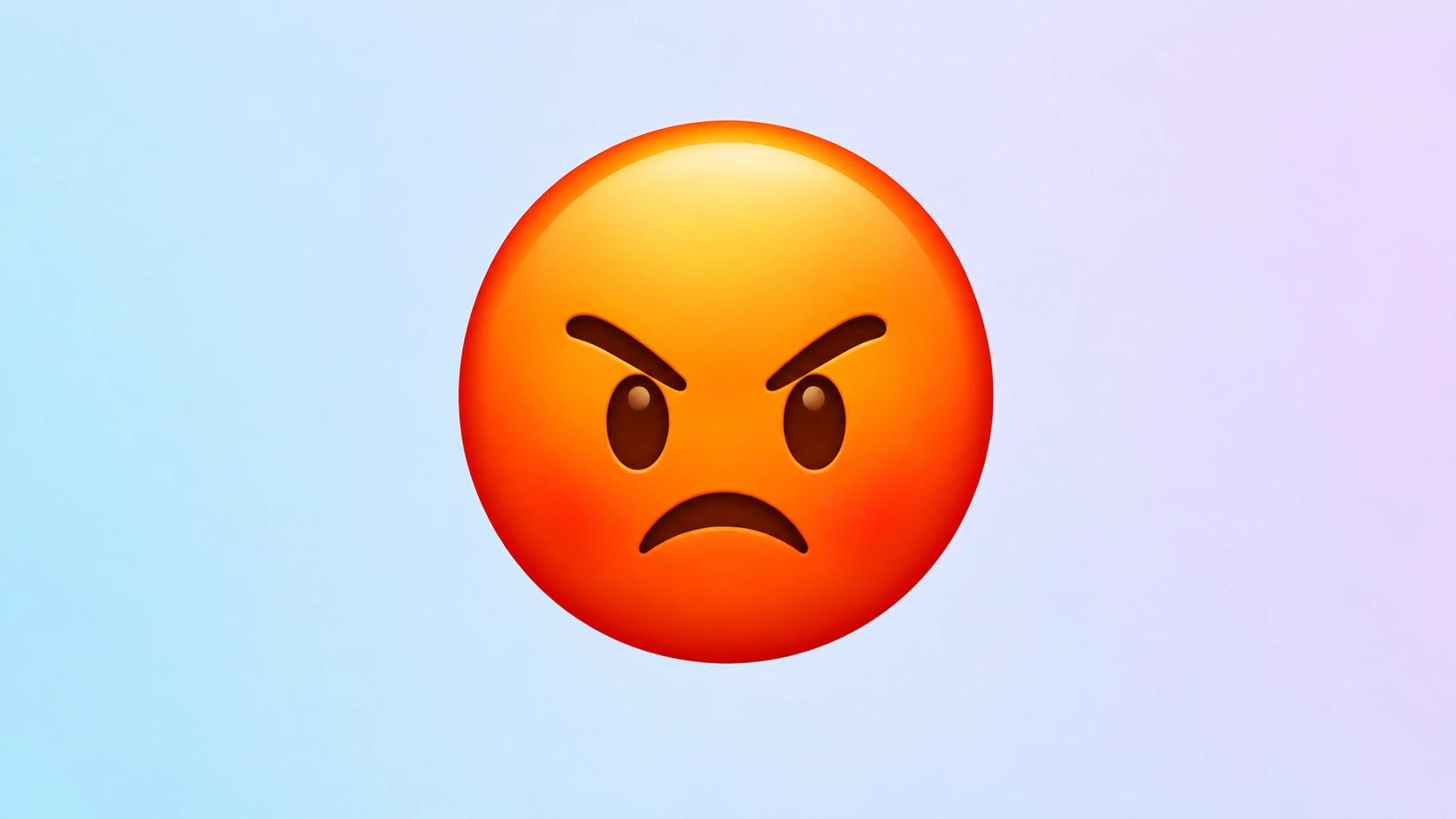
The most recognizable iPhone angry emoji is 😡, officially known as the Enraged Face. Depending on the conversation, though, people may also use 😠, 😤, 🤬, 😒, or related expressions to show irritation, frustration, annoyance, or stronger anger. The meaning is not completely fixed. Your words, relationship with the other person, and the situation all matter.
On WhatsApp, Instagram, TikTok, Facebook, or ordinary text messages, the same emoji can therefore feel slightly different. Learning those differences helps you choose an expression that matches what you actually want to say.
The iPhone angry emoji can turn a simple reaction into a clear emotional signal, but context decides how intense it feels. 😡
What Does the iPhone Angry Emoji Mean?
The iPhone angry emoji 😡 usually communicates strong anger, outrage, frustration, or serious displeasure. Its red face and tense expression make it noticeably more intense than a mildly annoyed face such as 😒. In texting, someone might send 😡 after receiving disappointing news, reacting to an argument, or jokingly showing that they are upset.
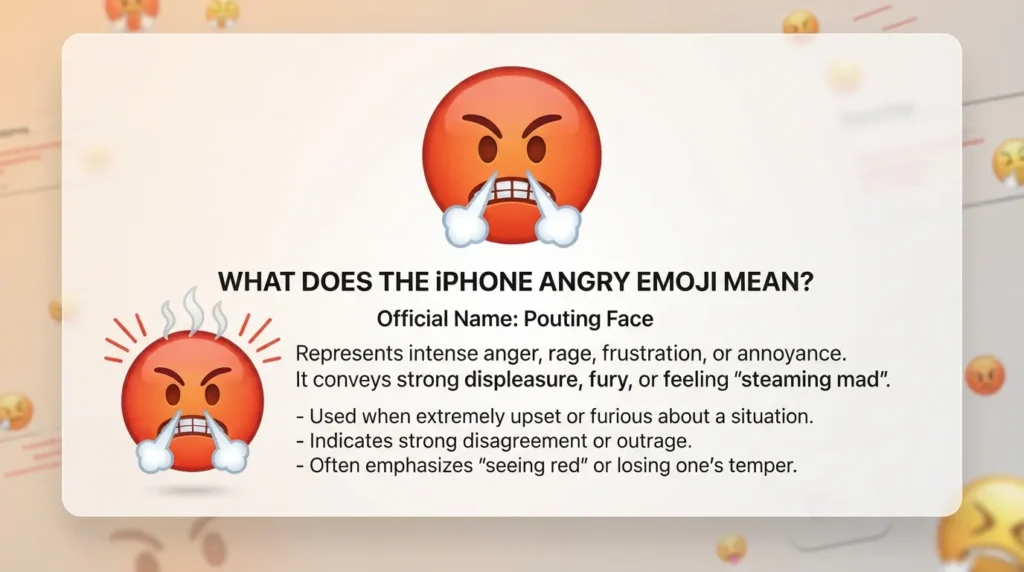
The important point is that 😡 does not always mean genuine rage. Friends sometimes use it playfully when complaining about something minor. For example, “You ate my fries 😡” can be a serious complaint or an exaggerated joke depending on the relationship. In a romantic conversation, the same emoji could signal genuine irritation, playful jealousy, or a request for reassurance.
Other nearby expressions help communicate different levels of emotion. 😠 can suggest ordinary anger or displeasure, while 😤 often feels more like frustration or being fed up. 🤬 is much stronger because it can imply intense anger or profanity. 😒 commonly expresses annoyance, skepticism, or dissatisfaction rather than outright rage. 🙄 can add an eye-rolling, “I cannot believe this” feeling.
Context matters especially in short messages. “Fine 😡” sounds very different from “That movie was terrible 😡😂.” The first may signal real tension, while the second could be exaggerated humor. Your relationship with the sender matters too. A close friend may understand an angry emoji as playful teasing, whereas the same symbol from a coworker could feel more serious.
So, there is no single universal interpretation. The iPhone angry emoji is best understood as an emotional amplifier whose exact tone comes from the surrounding conversation.
Meaning Table:
| Emoji | Core meaning | Possible misread | Best used when |
|---|---|---|---|
| 😡 | Strong anger or outrage | Can sound aggressive | You want to show serious displeasure |
| 😠 | Anger or irritation | May seem colder than intended | You are clearly annoyed |
| 😤 | Frustration or being fed up | Can look smug in some contexts | You are venting or frustrated |
| 🤬 | Very strong anger | May feel hostile | The situation is extremely frustrating |
| 😒 | Annoyance or dissatisfaction | Can sound dismissive | You are unimpressed |
| 🙄 | Eye-rolling or disbelief | Can appear disrespectful | You are reacting to something obvious |
| 😑 | Flat annoyance | May seem emotionally distant | You have little patience left |
| 😾 | Angry or displeased cat | May feel playful | You want an angry cat-style reaction |
| 🥺 | Vulnerability or pleading | Can soften an angry message | You want to ask for understanding |
| 😭 | Intense sadness or exaggerated emotion | May be mistaken for genuine distress | You are overwhelmed or dramatically reacting |
😡 Enraged Face
Meaning: Strong anger, outrage, or serious frustration.
Example 1: I cannot believe that happened 😡
Example 2: You promised you would tell me first 😡
😠 Angry Face
Meaning: Noticeable anger, irritation, or displeasure.
Example 1: I am still annoyed about yesterday 😠
Example 2: Please do not do that again 😠
😤 Face with Steam From Nose
Meaning: Frustration, determination, or being fed up.
Example 1: I have been waiting for an hour 😤
Example 2: I finally finished the whole project 😤
🤬 Face with Symbols on Mouth
Meaning: Extremely strong anger or a reaction associated with swearing.
Example 1: That was completely unfair 🤬
Example 2: My internet stopped again 🤬
😒 Unamused Face
Meaning: Annoyance, dissatisfaction, skepticism, or lack of enthusiasm.
Example 1: You really forgot again 😒
Example 2: That excuse is not convincing 😒
🙄 Face with Rolling Eyes
Meaning: Disbelief, irritation, sarcasm, or an “oh, please” reaction.
Example 1: Here we go again 🙄
Example 2: You said that last week too 🙄
😑 Expressionless Face
Meaning: Emotional flatness, impatience, or quiet annoyance.
Example 1: I honestly have no words 😑
Example 2: You sent the same message three times 😑
😾 Pouting Cat
Meaning: An angry or displeased reaction presented in a cute cat form.
Example 1: Someone stole my seat 😾
Example 2: I am not sharing my snacks 😾
🥺 Pleading Face
Meaning: A vulnerable, pleading, or emotionally soft expression.
Example 1: Please do not stay mad at me 🥺
Example 2: Can we talk about it? 🥺
😭 Loudly Crying Face
Meaning: Intense sadness, overwhelm, or exaggerated emotional reaction.
Example 1: I waited all day for this 😭
Example 2: That ending destroyed me 😭
How to Use the iPhone Angry Emoji the Right Way?
The best way to use an iPhone angry emoji is to match its intensity with your actual message. If you are mildly annoyed, 😒 or 😠 may feel more natural than 😡. If you are genuinely furious, 😡 or 🤬 communicates a much stronger reaction.
WhatsApp 💬
WhatsApp chats are highly dependent on relationships. With friends, 😡 can be playful when you exaggerate a small complaint.
“Why did you start the movie without me? 😡”
In a family conversation, it can communicate genuine frustration, but a softer expression may be better if you want to avoid escalating the situation. In personal chats, the emoji can also make a short message feel more emotionally obvious.
For a WhatsApp status, an angry emoji can work with a short statement such as “Not today 😡,” but remember that people viewing a status may not know the full story. A private chat gives you more room to explain the context.
Instagram 📸
On Instagram, angry emojis frequently appear in comments and captions as emotional reactions. Someone might comment “That ending 😡” on a dramatic video or use 😒 when reacting to an unpopular opinion.
The emoji can also be useful in captions when the visual content already establishes the context. However, using 😡 on a public post can make a playful comment look genuinely hostile if the surrounding words do not clarify your intention.
TikTok 🎵
TikTok comments often depend on humor, exaggeration, reactions, and fast-moving conversation. An angry emoji can therefore be deliberately dramatic.
For example:
“That plot twist 😡”
may mean “I am emotionally offended by how good or unexpected this was,” rather than actual anger.
Because TikTok conversations can move quickly, surrounding words are especially useful when your reaction could be interpreted seriously.
On Facebook, angry emojis can appear in posts, comments, and Messenger conversations. A public comment has a wider audience, so tone matters. 😡 can be appropriate for a clearly frustrating situation, while 😒 may communicate disappointment without sounding as aggressive.
The same principle applies to Facebook Messenger: the closer the relationship, the easier it may be for the receiver to recognize playful exaggeration.
Do’s and Don’ts:
Do:
- Use 😡 when you genuinely want a stronger angry reaction.
- Consider your relationship with the receiver.
- Let your words provide context.
- Choose 😠 or 😒 when your irritation is less intense.
- Check how the emoji appears on your device before sending something important.
Don’t:
- Assume every person reads an angry emoji exactly the same way.
- Use 🤬 casually in a sensitive professional conversation.
- Add several angry faces to make a message unnecessarily intense.
- Use 😡 when you actually want to apologize or calm someone down.
- Assume an angry-looking emoji always represents serious anger.
Why Does the iPhone Angry Emoji Look Different on iPhone and Android?
If you send 😡 from an iPhone to an Android phone, the recipient may notice that the face does not look exactly the same. That does not necessarily mean you sent a different emoji.
Emojis are based on Unicode, a standard that assigns characters and codes so different systems can recognize the same symbols. Companies then create their own visual artwork for those characters. Apple has its own emoji designs, while Google, Samsung, Microsoft, and other platforms can display their own versions.
As a result, the underlying 😡 character can remain the same while its appearance changes.
You may notice differences in the shape of the eyes, mouth, eyebrows, facial proportions, color, or overall rendering style. Size and presentation can also vary depending on the app and operating system.
This is especially useful to remember when discussing an “iPhone angry emoji.” When someone searches for that phrase, they may be looking specifically for Apple’s visual version rather than a completely separate emoji character.
There is no universal rule saying that the Apple version is the correct appearance and another platform’s version is wrong. They are different designs representing the same standardized character.
If an emoji looks slightly different after being sent to another device, the difference is usually visual rather than a change in the underlying emoji identity.
Best iPhone Angry Emoji Combos, Copy & Paste:
Romantic ❤️
😡❤️ — Use this when you are playfully annoyed with someone you love.
😠❤️ — Use this for a softer “I am mad, but I still care” message.
🥺😡 — Use this for playful relationship frustration that still feels emotionally soft.
Cute 🥰
😾🥺 — Use this when you want to make an angry reaction deliberately cute.
😡🥺 — Use this for exaggerated annoyance when you do not want the message to feel too harsh.
😒😾 — Use this for a playful unimpressed reaction with a cute edge.
Flirty 😉
😒🥺 — Use this when pretending to be annoyed while keeping the tone playful.
🙄😡 — Use this for exaggerated teasing between people who understand each other’s humor.
😠🥺 — Use this when you want to act annoyed while clearly softening the emotion.
Missing Someone 💭
😡😭 — Use this when you are dramatically frustrated because you miss someone.
😒🥺 — Use this when you are pretending to be annoyed about someone being away.
😑😭 — Use this for an exaggerated “I cannot deal with missing you” reaction.
Good Night 🌙
😡😴 — Use this jokingly when someone is keeping you awake.
😒😴 — Use this when you are mildly annoyed but ready to sleep.
🥺😴 — Use this for a softer bedtime message after a little disagreement.
Trending iPhone Angry Emoji in 2026:
In 2026, angry and annoyed facial emojis remain useful in everyday digital communication because they can express reactions quickly without requiring a long explanation. The most useful choices are not necessarily the strongest ones. People often select an expression according to the exact emotional shade they want.
😡 is commonly seen when users want to make displeasure obvious. 😤 works well for frustration, especially when someone is complaining about a situation rather than directly attacking another person. 😒 frequently appears in casual conversations where the user is unimpressed. 🙄 can add sarcasm or disbelief.
On WhatsApp and Messenger, these expressions often appear in direct conversations. On Instagram and TikTok, they can function as quick reactions to videos, captions, comments, and dramatic moments. Their tone can also shift according to community humor and the surrounding text.
| Emoji | Why trending | Who uses it | Platform |
|---|---|---|---|
| 😡 | Clear, strong reaction | Everyday texters and commenters | WhatsApp, Instagram, TikTok |
| 😤 | Expresses frustration quickly | Friends, creators, commenters | TikTok, WhatsApp |
| 😒 | Useful for casual annoyance | Social media users | Instagram, Facebook |
| 🙄 | Adds sarcasm or disbelief | Commenters and friends | TikTok, Instagram, messaging |
The broader pattern is simple: emoji usage keeps adapting to the tone of online conversations, and the same face can become playful, sarcastic, serious, or exaggerated depending on how people use it.
iPhone Angry Emoji Meaning in Different Contexts:
In a romantic conversation, 😡 can mean genuine frustration, playful jealousy, or “I am upset with you.” The surrounding words are crucial. “You forgot our plan 😡” feels more serious than “You ate the last cookie 😡.”
In friendship, angry emojis are often exaggerated for humor. A friend might write “You went without me? 😡” while actually teasing.
In family conversations, the same emoji may communicate real annoyance. If you are discussing something sensitive, a milder expression can help prevent your message from sounding more aggressive than intended.
In professional or casual communication, caution is useful. An angry face may feel too direct in a workplace discussion, especially when the recipient does not know your communication style. Clear words are usually better when the topic is serious.
In texting, brevity gives emojis extra weight. A message containing only “😡” can be harder to interpret than “I am really frustrated 😡.” Adding a few words can remove uncertainty.
In social media comments, context can make anger humorous. A reaction to a fictional character, sports moment, joke, or dramatic video may use 😡 as playful exaggeration.
In captions, the emoji can reinforce a mood without explaining every detail. Still, public audiences may interpret a short caption differently, so wording remains important.
The key is not to memorize one definition. Think about the emotional job the emoji is doing in that specific conversation.
How to Copy and Paste the iPhone Angry Emoji
If you simply need the angry emoji for a message, copy the character below:
😡
On an iPhone, you can also open the emoji keyboard, search for an angry or related face, and tap the emoji you want. To copy an emoji from a webpage or message, press and hold the character, select it, and choose Copy.
Then paste it wherever you need it:
- WhatsApp chats
- Instagram captions
- Instagram comments
- TikTok captions
- TikTok comments
- Facebook posts
- Messenger
- Text messages
You can also copy combinations such as 😡❤️ or 😒🥺 when the emotional tone fits your message. Before sending something serious, consider whether the combination makes your intended tone clearer or more confusing.
FAQs
1. What is the most popular iPhone angry emoji?
The red 😡 is one of the clearest angry-face choices when you want to communicate strong displeasure or frustration.
For milder irritation, people may choose 😠 or 😒 instead.
2. What does 😡 mean when someone sends it?
It can mean anger, frustration, outrage, or playful annoyance. The sender’s words, relationship with you, and situation matter more than the emoji alone.
It should not be interpreted through gender stereotypes or assumptions about the sender.
3. Why do emojis look different on iPhone vs Android?
Unicode provides the underlying emoji character, while Apple, Google, Samsung, Microsoft, and other platforms create their own visual designs.
That is why the same emoji can have different facial details or styling across devices.
4. Are iPhone angry emojis used differently in other countries?
Emoji interpretation can vary with language, community, culture, and individual communication habits.
There is no reliable rule that assigns one meaning to an angry emoji everywhere, so context remains important.
Conclusion
The iPhone angry emoji 😡 is a strong way to communicate anger, frustration, or exaggerated annoyance in digital conversations.
Choose between 😡, 😠, 😤, 😒, and related expressions according to the intensity you actually want to convey.
Most importantly, let your words and relationship with the receiver guide the tone. A thoughtful emoji can make your message clearer rather than more confusing. 😡

Nasrullah — Emoji Strategist & Content Writer
Nasrullah is a passionate emoji enthusiast and content writer who loves exploring the meanings, uses, and cultural context behind emojis. He creates simple, helpful, and easy-to-understand guides that help readers choose the right emoji for WhatsApp, Instagram, Facebook, texting, and everyday conversations.
With a focus on emoji meanings, combinations, social media usage, and modern digital communication, Nasrullah aims to make every emoji easier to understand and use with confidence. His content combines practical examples with clear explanations so readers can quickly find the meaning and usage they are looking for.
When he’s not researching emojis, Nasrullah enjoys exploring digital trends, writing useful online content, and learning about how people communicate in the digital world. 😊