You know the moment: you have the perfect message ready, but you cannot find the emoji that matches its mood. Maybe you want something friendly 😊, affectionate ❤️, funny 😂, or encouraging 👍. Instead of searching through hundreds of symbols, an emoji sheet gives you a quick visual reference.
In this guide, emoji sheets means organized collections of emojis that help you discover their meanings, compare similar symbols, and copy them for use elsewhere. Some sheets group emojis by category, while others organize them around moods, reactions, captions, or popular uses. Modern emoji reference tools can also show names, shortcodes, Unicode information, and different device designs.
The important thing is context. An emoji does not always communicate exactly the same feeling in every conversation. A ❤️ from a partner can feel romantic, while the same symbol from a friend may simply express appreciation. The surrounding words, relationship, platform, and tone all matter.
The best emoji sheet is the one that helps you find the right little symbol for exactly what you want to say. ✨
What Do Emoji Sheets Mean?
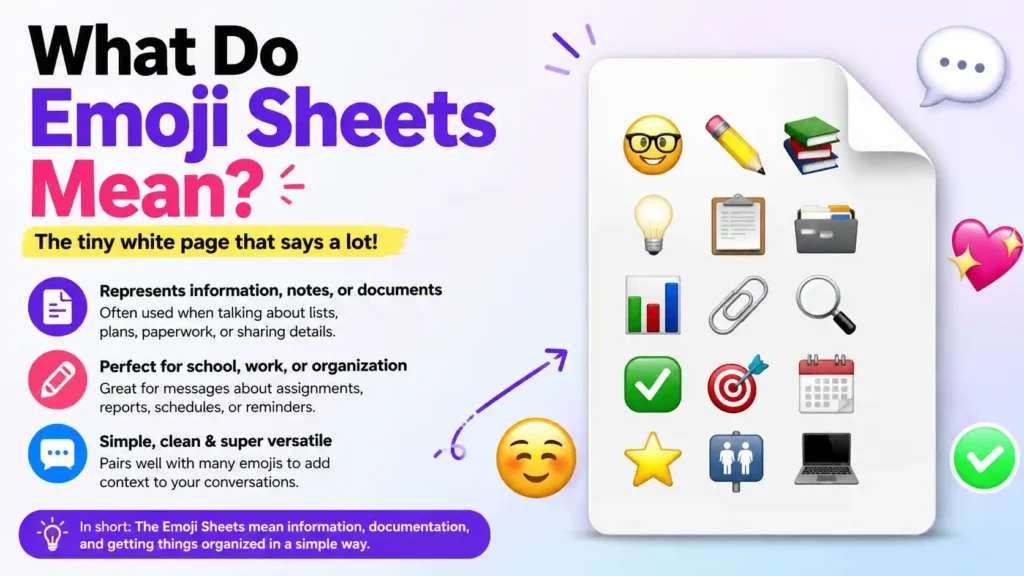
An emoji sheet is essentially a visual reference or organized collection of emojis. It can help you browse emoji symbols, understand common meanings, find related characters, and copy them into messages or social posts. Unlike an individual emoji, the phrase “emoji sheets” does not refer to one official Unicode character. Instead, it describes a useful way of presenting many emojis together.
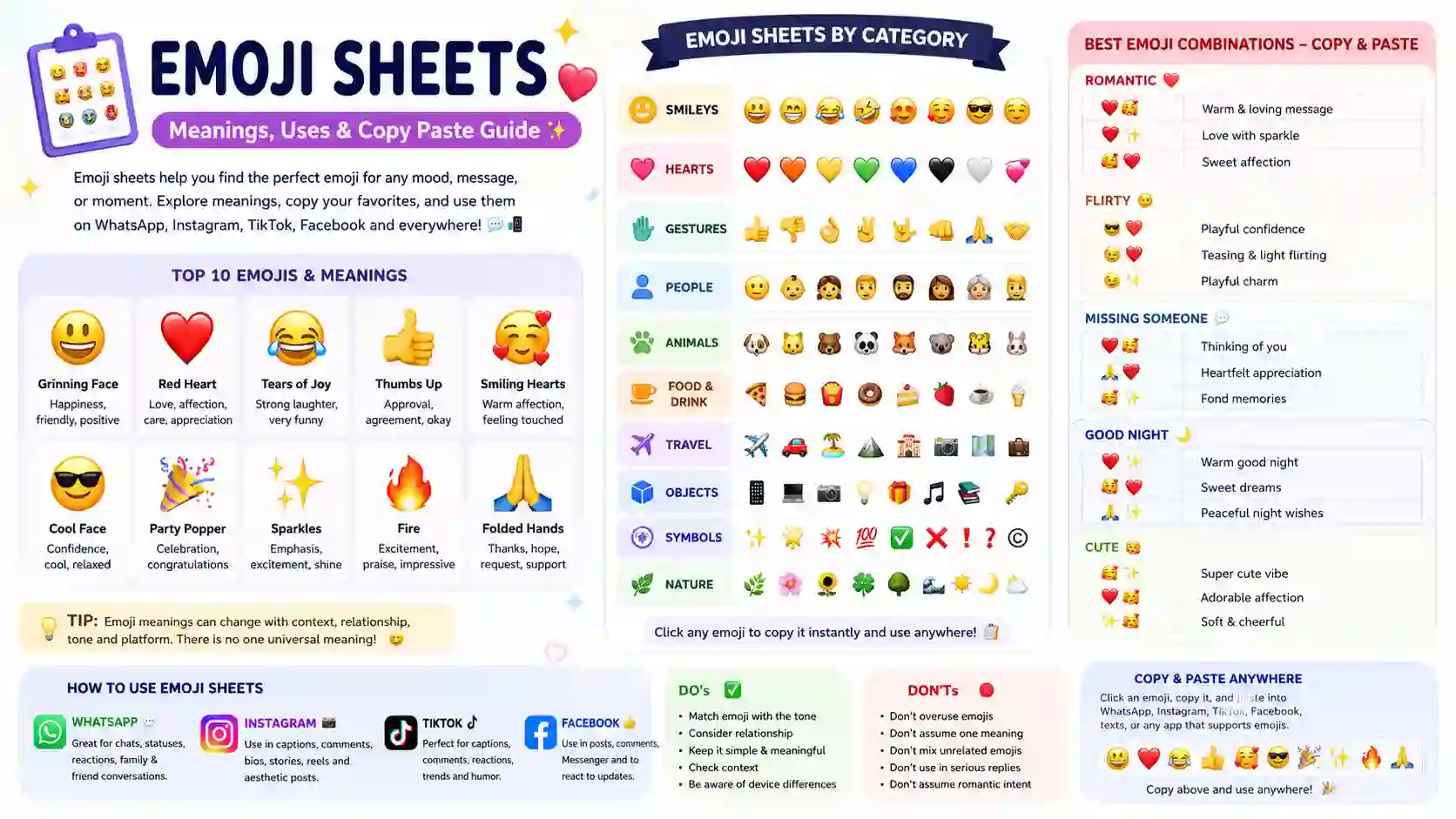
A typical sheet may include familiar symbols such as 😀 for friendliness, ❤️ for affection, 😂 for strong laughter, 👍 for approval, 🥰 for warmth, 😎 for confidence, 🎉 for celebration, ✨ for emphasis, 🔥 for excitement, and 🙏 for thanks or appreciation. Their meanings are flexible rather than absolute.
In texting, emoji sheets are especially useful when you know the feeling you want but not the exact symbol. ❤️On WhatsApp, you might browse for a heart or reaction. On Instagram, you may look for symbols that fit a caption. On TikTok, an emoji can add humor, excitement, irony, or emotional emphasis. Facebook comments and Messenger conversations use them in similarly flexible ways.
Context also matters when choosing an emoji. A 👍 can mean “sounds good” in a casual chat, while ❤️ can show affection without necessarily being romantic. 😂 may indicate genuine laughter, exaggeration, or a reaction to something ridiculous. Even a familiar symbol can feel different depending on the words around it.
The same principle applies to emoji sheets themselves. A romantic emoji sheet should feel different from a work-related reference sheet or a collection designed for captions. Good organization helps users select symbols based on intent instead of simply choosing whatever looks attractive.
Meaning Table :
| Emoji | Core meaning | Possible misread | Best used when |
|---|---|---|---|
| 😀 | Happiness | Forced positivity | Friendly messages |
| ❤️ | Affection | Romantic interest | Love or appreciation |
| 😂 | Strong laughter | Laughing at someone | Funny situations |
| 👍 | Approval | Dismissive reply | Agreement |
| 🥰 | Warm affection | Excessive sweetness | Cute or loving messages |
| 😎 | Confidence | Showing off | Casual confidence |
| 🎉 | Celebration | Overly excited tone | Good news |
| ✨ | Emphasis or sparkle | Decorative filler | Highlights and excitement |
| 🔥 | Excitement or praise | Literal fire | Praise and trends |
| 🙏 | Thanks, hope, or request | Prayer only | Gratitude or support |
😀 Grinning Face:
Meaning: Happiness, friendliness, and an upbeat tone.
Example 1: Great to hear from you! 😀
Example 2: We finally finished it 😀
❤️ Red Heart:
Meaning: Love, affection, care, appreciation, or emotional warmth.
Example 1: Thank you for always being there ❤️
Example 2: Have a beautiful day ❤️
😂 Face With Tears of Joy:
Meaning: Strong laughter or amusement.
Example 1: That message was hilarious 😂
Example 2: I cannot stop laughing 😂
👍 Thumbs Up:
Meaning: Agreement, approval, acknowledgment, or encouragement.
Example 1: Yes, that works for me 👍
Example 2: Nice job on the presentation 👍
🥰 Smiling Face With Hearts:
Meaning: Warm affection, happiness, appreciation, or feeling touched.
Example 1: This message made my day 🥰
Example 2: You are so thoughtful 🥰
😎 Smiling Face With Sunglasses:
Meaning: Confidence, coolness, playful pride, or relaxed energy.
Example 1: Ready for the weekend 😎
Example 2: We got this 😎
🎉 Party Popper:
Meaning: Celebration, congratulations, excitement, and good news.
Example 1: Congratulations on your new job! 🎉
Example 2: We finally did it! 🎉
✨ Sparkles:
Meaning: Emphasis, excitement, beauty, freshness, or a magical feeling.
Example 1: New look, new energy ✨
Example 2: You absolutely nailed it ✨
🔥 Fire:
Meaning: Excitement, praise, popularity, intensity, or something impressive.
Example 1: That outfit is 🔥
Example 2: Your new track is 🔥
🙏 Folded Hands:
Meaning: Thanks, appreciation, hope, request, or support depending on context.
Example 1: Thank you so much 🙏
Example 2: Please wish me luck 🙏
How to Use Emoji Sheets the Right Way
Emoji sheets are most useful when they help you choose an emoji based on what you actually want to communicate. On WhatsApp 💬, you can use a sheet to find quick reactions for personal chats, family conversations, friendships, and emotional messages. A simple “Thanks so much ❤️” feels warmer than plain text, while “That works 👍” gives a quick acknowledgment. For a status update, a few carefully chosen symbols can reinforce the mood without taking over the message.
On Instagram 📸, emoji sheets are useful for captions, comments, bios, and aesthetic posts. A creator might use ✨ to emphasize a new look, 🔥 to praise a photo, or 🎉 to celebrate an announcement. The key is consistency. One or two well-matched emojis can make a caption feel polished, while a long string can distract from the actual message.
On TikTok 🎵, emojis often become part of casual reactions and humorous captions. A viewer might leave 😂 after a funny clip, use 🔥 to praise a performance, or add 😎 to a confident joke. Context is particularly important because TikTok comments can be playful, ironic, or deliberately exaggerated.
On Facebook, emojis work naturally in posts, comments, and Messenger conversations. A celebration post might use 🎉, while a supportive comment could include ❤️ or 🙏. In family groups, simple emojis often communicate warmth without needing a long response.
The same emoji can also change meaning according to the relationship between people. A ❤️ from a close friend can mean appreciation, while the same symbol from someone you are dating may carry romantic weight. Emoji sheets help you find possibilities, but the surrounding conversation determines the final tone.
The most practical approach is simple: choose the feeling first, then choose the symbol. Do not start with an emoji simply because it looks attractive. Start with your intended message, then use the sheet as a visual shortcut.
Do and Don’t:
Do:
- Use emojis to support your message.
- Consider your relationship with the receiver.
- Match the symbol to the tone.
- Check context before sending.
- Remember that devices may display emojis differently.
Don’t:
- Assume one emoji has only one meaning.
- Fill serious messages with random symbols.
- Combine unrelated emojis without a reason.
- Assume every heart is romantic.
- Use an emoji just because it is trending.
Why Do Emoji Sheets Look Different on iPhone and Android?
Emoji sheets can look different across devices because the underlying emoji character and the artwork used to display it are two different things. Unicode provides standardized characters so that systems can recognize the same emoji, while companies such as Apple, Google, Samsung, Microsoft, and others create their own visual designs.
That means an emoji copied from one device can appear slightly different after you paste it somewhere else. The basic character remains the same, but the drawing can change. One platform might use a brighter color, another might have a different shape, and another might show a slightly different expression or level of detail.
This matters when you are using emoji sheets as visual references. A sheet showing an Apple-style design is not necessarily showing the universal appearance of the emoji. It is showing one platform’s artwork. Reference tools may therefore provide device comparisons or previews to help users understand these differences.
For example, imagine selecting 😀 from an emoji sheet on an iPhone and sending it to an Android user. The recipient does not receive a little Apple picture as the underlying message. They receive the emoji character, and their device renders that character using its own supported design.
The differences can involve facial expression, color, proportions, shadows, accessories, or overall artistic style. They are usually small enough that the intended meaning remains understandable, but occasionally a design difference can affect how a symbol feels.
Emoji sheets can also differ because some collections are built around specific platforms or data sources. Technical emoji libraries sometimes generate separate sprite sheets for different providers, which illustrates why an emoji collection may contain several visual versions of the same underlying character.
So, if an emoji looks slightly different on your friend’s phone, that does not automatically mean you sent a different emoji. In most everyday situations, you are simply seeing different artwork for the same Unicode character.
Best Emoji Sheets Combos, Copy & Paste:
Romantic ❤️
1.👉 ❤️🥰, Use this for a warm affectionate message.
2.👉 ❤️✨, Use this when you want affection with a soft, positive feel.
3.👉 🥰❤️, Use this for a sweet message to someone special.
Cute 🥰
1.👉 🥰✨, Use this for a sweet or adorable reaction.
2.👉 ❤️🥰, Use this for affectionate appreciation.
3.👉 ✨🥰, Use this for a soft, cheerful caption.
Flirty 😉
1.👉 😎❤️, Use this for playful confidence with affection.
2.👉 😉❤️, Use this for a light, teasing message.
3.👉 😉✨, Use this for playful charm without making the message too serious.
Missing Someone 💭
1.👉 ❤️🥰, Use this when telling someone you care about them.
2.👉 🙏❤️, Use this for a heartfelt message of appreciation.
3.👉 🥰✨, Use this when remembering someone fondly.
Good Night 🌙
1.👉 ❤️✨, Use this for a warm good-night message.
2.👉 🥰❤️, Use this for a sweet message before sleeping.
3.👉 🙏✨, Use this for a peaceful, hopeful closing message.
These combinations work because they stay within a small, recognizable emotional palette. Keeping combinations short usually makes them easier to understand and copy into messages, captions, or comments.
Trending Emoji Sheets in 2026:
Emoji sheets continue to be useful because people often want quick access to familiar symbols without searching through an entire keyboard. In 2026, commonly used choices such as ❤️, 😂, 👍, and ✨ remain easy to recognize across everyday digital communication, while collections built around moods, reactions, captions, and copy-paste use make browsing faster.
❤️ frequently appears in personal conversations, appreciation posts, relationship content, and comments. 😂 remains useful for humorous reactions, especially when a simple “lol” does not fully express the response. 👍 works as a quick acknowledgment, while ✨ is popular when people want to emphasize something attractive, exciting, polished, or new.
Current emoji reference tools also organize collections by categories and searchable keywords, which makes the sheet format practical for people who know the feeling they want but cannot remember the emoji name.
| Emoji | Why trending | Who uses it | Platform |
|---|---|---|---|
| ❤️ | Easy emotional expression | Friends, couples, creators | WhatsApp, Instagram |
| 😂 | Strong humorous reaction | Everyday users | TikTok, WhatsApp |
| 👍 | Fast approval | Everyone | Facebook, WhatsApp |
| ✨ | Visual emphasis | Creators and casual users | Instagram, TikTok |
The bigger trend is not necessarily one specific emoji winning every platform. Instead, people increasingly choose emojis according to the tone they want to create. A creator may use ✨ to make a caption feel polished, while a friend may use the same symbol simply to add excitement.
Emoji usage keeps evolving because online communication evolves with it. New expressions, communities, memes, and platform habits can influence how familiar symbols are interpreted, so an emoji sheet is most useful when it gives users choices rather than pretending there is one permanent meaning.
Emoji Sheets Meaning in Different Contexts:
The same emoji can communicate very different things depending on where it appears. In a romantic conversation, ❤️ can naturally suggest love or affection. In a friendship, it may simply mean “I care about you” or “thank you.” That difference comes from the relationship, not from the character itself.
In family chats, 👍 can be a convenient acknowledgment, while 🙏 can communicate thanks, encouragement, or a heartfelt request. A parent sending ❤️ may simply be showing affection, while a partner using the same symbol could create a more romantic tone.
In professional communication, moderation matters. 👍 can be useful for confirming that something is understood, but a large collection of emotional emojis may not fit a formal workplace conversation. Even then, workplace culture differs, so the relationship and setting should guide the choice.
In texting, emojis often act like tone markers. They can soften a short sentence, add humor, or make a response feel less cold. “Okay.” and “Okay 👍” can technically communicate the same information, but the second version can feel more explicitly acknowledging.
In social media comments, emojis can work almost like reactions. 😂 can signal amusement, 🔥 can praise something impressive, and ✨ can emphasize an attractive or exciting detail. The exact meaning can shift depending on the post.
Captions offer another use. Instead of explaining every emotion in words, users often combine a short phrase with one or two emojis. This keeps the caption visually light while giving readers an additional clue about the intended mood.
That is why emoji sheets are better viewed as reference guides rather than dictionaries with rigid definitions. They help you discover symbols, but the conversation supplies the final meaning.
How to Copy and Paste Emoji Sheets:
The easiest way to use an emoji sheet is to find the symbol you want, select it, copy it, and paste it into the destination app. Many emoji reference pages are designed specifically for this workflow, allowing users to click an emoji and copy the character directly.
Copy-paste line
😀 ❤️ 😂 👍 🥰 😎 🎉 ✨ 🔥 🙏
❤️On WhatsApp, paste the emoji into a chat, status, or message. On Instagram, it can be added to captions, comments, or supported profile text. On TikTok, you can use it in captions and comments. Facebook posts, comments, and Messenger also support ordinary Unicode emoji characters.
Remember that copying an emoji copies the character, not necessarily the exact artwork you saw on the sheet. The receiving device or app can render its own version.
Some reference sheets also provide shortcodes, Unicode values, or HTML forms. Those formats can be useful for technical work, but for ordinary messaging, copying the visible emoji itself is usually the simplest option.
FAQ:
1. What is the most popular emoji sheets?
There is no single official emoji sheet that is universally the most popular. People commonly use searchable emoji reference pages, category-based collections, and copy-paste cheat sheets to find familiar symbols quickly.
2. What does an emoji mean when someone sends it?
The meaning depends on the emoji, wording, relationship, and conversation. Avoid assuming that an emoji has a romantic meaning simply because someone sends it to you.
3. Why do emojis look different on iPhone vs Android?
Unicode identifies the emoji character, but Apple, Google, Samsung, Microsoft, and other platforms can create their own artwork. As a result, the same character can have different visual designs across devices.
4. Are emoji sheets used differently in other countries?
Emoji interpretation can vary between communities and cultures. Local communication habits, internet trends, and context can influence how people understand a symbol, so broad assumptions are best avoided.
Conclusion:
Emoji sheets are useful visual shortcuts for discovering meanings, comparing symbols, and finding copy-paste emojis for everyday communication.
Whether you are messaging on WhatsApp, posting on Instagram, commenting on TikTok, or chatting on Facebook, the best choice is usually the emoji that naturally matches your intended tone. 😊
Use the sheet as a guide, but let the context decide what your emoji ultimately says. ❤️

Nasrullah — Emoji Strategist & Content Writer
Nasrullah is a passionate emoji enthusiast and content writer who loves exploring the meanings, uses, and cultural context behind emojis. He creates simple, helpful, and easy-to-understand guides that help readers choose the right emoji for WhatsApp, Instagram, Facebook, texting, and everyday conversations.
With a focus on emoji meanings, combinations, social media usage, and modern digital communication, Nasrullah aims to make every emoji easier to understand and use with confidence. His content combines practical examples with clear explanations so readers can quickly find the meaning and usage they are looking for.
When he’s not researching emojis, Nasrullah enjoys exploring digital trends, writing useful online content, and learning about how people communicate in the digital world. 😊