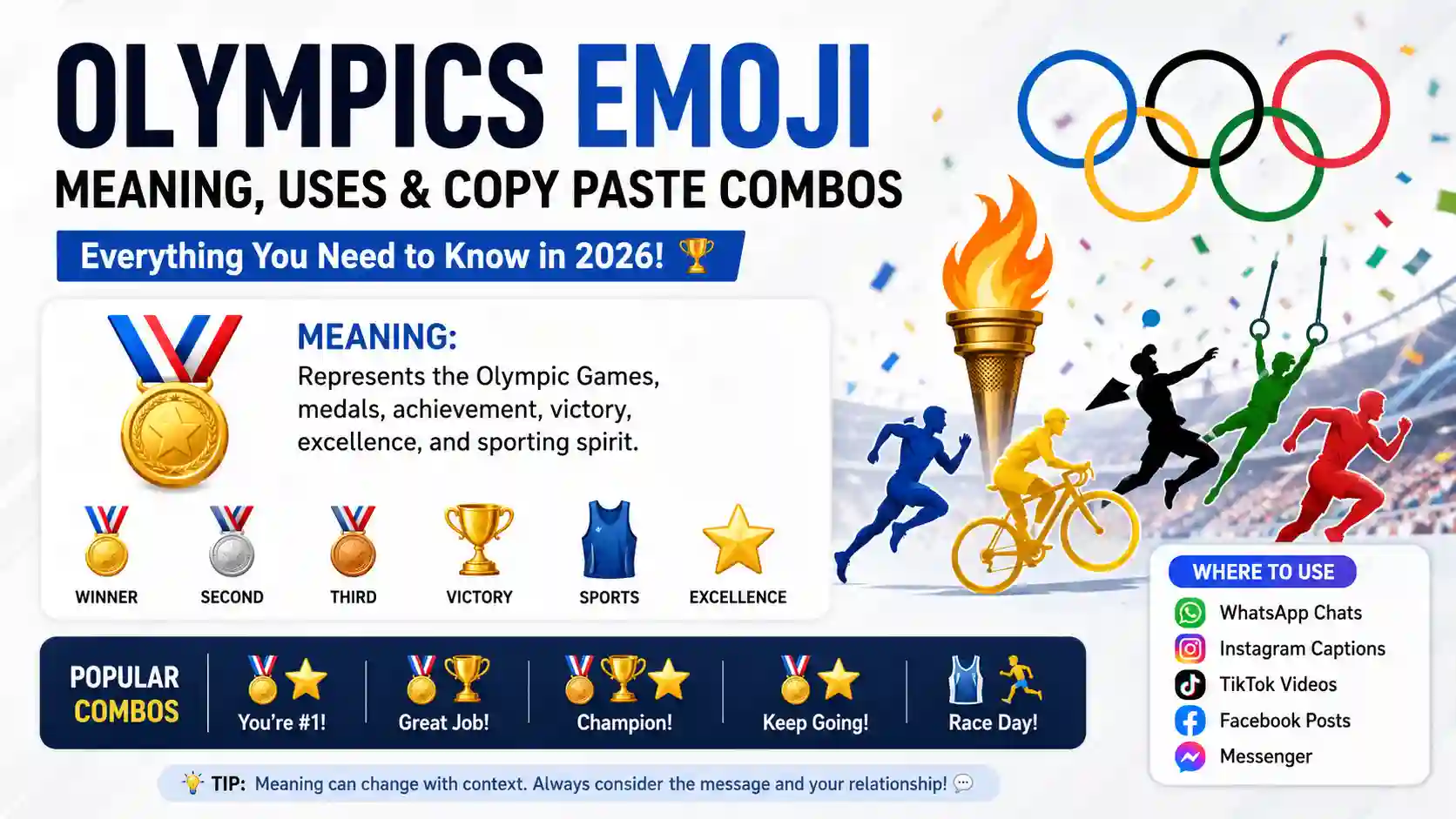
When someone searches for the Olympics emoji, they are usually looking for a simple way to represent the Olympic Games, athletic competition, winning, medals, achievement, or support for an athlete. There is not one universal emoji officially named “Olympics emoji.” Instead, people commonly use a small group of sports and medal emojis, especially 🏅, 🥇, 🥈, 🥉, and 🏆, depending on what they want to express. 🏅 can be particularly useful when you want a general medal or achievement feeling without saying exactly which place someone finished.
The meaning can change with context. A 🥇 in a friend’s message may mean “You are number one,” while the same symbol in an Instagram caption may celebrate an actual sporting achievement. On WhatsApp, it might simply show encouragement. In a TikTok comment, it can even be playful or ironic. Understanding the surrounding words is the key to reading these emoji symbols correctly.
Sometimes an Olympics-inspired emoji says “celebrate the achievement” without needing a whole speech. 🏅
What Does the Olympics Emoji Mean? 🏅
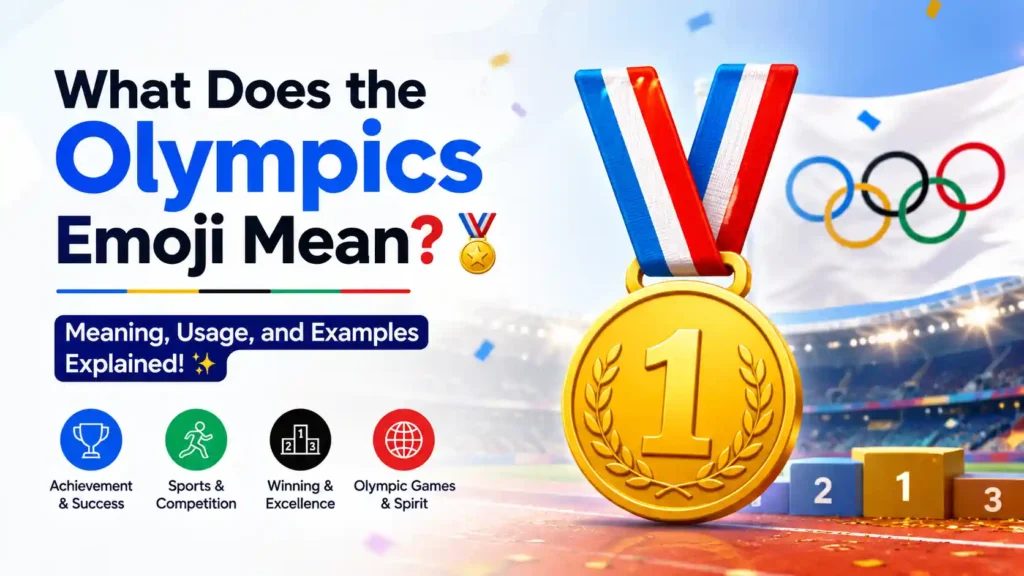
The Olympics emoji generally refers to emojis used to represent the Olympic Games, sporting competition, athletic achievement, medals, victory, and the excitement surrounding major international sporting events. Because there is no single standard emoji specifically depicting the Olympic rings, users normally choose related symbols that communicate the idea they have in mind. 🏅 is a strong general choice because it represents a sports medal and can suggest recognition, achievement, or participation. 🥇 is more specific and usually communicates first place or being the best, while 🥈 and 🥉 suggest second and third place.
In texting, these emojis can be encouraging. If a friend has finished a difficult race, you might say, “You crushed it! 🏅” The emoji adds celebration without making the message feel overly formal. On WhatsApp, a medal can also work in family chats, team conversations, or messages supporting someone who is preparing for a competition.
On Instagram and TikTok, Olympic-style emojis frequently appear in captions and comments about sports, fitness, competitions, personal goals, and impressive performances. A creator might use 🥇 to describe a personal milestone even when no actual competition is involved. For example, “Finally hit my goal 🥇” uses the medal as a metaphor for achievement.
Context still matters. A friend sending 🥇 after you finish an exam may mean “You did amazingly,” rather than anything related to sports. A sarcastic comment such as “Gold medal for being late 🥇” can reverse the tone and make the emoji humorous.
The relationship between sender and receiver matters too. A coach might use 🏅 as genuine encouragement, while a close friend might use 🥇 playfully. There is no single interpretation that applies to every conversation.
Meaning Table:
| Emoji | Core meaning | Possible misread | Best used when |
|---|---|---|---|
| 🏅 | Medal, achievement, recognition | Could seem generic | Celebrating effort or accomplishment |
| 🥇 | First place, excellence | Can sound competitive | Celebrating a win or top performance |
| 🥈 | Second place | May imply being “less than first” | Recognizing second place |
| 🥉 | Third place | May feel overly specific | Celebrating third place |
| 🏆 | Trophy, victory | Can imply winning | Celebrating a major achievement |
| 🎽 | Sports, athletics | May not suggest Olympics specifically | Talking about athletic activity |
| 🎖️ | Military medal, honor | Can be confused with sports medals | Discussing formal honors |
| 🎟️ | Ticket, event attendance | Not necessarily sports-related | Talking about attending an event |
| 📣 | Cheering, support | Can feel loud | Supporting athletes or teams |
| ⭐ | Excellence, standout performance | Not specifically Olympic | Highlighting an impressive achievement |
Emoji Cards:
🏅 Medal:
Meaning: Achievement, recognition, participation, or sporting success.
Example 1: Proud of how far you came 🏅
Example 2: What an incredible performance today 🏅
🥇 First Place Medal:
Meaning: Winning, first place, excellence, or being number one.
Example 1: You absolutely earned this 🥇
Example 2: Number one in my book 🥇
🥈 Second Place Medal:
Meaning: Second place, strong performance, and accomplishment.
Example 1: Silver medal and a huge achievement 🥈
Example 2: So proud of that finish 🥈
🥉 Third Place Medal:
Meaning: Third place and recognition for a successful performance.
Example 1: Bronze today, memories forever 🥉
Example 2: You gave it everything 🥉
🏆 Trophy:
Meaning: Victory, winning, success, and major achievement.
Example 1: Another big milestone reached 🏆
Example 2: This one deserves a celebration 🏆
🎽 Running Shirt:
Meaning: Athletics, sports activity, training, or an active lifestyle.
Example 1: Race day is finally here 🎽
Example 2: Training starts again tomorrow 🎽
🎖️ Military Medal:
Meaning: Honor, distinction, recognition, or a formal award.
Example 1: Honored for an incredible achievement 🎖️
Example 2: Recognition well deserved 🎖️
🎟️ Admission Ticket:
Meaning: Tickets, attendance, or going to an event.
Example 1: Got our tickets for the big event 🎟️
Example 2: Ready for an unforgettable day 🎟️
📣 Megaphone:
Meaning: Cheering, encouragement, loud support, or celebration.
Example 1: Let’s cheer them on! 📣
Example 2: Sending all my support today 📣
⭐ Star:
Meaning: Excellence, admiration, standout performance, or praise.
Example 1: You were the star of the day ⭐
Example 2: Absolutely outstanding performance ⭐
How to Use the Olympics Emoji the Right Way 🏅
The best way to use an Olympics-related emoji is to let the surrounding message explain the context. A medal can represent an actual sporting achievement, but it can also describe personal success, encouragement, or playful praise.
WhatsApp 💬
In personal chats, 🏅 works well when congratulating someone on a race, tournament, fitness goal, school competition, or difficult achievement. “You did it! 🏅” is short but encouraging.
In family conversations, it can celebrate someone’s accomplishment without sounding overly formal. A parent might use 🥇 after a child’s competition, while friends might use 🏆 after someone reaches a personal milestone.
For status updates, medal emojis can add a celebratory touch: “Months of training finally paid off 🏅.” The message makes it clear that the emoji represents achievement.
Instagram 📸
Instagram captions often use sports and medal emojis to frame accomplishments. A runner might write, “Race day complete 🏅,” while a fitness creator could use 🥇 to celebrate reaching a new personal best.
In comments, these emojis can work as quick reactions. Someone who posts about winning a competition might receive “Absolutely deserved 🥇” or “What a performance 🏆.”
They can also appear in aesthetic sports posts, training updates, reels, and achievement announcements. The emoji does not have to mean an official Olympic result. It can simply communicate excellence.
TikTok 🎽
On TikTok, Olympic-style emojis can be used seriously or humorously. A sports video may use 🥇 to highlight a winning moment, while a comedy creator might use it ironically after completing an everyday task.
For example, “Made it through Monday 🥇” turns the medal into a joke about surviving a difficult day. Comments such as “Gold medal energy 🥇” can praise someone’s confidence or performance.
On Facebook, these emojis fit posts about competitions, sports events, children’s achievements, fitness milestones, and celebrations. They also work in Messenger, where a simple 🏅 can add warmth to a congratulatory message.
Do’s and Don’ts:
Do:
- Use the emoji to support the meaning of your message. 🏅
- Consider your relationship with the receiver.
- Pay attention to the surrounding words.
- Match the emoji with the tone.
- Check how it appears across devices.
Don’t:
- Assume every medal emoji means the Olympic Games.
- Use 🥇 when you actually need to distinguish a different placement.
- Overload a serious message with sports symbols.
- Combine unrelated emojis without a reason.
- Assume an Olympic-style emoji automatically has a romantic meaning.
Why Do Olympics Emojis Look Different on iPhone and Android?
If an Olympics-related emoji looks slightly different on your phone compared with someone else’s device, that is normal. Emojis are represented through Unicode characters and standards, but companies create their own visual artwork for those characters. Apple, Google, Samsung, Microsoft, and other platforms can therefore display the same emoji with different shapes, proportions, colors, or details.
For example, 🏅 may have a slightly different medal design depending on the operating system. 🥇 can also vary in its shading, ribbon appearance, and overall visual style. The underlying emoji character remains the same even though the artwork changes.
This is especially important when discussing emoji meanings in chat. If someone sends an emoji from an iPhone to an Android phone, the receiver’s device normally renders that character using its own emoji font or design. The person did not necessarily send a different emoji.
The same principle applies across messaging and social media platforms. An emoji can look different in WhatsApp, Instagram, TikTok, Facebook, or another application because of platform rendering and design choices. Sometimes the differences are subtle, while occasionally they can make an expression appear slightly more cheerful, serious, large, or colorful.
There is no universally “correct” visual design for the emoji. What matters is the underlying Unicode character and the context in which it is used.
Best Olympics Emoji Combos, Copy & Paste 🏅
Romantic ❤️
1.👉 🥇⭐, Use this to playfully tell someone they are number one.
2.👉 🏅⭐, Use this for warm admiration and supportive praise.
3.👉 🏆🥇, Use this for a playful “winning together” message.
Cute 🥰
1.👉 🏅⭐, Use this after a cute little achievement.
2.👉 🥇🏅, Use this to celebrate someone’s adorable success.
3.👉 ⭐🏅, Use this for sweet encouragement after a proud moment.
Flirty 😉
1.👉 🥇⭐, Use this when teasing someone about being number one.
2.👉 🏆⭐, Use this for playful admiration.
3.👉 🥇🏆, Use this when joking that someone has won your attention.
Missing Someone 💭
1.👉 🏅⭐, Use this to support someone from a distance.
2.👉 🥇🏅, Use this when cheering for someone you cannot be there to watch.
3.👉 ⭐🏆, Use this for an encouraging message when someone is away.
Good Night 🌙
1.👉 🏅⭐, Use this after congratulating someone before bed.
2.👉 🥇🏅, Use this for a proud good-night message after competition day.
3.👉 🏆⭐, Use this when ending a celebratory day on a positive note.
Trending Olympics Emoji in 2026 🥇
In 2026, sports and achievement emojis continue to fit naturally into casual online communication, especially around competitions, fitness milestones, athletic content, and major sporting conversations. 🏅, 🥇, 🏆, and ⭐ are particularly useful because they can communicate achievement without requiring a long explanation.
Their appeal also comes from flexibility. Someone posting an actual competition result can use 🥇 literally, while another person can use it metaphorically to say that a friend did exceptionally well. This makes medal emojis useful beyond Olympic-specific conversations.
Creators commonly use these symbols in captions, comments, short-form videos, achievement posts, and everyday messages. The exact tone depends heavily on the surrounding words. “Gold medal performance 🥇” sounds like praise, while “Gold medal for procrastination 🥇” is clearly humorous.
| Emoji | Why trending | Who uses it | Platform |
|---|---|---|---|
| 🏅 | General achievement | Athletes, friends, creators | WhatsApp, Instagram |
| 🥇 | Excellence and winning | Sports fans, creators, friends | TikTok, Instagram |
| 🏆 | Major success | Teams, creators, communities | Facebook, Instagram |
| ⭐ | Praise and standout moments | General users, creators | All major platforms |
One broader trend is clear: emoji usage keeps becoming more contextual, with the same symbol moving easily between literal sports conversations, personal achievements, jokes, and social media reactions.
Olympics Emoji Meaning in Different Contexts:
The same Olympics-related emoji can communicate very different tones depending on the conversation.
Romantic conversations: A 🥇 can be playful when someone calls their partner “number one.” It does not automatically mean romance, but affectionate wording can give it that tone.
Friendship: Friends often use 🏅 or 🏆 to celebrate one another. “You actually finished it 🏆” can recognize a difficult achievement without sounding formal.
Family: Parents and relatives may use medal emojis to congratulate someone after a school event, race, competition, or personal milestone.
Professional or casual communication: In a professional setting, 🏅 may be appropriate in a friendly team chat after reaching a goal. In a formal business email, however, it may feel too casual unless the culture of the workplace supports emojis.
Texting: Short messages such as “You nailed it 🥇” rely on the words and emoji together. The emoji strengthens the praise rather than replacing the meaning.
Social media comments: A medal emoji can act as a quick reaction to a successful performance. On TikTok or Instagram, it may also be used humorously.
Captions: In a caption, 🏅 or 🏆 can summarize achievement, while 🥇 emphasizes being the best. A creator might use the same symbol literally for sport or metaphorically for an everyday accomplishment.
The safest approach is to read the entire message rather than interpreting the emoji by itself. Emoji meanings in chat are flexible, and personal communication often gives familiar symbols an individual tone.
How to Copy and Paste Olympics Emoji:
If you want a quick Olympics-style emoji for a message, you can copy one of these symbols:
🏅 🥇 🥈 🥉 🏆
Simply select the emoji, copy it, and paste it wherever you want. You can use it in WhatsApp messages, Instagram captions, TikTok comments, Facebook posts, Messenger chats, or other apps that support emojis.
If you want a general sports achievement symbol, 🏅 is a useful choice. If you specifically want to communicate first place, 🥇 is more precise. For a broader victory message, 🏆 can work well.
The important point is that there is no single official emoji character called “the Olympics emoji.” People choose from related sports and achievement symbols depending on the message they want to send.
FAQ:
1. What is the most popular Olympics emoji?
There is no single official emoji called the Olympics emoji. 🏅 and 🥇 are among the most natural choices for communicating medals, athletic achievement, competition, or Olympic-style celebration.
2. What does 🏅 mean when someone sends it?
It usually suggests achievement, recognition, sporting success, encouragement, or celebration. The meaning depends on the message and relationship rather than gender stereotypes or one fixed interpretation.
3. Why do emojis look different on iPhone vs Android?
Unicode provides the underlying emoji character, while companies such as Apple and Google create their own artwork. As a result, the same emoji can have different shapes, colors, or details across devices.
4. Are Olympics emojis used differently in other countries?
They can be interpreted differently depending on cultural context, community habits, and the conversation. However, the basic ideas of achievement, medals, competition, and celebration are often understandable across many online conversations.
Conclusion:
The Olympics emoji is best understood as a group of sports and achievement symbols rather than one single official character. 🏅, 🥇, and 🏆 can celebrate competition, effort, victory, or even everyday accomplishments.
Use the emoji that best matches your message, and let the surrounding words provide the context. 🥇

Nasrullah — Emoji Strategist & Content Writer
Nasrullah is a passionate emoji enthusiast and content writer who loves exploring the meanings, uses, and cultural context behind emojis. He creates simple, helpful, and easy-to-understand guides that help readers choose the right emoji for WhatsApp, Instagram, Facebook, texting, and everyday conversations.
With a focus on emoji meanings, combinations, social media usage, and modern digital communication, Nasrullah aims to make every emoji easier to understand and use with confidence. His content combines practical examples with clear explanations so readers can quickly find the meaning and usage they are looking for.
When he’s not researching emojis, Nasrullah enjoys exploring digital trends, writing useful online content, and learning about how people communicate in the digital world. 😊