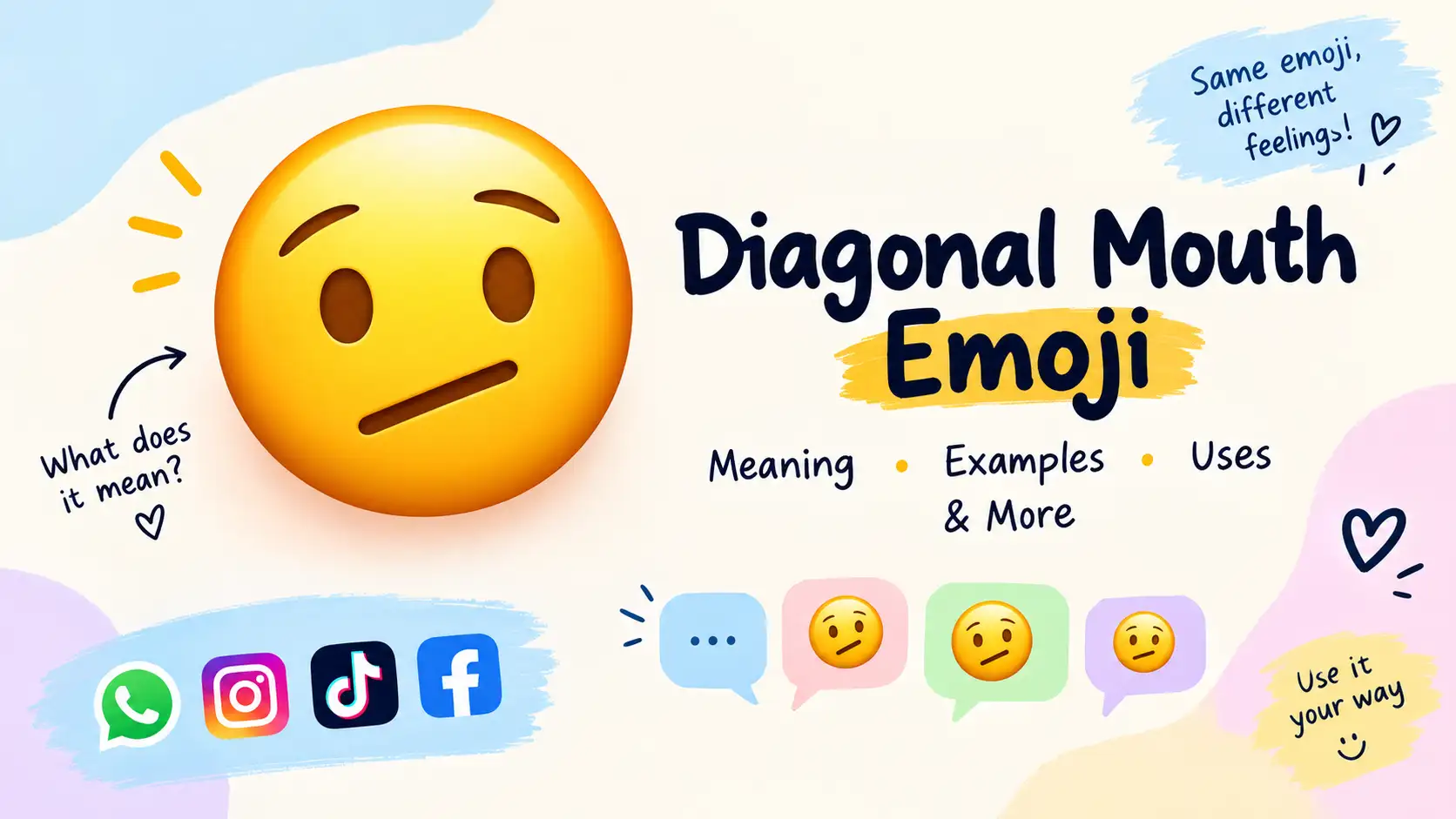
You send a message, realize it sounds a little awkward, and add 😬 to show what you really mean. Suddenly, the conversation feels less serious. The diagonal mouth emoji is often used to express nervousness, embarrassment, awkwardness, or discomfort without writing a long explanation. It can also show an uncomfortable reaction when something unexpected happens.
People search for the diagonal mouth emoji because its expression can be tricky to interpret. Is someone feeling embarrassed, reacting to bad news, joking about an awkward situation, or trying to soften a difficult message? The answer depends on the conversation.
On WhatsApp, it can make a personal message feel less tense. On Instagram and TikTok, it often fits funny, cringeworthy, or relatable moments. 😬 The same face may communicate nervous laughter, mild regret, or an uncomfortable smile, depending on who sends it and why.
In this guide, you will learn how to interpret the diagonal mouth emoji, use it naturally across social platforms, explore relevant combinations, and copy and paste it into your messages. Context is the key to understanding its tone.
Sometimes, 😬 says, “That was awkward,” without needing another word.
7. What Does the Diagonal Mouth Emoji 😬 Mean?
The diagonal mouth emoji 😬 is officially known as the Grimacing Face. It shows a face with a tense, toothy expression. People commonly use it to communicate awkwardness, nervousness, embarrassment, or discomfort. However, the expression does not always indicate a negative feeling.

In everyday texting, 😬 often means, “That feels awkward,” “I am nervous about this,” or “Oops, that did not go as planned.” For example, if a friend tells you they accidentally sent a private message to the wrong person, replying with 😬 can express sympathy and secondhand embarrassment.
The emoji can also soften an uncomfortable statement. Imagine telling someone, “I completely forgot our meeting 😬.” The face acknowledges the mistake and makes the message feel less blunt.
Here are a few related facial expressions that can help clarify the tone:
- 😬 Awkwardness: Useful when something feels uncomfortable or embarrassing.
- 😅 Nervous relief: Often suggests that a stressful moment ended better than expected.
- 😳 Shock or embarrassment: Fits surprising news or an unexpectedly personal situation.
- 🙃 Playful irony: Can suggest sarcasm, mixed feelings, or pretending everything is fine.
- 😐 Neutral reaction: Works when you feel unimpressed or have little to say.
- 😟 Worry: Communicates concern about a situation or its possible outcome.
On social media, 😬 frequently appears in reaction comments, funny captions, and posts about relatable mistakes. Someone might use it after watching an awkward interview or reading an embarrassing confession. It can communicate a reaction without explaining every detail.
Still, the emoji does not have one fixed emotional meaning. A close friend might use it playfully, while a coworker might use it to acknowledge a genuine mistake. Someone you like could send it after an awkward compliment, but that alone does not prove romantic interest.
Your best clue is the surrounding message. Consider the words, the relationship, the conversation’s mood, and the sender’s usual style before deciding what 😬 means.
8. Diagonal Mouth Emoji Meaning Table
The following table compares the main expression with closely related faces. These distinctions can help you choose the right emoji for your message.
| Emoji | Core meaning | Possible misread | Best used when |
|---|---|---|---|
| 😬 | Awkwardness or tension | Anger or disgust | Something feels uncomfortable |
| 😅 | Nervous laughter or relief | Ordinary happiness | You escaped a tricky situation |
| 😳 | Surprise or embarrassment | Fear or confusion | Something catches you off guard |
| 🙃 | Irony or playful frustration | Genuine happiness | You want a joking, opposite-tone reaction |
| 😐 | Neutrality or disapproval | Rudeness | You have little to say |
| 😶 | Speechlessness | Indifference | You are unsure how to respond |
| 😟 | Concern or worry | Sadness alone | Something genuinely worries you |
| 🙂 | Mild friendliness | Hidden annoyance | You want a restrained, polite response |
| 😁 | Excitement or a broad smile | Nervousness | You feel cheerful or enthusiastic |
| 🫣 | Shyness or apprehension | Fear | You are nervous to look or react |
| 😔 | Disappointment or sadness | Anger | Something has let you down |
9. 10 Emoji Cards
These related facial expressions can help you communicate different reactions without changing the general theme of the conversation.
😬 Grimacing Face
Meaning: Awkwardness, nervousness, or discomfort.
Example 1: I just waved at someone who was waving at the person behind me 😬
Example 2: I forgot to reply for three days 😬
😅 Grinning Face with Sweat
Meaning: Nervous laughter, relief, or a slightly embarrassing moment.
Example 1: I finished the assignment one minute before the deadline 😅
Example 2: That was close, but everything worked out 😅
😳 Flushed Face
Meaning: Surprise, embarrassment, or feeling caught off guard.
Example 1: You remembered that tiny detail about me 😳
Example 2: They just called my name in front of everyone 😳
🙃 Upside-Down Face
Meaning: Playful irony, awkward humor, or mixed feelings.
Example 1: Another Monday, exactly what I needed 🙃
Example 2: My computer crashed just before I saved the file 🙃
😐 Neutral Face
Meaning: A restrained, neutral, or unimpressed reaction.
Example 1: He told the same joke for the fifth time 😐
Example 2: The meeting could have been an email 😐
😶 Face Without Mouth
Meaning: Speechlessness or not knowing what to say.
Example 1: I honestly have no response to that 😶
Example 2: You did what during the interview? 😶
😟 Worried Face
Meaning: Concern, uneasiness, or uncertainty.
Example 1: I have not received the results yet 😟
Example 2: I hope everyone gets home safely 😟
🙂 Slightly Smiling Face
Meaning: Mild friendliness, politeness, or restrained happiness.
Example 1: Thanks for letting me know 🙂
Example 2: Sure, we can discuss it tomorrow 🙂
😁 Beaming Face with Smiling Eyes
Meaning: Cheerfulness, excitement, or enthusiastic happiness.
Example 1: I finally passed my driving test 😁
Example 2: We are meeting again this weekend 😁
🫣 Face with Peeking Eye
Meaning: Shyness, apprehension, or nervous curiosity.
Example 1: I am too nervous to check the results 🫣
Example 2: I posted the video, and now I am waiting for reactions 🫣
10. How to Use the Diagonal Mouth Emoji the Right Way
The diagonal mouth emoji works best when it supports the tone of your message. It can make an awkward confession feel lighter, show sympathy for an embarrassing moment, or express discomfort without sounding overly dramatic.
WhatsApp 💬
On WhatsApp, 😬 is useful in private conversations where the other person already understands your sense of humor.
- Personal chats: “I think I misunderstood what you meant 😬”
- Family conversations: “I told everyone the surprise before the party 😬”
- Friendships: “I accidentally liked a picture from five years ago 😬”
- Emotional messages: “I do not know how to explain what happened 😬”
- Status updates: “When you remember the deadline at midnight 😬”
With close friends, the face can create a lighthearted moment. In a serious family conversation, however, it might seem dismissive if the issue deserves a sincere apology. Choose your wording carefully.
Instagram 📸
Instagram emojis help communicate reactions in captions, comments, bios, and Reels. The grimacing face is particularly suitable for humorous or relatable situations.
- Captions: “That moment when your plan goes completely wrong 😬”
- Comments: “Watching this happen was painful 😬”
- Reels: Add it to a caption about a social mistake or unexpected mishap.
- Aesthetic posts: Use it sparingly when the post has a humorous or self-aware tone.
- Bios: It can add a playful touch to a personal bio, although it is less suitable for a polished professional profile.
For example, a creator might caption a video about forgetting their lines with “The confidence was there. The memory was not 😬.” The emoji helps readers recognize the humor.
TikTok 🎵
TikTok often features reactions to embarrassing stories, uncomfortable moments, and unexpected situations. The diagonal mouth emoji can fit these formats naturally.
- Captions: “Me realizing I misunderstood the assignment 😬”
- Comments: “The silence afterward was unreal 😬”
- Reactions: Use it when a video makes you feel secondhand embarrassment.
- Humor and irony: Pair it with a short line about a plan going wrong.
It can also appear in relatable storytelling videos. However, avoid assuming that every creator using 😬 is genuinely uncomfortable. Sometimes the expression is deliberately exaggerated for comedy.
On Facebook, the emoji works in posts, comments, Messenger conversations, and everyday reactions. You might use it to acknowledge a small mistake, respond to an awkward family story, or share a funny personal experience.
For example, “I accidentally posted that in the wrong group 😬” communicates embarrassment while keeping the message casual.
When discussing a serious disagreement, use clear words alongside the emoji. Facial symbols cannot replace a sincere explanation, apology, or expression of concern.
11. Dos and Don’ts
A little thought can make emoji communication clearer.
Do
- Use 😬 to support an awkward or nervous message.
- Consider your relationship with the recipient before adding humor.
- Read the surrounding conversation to understand the intended tone.
- Match the expression to the situation. For example, 😅 may suit relief better than 😬.
- Remember that device designs can vary slightly.
Don’t
- Add 😬 randomly when it does not match your message.
- Assume every recipient interprets facial emojis in the same way.
- Use it to make a serious apology appear unimportant.
- Combine it with unrelated expressions without a clear reason.
- Assume it automatically signals attraction, flirting, or romantic interest.
The goal is not to use more emojis. It is to make your meaning easier to understand.
12. Why Does the Diagonal Mouth Emoji Look Different on iPhone and Android?
Have you ever sent 😬 to a friend and noticed that it looks slightly different on their phone? That is normal.
Emojis are encoded using Unicode standards, which allow supported devices and applications to recognize the same underlying character. However, Unicode does not require every company to draw each emoji identically.
Apple, Google, Samsung, Microsoft, and other platform providers create their own visual designs. As a result, the grimacing face may have slightly different teeth, mouth shapes, colors, shading, or proportions depending on the device and software.
For example, the expression might look more tightly clenched on one platform and somewhat more exaggerated on another. One design may appear more nervous, while another might seem more uncomfortable. These small differences can influence how a person interprets the face.
Size and style also vary. An emoji displayed inside an iPhone messaging app might look different from the same character shown in a web browser or social media application on an Android phone.
The underlying character can still be the same even when its appearance changes. This is why an emoji should not be treated as a perfectly identical picture across every device.
If a conversation is sensitive, rely on clear wording rather than expecting the recipient to interpret a particular facial expression exactly as you intended. A simple sentence explaining your reaction can prevent confusion.
13. Best Diagonal Mouth Emoji Combos: Copy and Paste
The diagonal mouth emoji is especially useful for awkward, nervous, shy, or humorous situations. The combinations below use related facial expressions to create different tones.
Romantic ❤️
These combinations suit nervous compliments, shy messages, and uncertain romantic moments.
- 👉 😬😳: Use this when a compliment leaves you feeling embarrassed.
- 👉 😳🙂: Send this after a sweet message catches you off guard.
- 👉 🫣😬: Use this when you feel nervous about expressing your feelings.
Cute 🥰
These combinations fit playful embarrassment and shy reactions.
- 👉 😅😁: Use this after a funny mistake turns into a happy moment.
- 👉 🫣🙂: Send this when you feel shy but want to respond warmly.
- 👉 😳😁: Use this when surprise quickly turns into excitement.
Flirty 😉
These combinations suit playful teasing when both people are comfortable with that tone.
- 👉 😬🙃: Use this for an awkward but playful response.
- 👉 😳🫣: Send this after a teasing compliment makes you blush.
- 👉 🙂😬: Use this when you are trying to sound casual despite feeling nervous.
Missing Someone 💭
These combinations fit uncertainty, emotional hesitation, and nervous attempts to reconnect.
- 👉 😔😬: Use this when you miss someone but feel awkward reaching out.
- 👉 🫣😳: Send this when you are nervous about starting a conversation.
- 👉 😶😔: Use this when you have feelings you find difficult to express.
Good Night 🌙
These combinations work for shy sign-offs and conversations that end on a slightly awkward note.
- 👉 😅🙂: Use this after a funny late-night conversation.
- 👉 🫣😬: Send this when you feel embarrassed about something you said.
- 👉 😁🙂: Use this to end a cheerful conversation on a friendly note.
These are suggested combinations, not official emoji definitions. Pick the one that fits the relationship and message, and add words if the intended meaning might be unclear.
14. Trending Diagonal Mouth Emoji in 2026
The diagonal mouth emoji remains useful in everyday digital communication because awkward situations are easy to recognize and often make relatable content. However, its popularity in a particular community does not establish that it is officially trending or ranked above other emojis.
Here are four related expressions and how they can appear in online conversations during 2026.
😬 The Awkward Reaction
This face suits embarrassing confessions, uncomfortable pauses, and unexpected mistakes. It commonly fits reaction comments, personal messages, and short captions about things going wrong.
Creators may use it when telling a story about a social mishap. Friends may send it when they understand exactly why a situation feels uncomfortable.
😅 The Nervous Laugh
This expression is useful when a stressful moment becomes funny or ends in relief. It can appear in messages about deadlines, close calls, minor mistakes, and situations that could have gone worse.
Its tone often feels lighter than a tense grimace, although context still matters.
🙃 The Ironic Response
The upside-down face can add playful irony to comments and captions. Someone might use it when describing a frustrating day with exaggerated positivity.
It is particularly helpful when the written words sound cheerful but the context suggests the opposite.
🫣 The Shy Reaction
This face can express nervous curiosity, embarrassment, or hesitation. It fits posts about checking results, sharing something personal, or waiting to see how others react.
People may use it in comments, private messages, and relatable videos.
| Emoji | Why trending | Who uses it | Platform |
|---|---|---|---|
| 😬 | Relatable awkward moments | Friends and casual creators | WhatsApp, Instagram, TikTok |
| 😅 | Nervous humor and relief | Students, coworkers, everyday users | WhatsApp, Facebook |
| 🙃 | Ironic reactions | Humor fans and social media users | Instagram, TikTok |
| 🫣 | Shy anticipation | Friends and personal-content creators | WhatsApp, Instagram |
These examples describe common communication patterns, not verified platform rankings or measured trends. Emoji usage continues to evolve as communities develop new ways to express humor, discomfort, and emotion online.
15. Diagonal Mouth Emoji Meaning in Different Contexts
The same emoji can communicate different feelings depending on who sends it, what happened, and how the conversation is progressing.
Romantic Conversations
When someone you like sends 😬, they might feel nervous about a compliment, embarrassed by a confession, or unsure how to respond.
For example, “I wanted to tell you this for a while 😬” could suggest hesitation. However, it is not reliable proof of romantic interest. Look at the actual words and the broader relationship.
Friendship
Friends often use the face to acknowledge silly mistakes or uncomfortable situations.
Example: “I just called our teacher Mom 😬.”
Here, the emoji helps turn an embarrassing moment into shared humor.
Family
Family members may use it when admitting a mistake, explaining an awkward encounter, or reacting to unexpected news.
Example: “I forgot to bring the cake we promised everyone 😬.”
Depending on the situation, the face can soften the admission. For serious mistakes, follow it with a clear explanation.
Professional and Casual Communication
Among familiar coworkers, 😬 can acknowledge a small mishap or an uncomfortable meeting.
Example: “I sent the earlier draft instead of the final version 😬.”
In formal communication, however, a direct explanation is usually more useful than relying on an emoji. Keep your tone appropriate for the workplace.
Texting and Social Media Comments
In texting, the expression may be a quick reaction to something surprising or uncomfortable. In public comments, it may communicate secondhand embarrassment about a video or story.
Example: “That pause after the question 😬.”
The surrounding content determines whether the reaction is playful, sympathetic, or critical.
Captions
A caption can use 😬 to make a personal mistake feel relatable.
Example: “When you rehearse what to say and forget every word the moment you arrive 😬.”
The expression gives readers a visual clue about the intended humor without requiring a lengthy explanation.
16. How to Copy and Paste the Diagonal Mouth Emoji
Want to use the diagonal mouth emoji in your next message? Copy it directly from this line.
Copy the emoji
😬
Grimacing Face Copy 😬
Follow these simple steps:
- Select the emoji above and copy it, or use the copy button.
- Open WhatsApp, Instagram, TikTok, Facebook, or your preferred messaging app.
- Tap the message, caption, comment, or status field.
- Paste the emoji where you want it.
- Add a few words if the expression needs more context, then send or publish your message.
You can also find the face in your phone’s emoji keyboard by searching for a term such as “grimacing” or browsing the facial-expression category.
The emoji may look slightly different after you paste it, depending on the application and device. Its basic character remains recognizable across supported platforms.
17. Frequently Asked Questions
1. What is the most popular diagonal mouth emoji?
The primary emoji associated with this keyword is 😬, known as the Grimacing Face. There is no verified universal ranking that establishes it as the most popular version of this expression.
2. What does 😬 mean when someone sends it?
It often communicates awkwardness, nervousness, embarrassment, or discomfort. The intended meaning depends on the message, relationship, and situation, rather than the sender’s gender.
3. Why do emojis look different on iPhone vs Android?
Unicode provides a common character standard, while Apple, Google, Samsung, and other companies design their own emoji artwork. The expression may look different even when the underlying character is the same.
4. Are diagonal mouth emojis used differently in other countries?
Interpretations can vary across languages, cultures, and online communities. Some people use 😬 mainly for awkwardness, while others use it humorously or to soften a mistake. Consider the local conversation and the sender’s usual style.
18. Conclusion
The diagonal mouth emoji 😬 is a handy way to express awkwardness, nervousness, and uncomfortable humor in everyday conversations. Its meaning becomes clearer when you consider the message and your relationship with the sender.
Use it naturally in chats, captions, and comments, and add words when your feelings might be misunderstood. A little context can make every emoji more meaningful.

Nasrullah — Emoji Strategist & Content Writer
Nasrullah is a passionate emoji enthusiast and content writer who loves exploring the meanings, uses, and cultural context behind emojis. He creates simple, helpful, and easy-to-understand guides that help readers choose the right emoji for WhatsApp, Instagram, Facebook, texting, and everyday conversations.
With a focus on emoji meanings, combinations, social media usage, and modern digital communication, Nasrullah aims to make every emoji easier to understand and use with confidence. His content combines practical examples with clear explanations so readers can quickly find the meaning and usage they are looking for.
When he’s not researching emojis, Nasrullah enjoys exploring digital trends, writing useful online content, and learning about how people communicate in the digital world. 😊