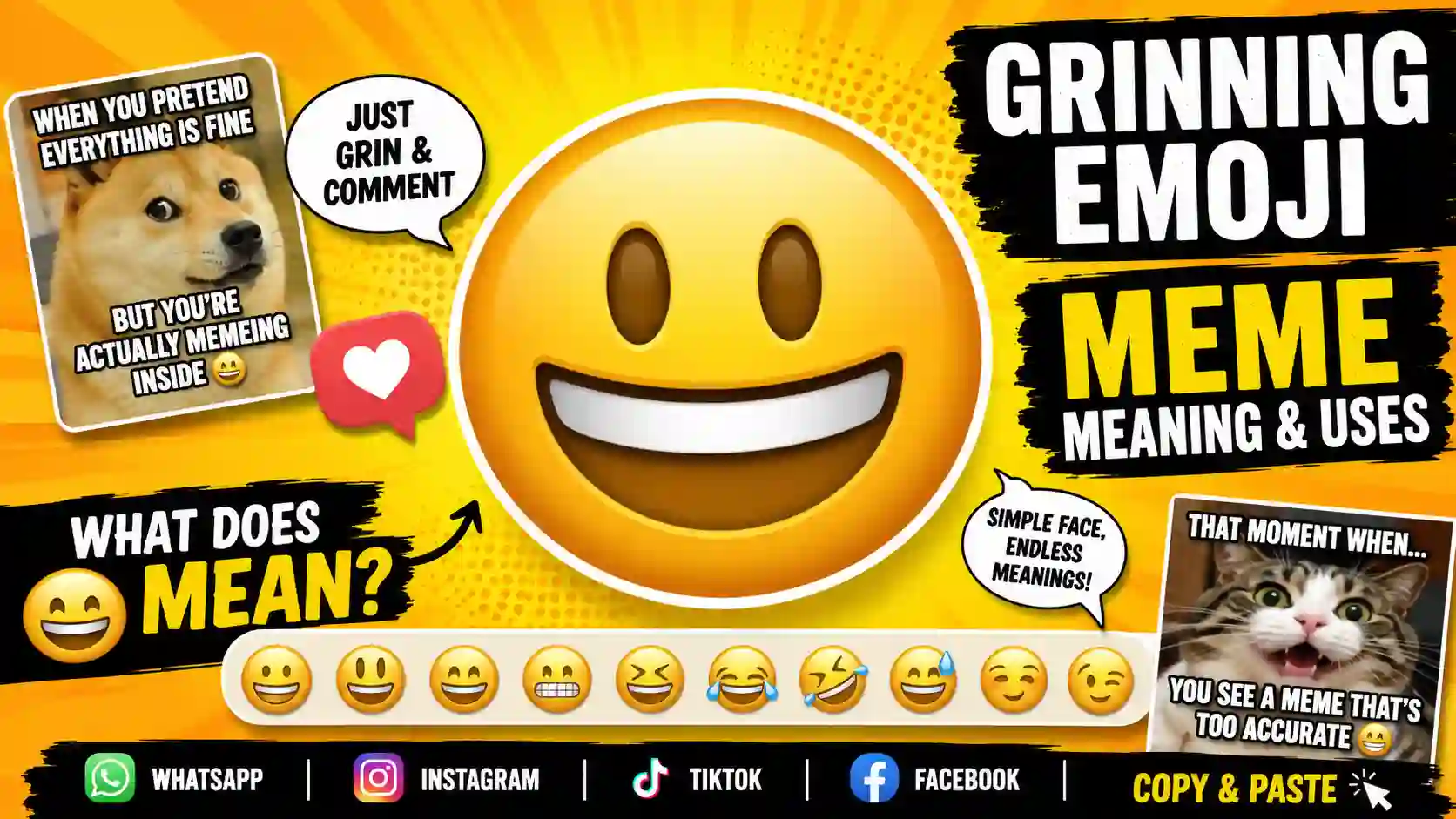
You may see 😀 in a post that is genuinely happy, sarcastic, awkward, or deliberately absurd. That is what makes the grinning emoji meme so useful online: the face itself looks cheerful, but the surrounding text can completely change the joke. The standard 😀 Grinning Face has a broad open smile and is commonly associated with good cheer, pleasure, or humor. It is also distinct from nearby faces such as 😃 and 😄, which use different eye expressions.
In texting, 😀 can make a plain sentence feel lighter. On WhatsApp, it can soften a reply. On Instagram and TikTok, it can become part of a reaction meme where the contrast between innocent-looking happiness and a ridiculous situation creates the humor. Context matters, especially when someone is obviously exaggerating. The sender’s wording, your relationship, the platform, and even the visual design you see can all influence how the grinning emoji meme lands.
What does grinning emoji meme mean?
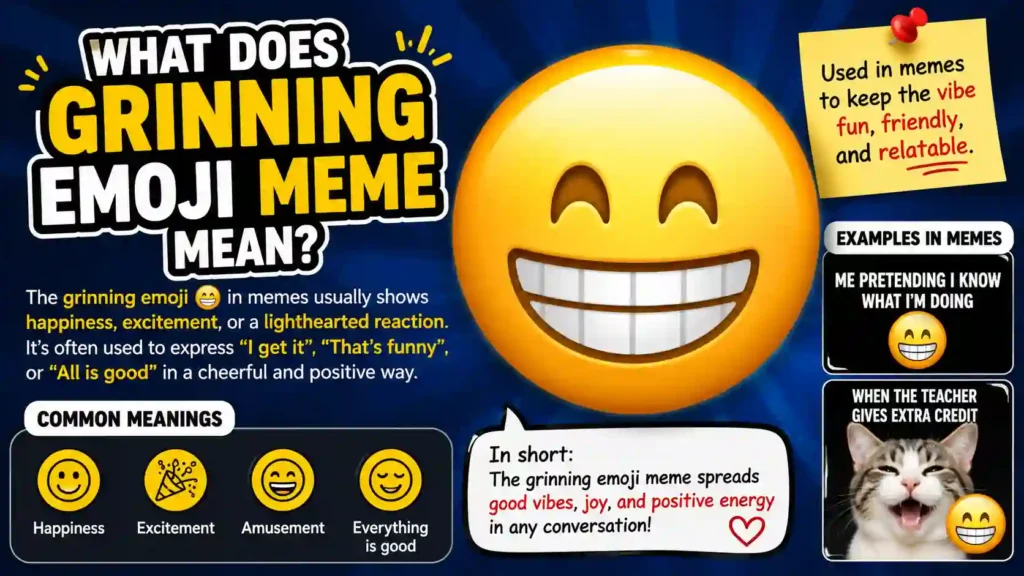
At its simplest, the grinning emoji meme centers on 😀, a cheerful face with an open smile. Its standard interpretation is broad happiness, friendliness, pleasure, or light humor. But meme culture gives that smile extra flexibility. A post can use 😀 sincerely, or place it beside an obviously bad situation to create deadpan comedy.
In texting, “I totally forgot 😃” may sound playful, while “I totally forgot 😀” can look deliberately blunt or comically calm. 😄 often feels warmer because its smiling eyes make the expression more obviously cheerful. 😁 can look more enthusiastic or toothy, while 😆 and 😂 push the mood toward laughter. 🙂 is subtler and can even sound ironic depending on the message.
The grinning emoji meme can therefore represent positive energy, awkward cheerfulness, exaggerated confidence, or a joke built around emotional contrast. If a friend sends “Great, another meeting 😀,” the emoji might signal that they are joking rather than celebrating. If someone sends “You did it! 😀,” the same character is much more likely to communicate genuine excitement.
Relationship matters too. From a close friend, 😀 can be casual and silly. From a romantic interest, it is usually friendly rather than automatically romantic. In a work chat, it can soften a short response, although a simple smile may still be interpreted differently by different people. Culture and online communities can also shape how a face is read.
The important point is that no emoji has one universal emotional translation. The grinning emoji meme works because users understand the surrounding sentence and the social situation. That is why a cheerful face can become funny, sarcastic, wholesome, awkward, or intentionally absurd without changing its underlying character.
Meaning Table:
| Emoji | Core meaning | Possible misread | Best used when |
|---|---|---|---|
| 😀 | Cheerful grin | Forced happiness | Simple positive reactions |
| 😃 | Open happiness | Overexcited tone | Bright, upbeat replies |
| 😄 | Warm happiness | Too enthusiastic | Friendly encouragement |
| 😁 | Big grin | Showing off | Excitement or playful pride |
| 😆 | Strong amusement | Loud reaction | Funny moments |
| 😂 | Laughter | Overreaction | Something is genuinely hilarious |
Emoji Cards
😀 Grinning Face:
Meaning: General happiness, good cheer, or playful humor.
Example 1: That actually worked 😀
Example 2: Me pretending I know what I’m doing 😀
😃 Grinning Face with Big Eyes:
Meaning: Bright happiness, excitement, and good-natured amusement.
Example 1: We finally made it 😃
Example 2: You remembered my birthday 😃
😄 Grinning Face with Smiling Eyes:
Meaning: Warm, friendly happiness with a more expressive smile.
Example 1: So happy for you 😄
Example 2: That was such a good surprise 😄
😁 Beaming Face with Smiling Eyes:
Meaning: A broad, enthusiastic grin that can show excitement or pride.
Example 1: I got the tickets 😁
Example 2: Look who finally finished the project 😁
😆 Grinning Squinting Face:
Meaning: Strong amusement, excitement, or hearty laughter.
Example 1: That video got me 😆
Example 2: You really said that out loud 😆
😅 Grinning Face with Sweat:
Meaning: Nervous laughter, relief, or an awkward but humorous moment.
Example 1: I nearly missed the deadline 😅
Example 2: That could have gone badly 😅
😂 Face with Tears of Joy:
Meaning: Strong laughter or a reaction to something very funny.
Example 1: I cannot stop laughing 😂
Example 2: Your caption is perfect 😂
🤣 Rolling on the Floor Laughing:
Meaning: Extremely strong laughter or exaggerated amusement.
Example 1: That meme is ridiculous 🤣
Example 2: I’m still laughing at this 🤣
🙂 Slightly Smiling Face:
Meaning: A mild, friendly smile that can also become ironic in context.
Example 1: Sure, I’ll try again 🙂
Example 2: Everything is totally fine 🙂
😉 Winking Face:
Meaning: Playfulness, joking, flirtation, or a hidden humorous tone.
Example 1: You know what I mean 😉
Example 2: Maybe I planned it that way 😉
How to use grinning emoji meme the right way
WhatsApp 💬
On WhatsApp, 😀 works best when the words already establish the mood. In a personal chat, “That was fun 😀” is an easy cheerful response. In a family group, it can make a short answer feel friendlier. In a joke between friends, the same face can become deliberately deadpan: “Yep, I definitely read the instructions 😀.” For status updates, a single 😀 can make a simple win or everyday moment feel upbeat.
If the message is emotional or serious, use the grinning emoji meme carefully. A smile placed after bad news can make the sentence look dismissive. When the goal is humor, the surrounding wording should give the receiver enough context to understand the joke.
Instagram 📸
Instagram gives 😀 a more public, performative role. It can appear in captions, comments, Reels descriptions, or casual replies. A creator might use it after a deliberately ridiculous statement to make the humor obvious. In comments, 😀 can react to a funny reveal without needing a full sentence.
For meme posts, the contrast is especially useful. A perfectly cheerful 😀 beside an exaggerated complaint can communicate, “I know this is ridiculous.” It can also work in a caption when the creator wants a casual rather than dramatic tone.
TikTok 🎵
TikTok comments often depend on quick emotional signals, so 😀 can function as a compact reaction. It can accompany an unexpected moment, a relatable joke, or an intentionally awkward situation. The face may also appear in ironic comments where the written words and cheerful expression clash for comic effect.
On Facebook, 😀 can fit posts, comments, and Messenger conversations. It is useful for congratulations, friendly reactions, jokes, and casual updates. The main rule is the same across platforms: let the words and situation establish whether the grin is sincere or ironic.
Do and don’t:
Do:
- Use 😀 to support the tone of your message.
- Consider who will receive it.
- Let the context explain a meme or joke.
- Match the expression to the seriousness of the conversation.
- Remember that platform designs can look slightly different.
Don’t:
- Assume 😀 always means happiness.
- Add it to sensitive news without thinking about tone.
- Treat an emoji as automatically romantic.
- Mix unrelated emojis just to make a message look busy.
- Assume everyone will understand the same meme reference.
Why does grinning emoji meme look different on iPhone and Android?
The character 😀 is standardized through Unicode, but Unicode does not dictate one exact colorful picture for every phone. Platform vendors create their own emoji artwork, so Apple, Google, Samsung, Microsoft, and others can give the same character different visual details. Unicode itself says it does not control the emoji images used by platform vendors.
That means the smile can vary in shape, eye size, shading, mouth details, proportions, and overall style. One device may make 😀 look especially wide and cheerful, while another may make it appear flatter or more cartoon-like. These differences do not normally mean that you sent a different emoji.
The same idea applies to nearby faces. 😃 and 😄 have their own Unicode identities, but each vendor draws them according to its design language. Emojipedia notes that 😀 is a broad open smile, while 😃 uses more expressive eyes.
This matters for grinning emoji memes because meme humor often depends on facial appearance. A slightly different grin can make a reaction look warmer, stranger, or more exaggerated. If a joke seems different on your phone than on a friend’s phone, the artwork may be contributing to that feeling.
So there is no single platform that displays the “correct picture.” The underlying character is the same, while the artwork belongs to the platform or font system rendering it.
Best grinning emoji meme combos, copy & paste
Romantic ❤️
😀😉: A playful, lighthearted romantic reply.
😄😉: Use when teasing someone you like.
😁😄: A cheerful combination for sharing excitement together.
Cute 🥰
😃😄: A bright, happy reaction.
😀😌: A calm, content little smile.
😁🙂: A sweet grin with a softer finish.
Flirty 😉
😉😀: Playful teasing without making the message too intense.
😄😉: Friendly flirtation with a cheerful tone.
😁😉: A confident, joking response.
Missing Someone 💭
😀😌: A warm way to say you are thinking positively about them.
😄🙂: A gentle, friendly check-in.
😅😀: Use when missing someone but keeping the message playful.
Good Night 🌙
😀😌: A cheerful but relaxed good-night mood.
😄🙂: A soft, friendly sign-off.
😁😌: A happy ending to a fun conversation.
Trending grinning emoji meme in 2026:
In 2026, the grinning emoji meme fits the wider style of casual, reaction-driven online communication. Rather than relying on one official ranking, it is more useful to look at how familiar smileys are commonly used in captions, comments, private chats, and meme formats. 😀 remains especially recognizable because its broad smile is easy to read quickly, while 😆, 😂, and 😉 can change the emotional direction of a joke.
Creators often use 😀 when they want an intentionally innocent reaction. That makes it useful for contrast humor: the text may describe chaos, embarrassment, or an obviously questionable decision while the face stays cheerful. 😆 and 😂 are more direct when the goal is unmistakable laughter, while 😉 can introduce a teasing or knowing tone.
| Emoji | Why trending | Who uses it | Platform |
|---|---|---|---|
| 😀 | Simple meme-friendly grin | General users | TikTok, Instagram |
| 😆 | Strong reaction energy | Meme viewers | TikTok, comments |
| 😂 | Clear laughter signal | Friends and creators | WhatsApp, Facebook |
| 😉 | Teasing and irony | Casual users | Instagram, chats |
The broader lesson is that emoji usage keeps shifting with online humor, even when the underlying characters stay familiar. The same smile can feel wholesome in one post and completely ironic in another.
Grinning emoji meme meaning in different contexts
In a romantic conversation, 😀 is usually friendly and positive rather than automatically flirtatious. If someone writes “I’d love to see you again 😀,” the grin can make the invitation feel relaxed. If the message already contains obvious teasing, 😀 may simply reinforce the joke.
Among friends, the grinning emoji meme can become much more sarcastic. “Perfect, another 8 a.m. class 😀” might mean the exact opposite of what the literal smile suggests. Shared humor makes this kind of contrast easier to understand.
In family chats, 😀 is often straightforward. It can accompany congratulations, good news, or a funny everyday update. In professional or semi-professional communication, a simple grin can soften a short message, but it is better to consider the relationship and workplace culture first.
In social media comments, context becomes even more important because readers do not have the same private history as friends. A meme may rely on exaggeration, irony, or a shared trend. In captions, 😀 can make an intentionally dramatic statement feel self-aware.
The safest approach is to read the entire message rather than translating the emoji alone. The same character can express happiness, awkward humor, irony, or simple friendliness depending on the words around it.
How to copy and paste grinning emoji meme:
Copy this emoji: 😀
On a phone or computer, select the character, copy it, and paste it wherever you want. It can be used in WhatsApp messages, Instagram captions and comments, TikTok comments, Facebook posts, Messenger chats, and other supported text fields.
You can also combine it with nearby smileys when the extra expression helps clarify your tone. For example, 😀 feels broadly cheerful, while 😂 makes laughter much more obvious and 😉 can signal playful teasing.
FAQs:
1. What is the most popular grinning emoji meme?
😀 is the primary grinning face behind this phrase because it has a simple, recognizable open smile. Its meme meaning depends heavily on the surrounding text and situation.
2. What does 😀 mean when someone sends it?
It can mean happiness, friendliness, humor, relief, or playful irony. Do not assume a romantic meaning based only on the emoji. The sender’s words and your relationship matter.
3. Why do emojis look different on iPhone vs Android?
Unicode standardizes the character, but platform vendors design their own emoji artwork. As a result, the same emoji can have different shapes, shading, or facial details on different devices.
4. Are grinning emoji memes used differently in other countries?
They can be. Online communities and cultural communication styles can influence how irony, enthusiasm, or friendliness is expressed. It is better to read the local context than assume one interpretation applies everywhere.
Conclusion
The grinning emoji meme is a good example of how a simple 😀 can carry more than one tone. It can be cheerful, playful, awkward, or intentionally ironic depending on the words and situation. Use the surrounding context as your guide, especially in jokes and public comments. A little thought can make your emoji reactions clearer and more fun. 😄

Nasrullah — Emoji Strategist & Content Writer
Nasrullah is a passionate emoji enthusiast and content writer who loves exploring the meanings, uses, and cultural context behind emojis. He creates simple, helpful, and easy-to-understand guides that help readers choose the right emoji for WhatsApp, Instagram, Facebook, texting, and everyday conversations.
With a focus on emoji meanings, combinations, social media usage, and modern digital communication, Nasrullah aims to make every emoji easier to understand and use with confidence. His content combines practical examples with clear explanations so readers can quickly find the meaning and usage they are looking for.
When he’s not researching emojis, Nasrullah enjoys exploring digital trends, writing useful online content, and learning about how people communicate in the digital world. 😊