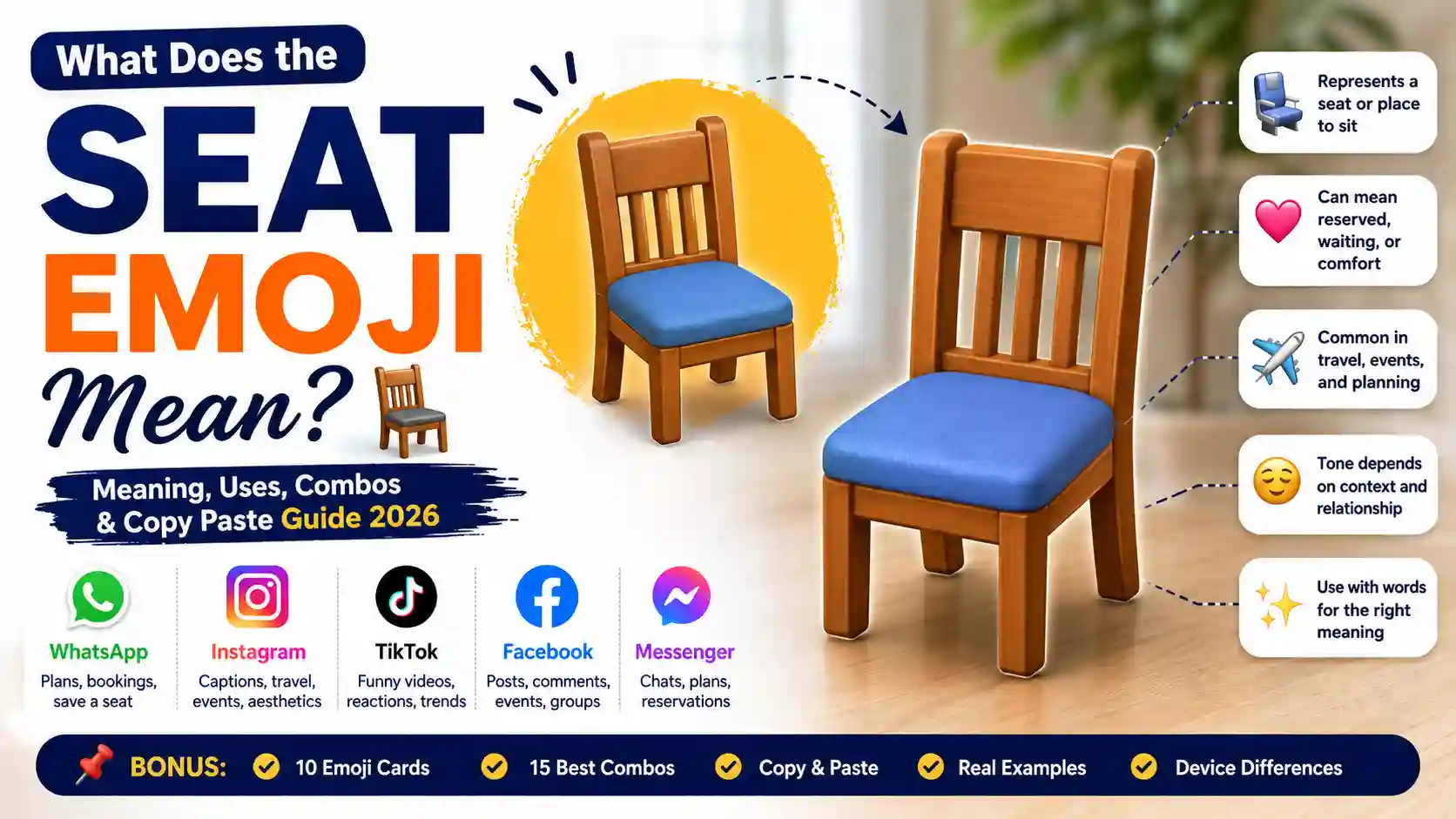
One tiny 💺 can turn an ordinary message into a clear picture of a seat, a journey, or simply being ready to watch.
The 💺 seat emoji usually represents a seat, seating, or having a place to sit, but its meaning can become more flexible in everyday chats. Someone might use it while talking about an airplane seat, waiting for a show, choosing a place at an event, or joking about being ready to watch something unfold. That is why people search for the seat emoji meaning in texting and social media. The surrounding words often matter more than the symbol itself. On WhatsApp, Instagram, TikTok, and Facebook, 💺 can feel practical, playful, or humorous depending on the conversation. Related symbols such as 🪑, ✈️, 🎟️, and 🎭 can make the intended setting clearer. The emoji does not have one universal emotional message. Context, relationship, wording, platform, and tone all help determine what the sender intends. 💺 can be straightforward in one message and playful in another.
Sometimes 💺 simply says, “There is a place for me here,” while the conversation gives it the rest of its meaning.
What does Seat emoji mean? 💺
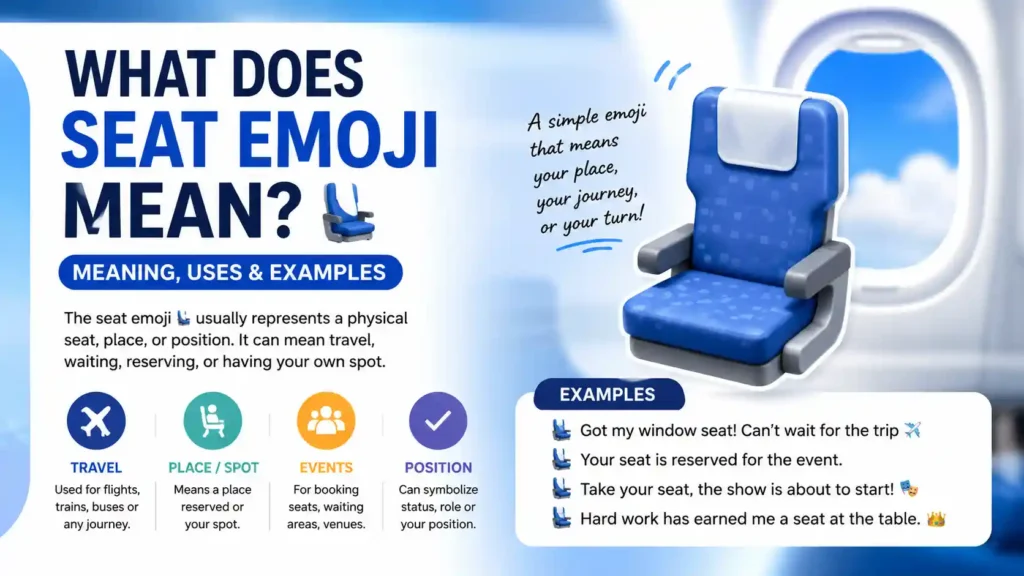
The 💺 seat emoji is most directly used for a seat or seating position. It can point to an actual place to sit, including an airplane seat, theater seat, bus seat, or reserved place. In texting, it often works as a visual shortcut for conversations about travel, events, waiting areas, or choosing where to sit. For example, “I got a window 💺” makes a travel message instantly understandable, while “Save a 💺 for me” can simply mean “save me a place.” It may also be used humorously when someone wants to signal that they are settling in to watch a situation.
On social media, 💺 can become more expressive. A creator might use it in a caption about watching an interesting story unfold, while a commenter may use it playfully to say they are ready to see what happens next. The meaning is not automatically romantic, sarcastic, or funny. Those interpretations come from the words around it and the relationship between the people communicating. A friend may use 💺 as a joke, while a travel conversation may use it literally.
Other related symbols can narrow the context. 🪑 feels more like an ordinary chair or furniture, ✈️ suggests air travel, 🎟️ points toward tickets or an event, and 🎭 can suggest a theater setting. 🚗, 🚌, and 🚆 can similarly make transportation the focus. A person should therefore read the whole message rather than treating one emoji as a fixed code. Unicode identifies the character, but everyday emoji meanings develop through normal communication, community habits, and situation.
| Emoji | Core meaning | Possible misread | Best used when |
|---|---|---|---|
| 💺 | Seat or seating | Watching drama | Travel or events |
| 🪑 | Chair or furniture | Too literal | Home or furniture |
| ✈️ | Air travel | Travel excitement | Flights and trips |
| 🎟️ | Ticket or admission | Event-specific | Shows and entry |
| 🎭 | Theater or performance | Dramatic mood | Performances |
| 🚗 | Car travel | General transport | Road trips |
| 🚌 | Bus travel | School commute | Bus journeys |
| 🚆 | Train travel | Long-distance travel | Rail trips |
| 🏟️ | Stadium or venue | Sports assumption | Large events |
| 🎬 | Film or filming | Movie-only meaning | Movies and videos |
💺 Seat Emoji:
Meaning: A physical seat or a place to sit.
Example 1: I saved a 💺 for you.
Example 2: My airplane 💺 is by the window.
🪑 Chair Emoji:
Meaning: An ordinary chair or place to sit.
Example 1: This 🪑 looks comfortable.
Example 2: Move that 🪑 over here.
✈️ Airplane Emoji:
Meaning: Flying, flights, or air travel.
Example 1: My ✈️ leaves tonight.
Example 2: I finally got my window seat ✈️.
🎟️ Ticket Emoji:
Meaning: Tickets, admission, or an upcoming event.
Example 1: I got my 🎟️ for the show.
Example 2: Keep your 🎟️ safe.
🎭 Performing Arts Emoji:
Meaning: Theater, acting, or a dramatic performance.
Example 1: We are going to the 🎭 tonight.
Example 2: The performance was amazing 🎭.
🚗 Automobile Emoji:
Meaning: Cars, driving, or road travel.
Example 1: We are leaving in the 🚗 soon.
Example 2: The 🚗 is ready for the trip.
🚌 Bus Emoji:
Meaning: Bus travel, commuting, or public transport.
Example 1: I just got on the 🚌.
Example 2: The 🚌 was surprisingly quiet today.
🚆 Train Emoji:
Meaning: Train travel or a railway journey.
Example 1: Our 🚆 arrives at noon.
Example 2: I love traveling by 🚆.
🏟️ Stadium Emoji:
Meaning: A stadium, venue, or large event.
Example 1: We are inside the 🏟️ now.
Example 2: The crowd filled the 🏟️.
🎬 Clapper Board Emoji:
Meaning: Film, filming, or movie-related activity.
Example 1: Movie night starts soon 🎬.
Example 2: Behind the scenes 🎬.
How to use Seat emoji the right way 💺
Using 💺 well is mostly about matching it with the situation. On WhatsApp, it works naturally in personal chats when discussing travel, reservations, events, or saving someone a place. “Which 💺 did you get?” can fit a flight or show conversation, while “Save me a 💺” can be a friendly request. In family chats, it can refer to seating arrangements at a gathering. A status such as “Finally got my favorite 💺” can also be a simple update. The same symbol can become playful when the surrounding message suggests that the sender is settling down to watch something interesting.
On Instagram, 💺 can work in captions, comments, bios, and Reels when seating or watching is part of the visual idea. A travel creator might mention a preferred airplane 💺, while an event post could use it to highlight the excitement of getting a good spot. In comments, 💺 may be used as a light reaction when someone wants to signal that they are staying around to see what happens. The exact tone depends on the post.
On TikTok, the emoji can appear in captions and comments with a more playful tone. A person might use 💺 after a surprising story, funny situation, or dramatic reveal to suggest that they are ready to watch. It can also remain completely literal when a video discusses travel or event seating. TikTok communication often relies heavily on surrounding text, so the same emoji can shift from practical to humorous.
Facebook supports similar uses in posts, comments, and Messenger. Someone might write “Best 💺 in the house” after attending an event, or use it when talking about travel arrangements. The key is not to force a hidden meaning onto it. If the conversation is about an actual seat, keep the interpretation literal. If the surrounding words are playful, the emoji can become playful too. 💺 works best when it adds a visual clue rather than replacing the entire message.
Why do Seat emoji look different on iPhone and Android?
If 💺 looks slightly different on an iPhone, Android phone, Windows computer, or another device, that does not usually mean the sender used a different emoji. Emoji characters are based on Unicode standards, which provide a shared system for representing characters across digital platforms. Companies then create their own artwork to display those characters. Apple, Google, Samsung, Microsoft, and other technology companies can therefore give the same Unicode emoji a different visual design.
This is why the shape, proportions, colors, shading, or overall style of 💺 may vary. One device might make the seat look more detailed, while another may use a simpler design. Small differences can also appear in related symbols such as ✈️, 🎟️, 🎭, 🚗, 🚌, or 🚆. The underlying character remains the same even when its artwork changes.
The difference is especially noticeable when people compare screenshots from different phones. A sender may see one version and the receiver may see another. That does not automatically change the intended meaning. If someone sends “My 💺 is ready,” both people can generally understand that the message refers to a seat even if the artwork is slightly different.
Emoji designs can also change when operating systems receive updates. A company may refresh its artwork without changing the Unicode identity of the character. This is one reason an emoji can look somewhat different over time.
It is better to think of Unicode as the shared character system and each platform as the designer of its visual appearance. There is no universal requirement that Apple’s, Google’s, Samsung’s, or Microsoft’s artwork must look identical. The important part is that the same underlying emoji character can travel between services. If a particular design seems unusual, the surrounding text usually provides enough context to understand what the sender intended.
Best Seat emoji combos – copy & paste:
Romantic ❤️
1.👉 💺✨ – Use this for a sweet message about saving someone a special place.
2.👉 💺❤️ – Use this when talking about sitting together affectionately.
3.👉 💺✈️ – Use this for a romantic travel or flight message.
Cute 🥰
1.👉 💺🪑 – Use this for a playful conversation about sitting together.
2.👉 💺🎟️ – Use this when sharing excitement about an event.
3.👉 💺🎭 – Use this for a cute theater or performance plan.
Flirty 😉
1.👉 💺✈️ – Use this when teasing someone about joining your trip.
2.👉 💺✨ – Use this for a playful “save me a spot” message.
3.👉 💺🎬 – Use this when joking about staying to watch what happens.
Missing Someone 💭
1.👉 💺❤️ – Use this when wishing someone were sitting beside you.
2.👉 💺✈️ – Use this when missing someone who is far away.
3.👉 💺🚆 – Use this for a message about traveling back to someone.
Good Night 🌙
1.👉 💺🎬 – Use this for settling in with a movie before bed.
2.👉 💺🪑 – Use this for a relaxed evening-at-home message.
3.👉 💺✨ – Use this as a gentle sign-off after a quiet evening.
Trending Seat emoji in 2026 💺
In 2026, 💺 remains useful because it can communicate both literal seating and a playful “I am watching” attitude. It is commonly seen in casual online conversations where people discuss travel, shows, events, or situations worth following. Its flexibility makes it suitable for ordinary messages as well as comments that rely on humor. Unlike a highly emotional symbol, 💺 often gets its personality from the surrounding words.
Creators can use 💺 in captions about getting a good spot at a concert, theater, stadium, or travel destination. Everyday users may place it in WhatsApp messages when discussing seats or reservations. On TikTok and Instagram, it can also appear in comments when someone wants to signal that they are staying to see the outcome of a story or conversation. That use is highly context-dependent, so it should not be treated as a fixed dictionary definition.
Related emojis can reinforce the setting. ✈️ makes travel more obvious, 🎟️ suggests an event, and 🎬 can point toward watching a film or video. This makes combinations especially useful when a single 💺 might otherwise be ambiguous.
| Emoji | Why trending | Who uses it | Platform |
| 💺 | Flexible seating or watching reference | Casual users | WhatsApp, TikTok |
| ✈️ | Travel and flight conversations | Travelers | Instagram, WhatsApp |
| 🎟️ | Events and admissions | Event-goers | Instagram, Facebook |
| 🎬 | Movies and video content | Creators and viewers | TikTok, Instagram |
The broader pattern is simple: emoji usage keeps evolving as people find new ways to combine familiar symbols with changing online conversation styles.
Seat emoji meaning in different contexts:
The meaning of 💺 can change considerably depending on who sends it and what the conversation is about. In a romantic conversation, “Save a 💺 for me” may simply express a wish to sit beside someone, but the words and relationship create the emotional tone. The emoji itself does not automatically make a message romantic. A friendship conversation can use the same symbol for a casual invitation, such as “There is a 💺 next to me.”
In family chats, 💺 is often practical. It can refer to seating at dinner, a family gathering, a wedding, or a trip. Someone arranging a group outing might use it as a quick visual reference to where people will sit. In professional or casual communication, the safest interpretation is usually literal unless the surrounding wording clearly signals humor.
In texting, 💺 may be part of a short message such as “Got my 💺” or “Your 💺 is waiting.” The missing details come from the conversation itself. In social media comments, however, people sometimes use it more playfully. A commenter might post 💺 after a dramatic statement to communicate that they are sticking around to see what happens. This is not a universal meaning, but it has become an understandable contextual use in casual online spaces.
Captions can use the symbol to highlight travel, events, movies, or experiences. For example, a travel caption might mention a preferred airplane 💺, while an event caption could focus on having a great view. The same emoji can therefore move between literal and figurative use without changing its underlying identity.
Cultural and community habits can also affect interpretation. Some groups may use emojis more humorously, while others may prefer literal meanings. The best approach is to consider the full message, the sender’s usual style, and the conversation topic before assigning an emotional meaning to 💺.
How to copy and paste Seat emoji 💺
Copying the seat emoji is simple:
💺
Select the emoji above, copy it, and paste it wherever you want to use it. You can add 💺 to WhatsApp messages, Instagram captions, TikTok comments, Facebook posts, Messenger chats, or other supported text fields.
On a phone, press and hold the emoji if your keyboard or app allows text selection. On a computer, you can copy it with the normal copy command and paste it into the destination. You can also save useful combinations such as 💺✈️, 💺🎟️, or 💺🎬 for quick reuse.
Remember that the appearance may change slightly after you paste it onto another device. That is normal platform rendering, not necessarily a different emoji.
FAQs:
1. What is the most popular Seat emoji?
The main seat emoji is 💺. It commonly represents a seat, seating, or having a place to sit, with the exact tone determined by context.
2. What does 💺 mean when someone sends it?
It usually refers to a seat or seating, but it can also be playful when someone is signaling that they are ready to watch a situation unfold. Context matters more than stereotypes.
3. Why do emojis look different on iPhone vs Android?
Unicode provides the underlying emoji character, while companies create their own visual designs. As a result, 💺 can have different shapes, colors, or details on different platforms.
4. Are Seat emojis used differently in other countries?
Emoji interpretation can vary between communities and cultures. Local communication habits, online trends, and the surrounding conversation can influence how 💺 is understood.
Conclusion:
The 💺 seat emoji is useful for talking about seating, travel, events, and playful “watching” situations. Its meaning depends heavily on context, wording, and the relationship between the people communicating. Use it naturally, combine it with relevant symbols, and let your message provide the final meaning. 💺✨

Nasrullah — Emoji Strategist & Content Writer
Nasrullah is a passionate emoji enthusiast and content writer who loves exploring the meanings, uses, and cultural context behind emojis. He creates simple, helpful, and easy-to-understand guides that help readers choose the right emoji for WhatsApp, Instagram, Facebook, texting, and everyday conversations.
With a focus on emoji meanings, combinations, social media usage, and modern digital communication, Nasrullah aims to make every emoji easier to understand and use with confidence. His content combines practical examples with clear explanations so readers can quickly find the meaning and usage they are looking for.
When he’s not researching emojis, Nasrullah enjoys exploring digital trends, writing useful online content, and learning about how people communicate in the digital world. 😊