You send a blue heart 💙 instead of a red one, and suddenly you’re wondering what you just said.
You’re texting someone, you go to drop a heart emoji, and your thumb lands on the blue one instead of the usual red ❤️. Was that on purpose? Does it mean something different? If you’ve ever paused mid-conversation wondering what emoji blue heart actually communicates, you’re not alone. People search for this constantly, because emojis carry tone the same way a raised eyebrow or a change in voice does, and the wrong (or right) one can shift an entire conversation.
The blue heart tends to read as warm but calmer than red, which is exactly why it shows up so often between close friends, family members, and couples who want something sincere without feeling too intense. Context always plays a role though, so let’s break down what it actually means. 💙
Sometimes the color of a heart says more than the words around it. 💙
What Does Emoji Blue Heart Mean?
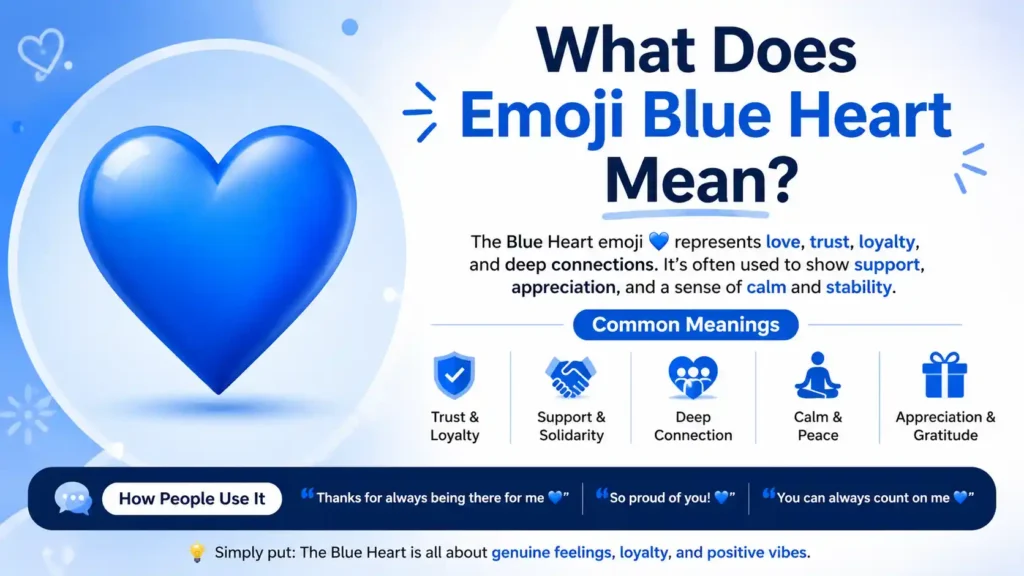
At its core, the blue heart emoji 💙 represents affection that feels calm, loyal, and steady rather than passionate or urgent. Where the red heart ❤️ leans into romantic intensity, blue heart emoji meaning usually points toward trust, friendship, support, and a kind of quiet devotion. People send it to best friends, siblings, teammates, and partners alike, which is part of what makes it so flexible.
In texting, 💙 often shows up as a low-pressure way to say “I care about you” without the weight that a red heart can carry. Someone might text “thinking of you today 💙” to a friend going through a hard week, and it reads as genuine support rather than romance. On social media, the tone shifts slightly depending on the caption around it. A photo with a friend group captioned “these people 💙” signals loyalty and closeness, while a couple’s anniversary post using 💙 might lean romantic if the rest of the caption is affectionate.
Emotionally, blue is also associated with calmness and stability, so the emoji tends to soften a message. It can express comfort during a difficult moment, quiet appreciation, or steady support that doesn’t need to be loud. Some people also use it to represent loyalty to a sports team, school, or cause with blue as the associated color, which has nothing to do with love at all.
The relationship between sender and receiver changes everything. A parent texting 💙 to a child feels protective. A partner sending it during a calm, comfortable stretch of a relationship feels reassuring. A stranger commenting 💙 under a post is usually just casual appreciation. Culture, platform, and the words surrounding the emoji all shape the final interpretation, so it’s never wise to assume one fixed meaning. Other hearts in the same family, like 💚, 💜, 🖤, and 🤍, follow similar logic: color often nudges the tone, but context decides the meaning.
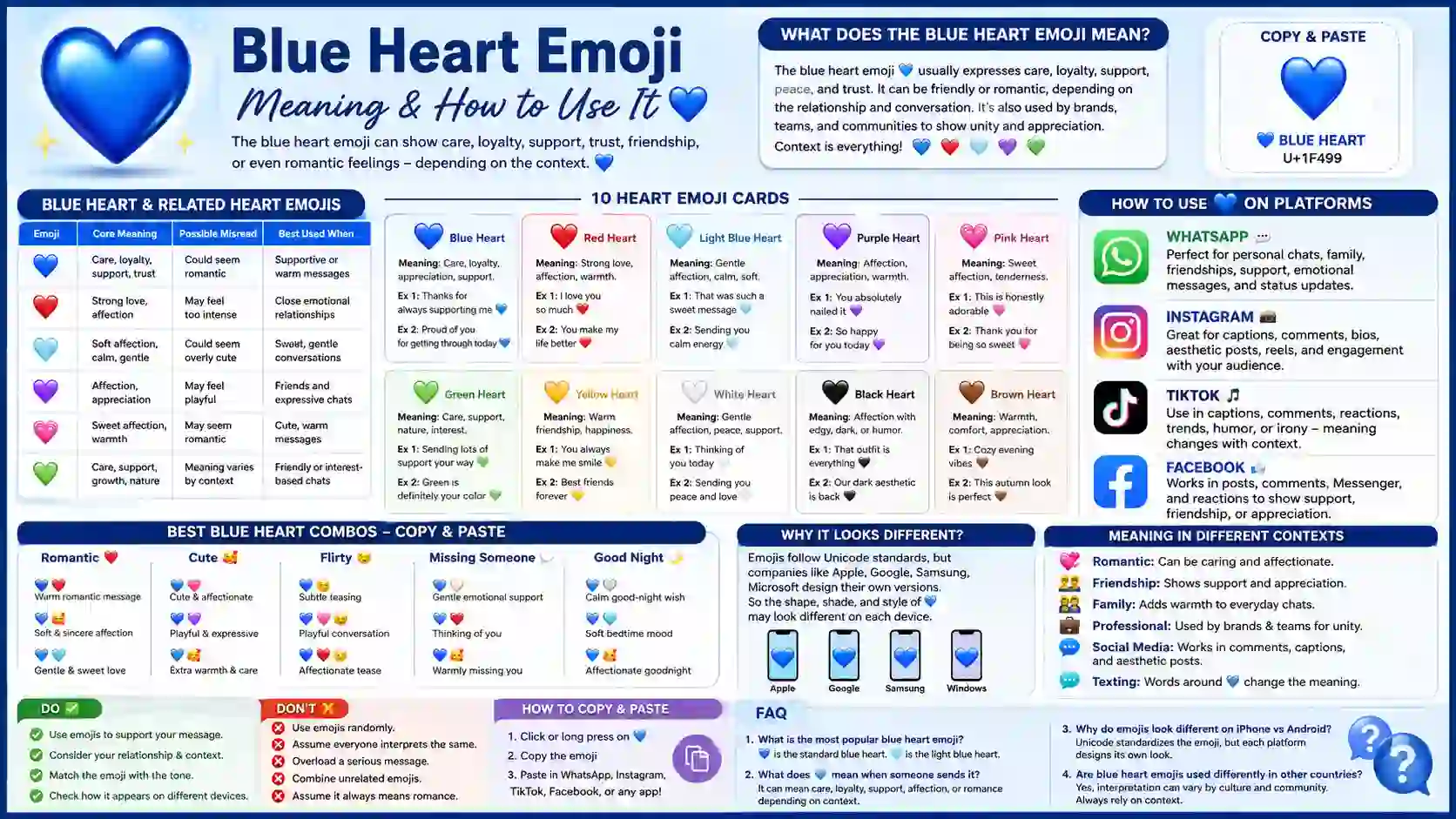
Meaning Table
| Emoji | Core meaning | Possible misread | Best used when |
|---|---|---|---|
| 💙 | Calm affection, loyalty, trust | Mistaken as purely platonic when it’s romantic | Supporting a friend or expressing steady love |
| ❤️ | Deep love and romantic intensity | Read as “too much” for casual friendships | Strong romantic or family affection |
| 💛 | Friendship, happiness, warmth | Assumed romantic when it’s platonic | Cheering someone up or celebrating friendship |
| 💚 | Growth, nature, calm support | Confused with jealousy in older slang | Wishing someone well or eco-related content |
| 🩵 | Soft affection, gentle comfort | Mixed up with 💙 due to similar color | Light, tender messages between close friends |
| 💜 | Deep, quiet affection or admiration | Assumed exclusively romantic | Supporting a friend or admiring someone’s talent |
| 🖤 | Style, edge, or dark humor | Misread as sadness or lack of feeling | Aesthetic captions or playful dark humor |
| 🤍 | Purity, simplicity, calm love | Read as cold or distant | Minimalist captions or sincere, quiet affection |
| 🧡 | Warmth, encouragement, closeness | Confused with romantic interest | Encouraging a friend or celebrating a win |
| 💕 | Sweet, bubbly affection | Read as overly cutesy in formal contexts | Cute captions or light romantic messages |
| 💖 | Excited, sparkly affection | Seen as excessive if overused | Celebrating someone or expressing genuine excitement |
10 Emoji Cards
💙 Blue Heart:
Meaning: Calm, loyal affection and steady support.
Example 1: Thinking of you today 💙
Example 2: So proud of you for getting through this 💙
❤️ Red Heart:
Meaning: Deep love, affection, and emotional connection.
Example 1: I miss you ❤️
Example 2: You are my everything ❤️
💛 Yellow Heart:
Meaning: Friendship, happiness, and platonic warmth.
Example 1: Best friends for life 💛
Example 2: Grateful for you today 💛
💚 Green Heart:
Meaning: Growth, calm support, and nature-related warmth.
Example 1: Rooting for you 💚
Example 2: New beginnings, new energy 💚
🩵 Light Blue Heart:
Meaning: Gentle, soft affection with a comforting tone.
Example 1: Sending soft vibes your way 🩵
Example 2: You always make things easier 🩵
💜 Purple Heart:
Meaning: Quiet admiration, deep affection, or heartfelt respect.
Example 1: I really look up to you 💜
Example 2: Sending love and strength 💜
🖤 Black Heart:
Meaning: Edgy style, dark humor, or aesthetic flair.
Example 1: New playlist, dark mood 🖤
Example 2: That outfit is everything 🖤
🤍 White Heart:
Meaning: Purity, simplicity, and quiet sincerity.
Example 1: Simple things, full heart 🤍
Example 2: Grateful for the little moments 🤍
🧡 Orange Heart:
Meaning: Encouragement, closeness, and everyday warmth.
Example 1: You’ve got this 🧡
Example 2: So happy for you 🧡
💕 Two Hearts:
Meaning: Sweet, light affection with a playful tone.
Example 1: Love this for us 💕
Example 2: Can’t stop smiling 💕
How to Use Emoji Blue Heart the Right Way
WhatsApp 💬
In personal chats, 💙 works well for checking in on someone or reassuring them during a hard moment. Between family members, it can close out a message like “call me when you’re free 💙” without feeling formal. In friendships, it’s a low-key way to show support, and on status updates it often pairs with quiet, reflective captions rather than loud celebrations.
Instagram 📸
On Instagram, 💙 fits naturally into captions about loyalty, close friendships, or calm romantic moments. In comments, it usually signals genuine appreciation rather than a generic reaction. In bios, some people use it to hint at a favorite color, a cause, or a steady relationship. On aesthetic posts and reels, it often pairs with cooler color palettes, like ocean shots or calm, moody edits.
TikTok 🎵
TikTok comments use 💙 for sincere reactions, especially under emotional or wholesome videos. It also shows up in captions for slower, more reflective content. Occasionally it’s used with a slightly ironic tone, similar to how 🖤 gets used for dry humor, where the calmness of the emoji contrasts with a chaotic or funny video.
On Facebook, 💙 appears often in posts marking anniversaries, tributes, or supportive comments under news about a friend’s life event. In Messenger, it’s a common way to end a warm conversation, and as a reaction, it tends to replace the standard “like” when the post feels emotionally significant rather than just informative.
Dos and Don’ts
Do:
- Use 💙 to support your message, not replace it.
- Consider your relationship with the receiver before sending it.
- Pay attention to the words surrounding the emoji.
- Match the emoji’s calm tone to calm, sincere messages.
- Check how it may render differently across devices.
Don’t:
- Use 💙 randomly without a clear intention.
- Assume everyone reads it the same way.
- Overload a serious message with multiple hearts.
- Combine unrelated emojis without a real purpose.
- Assume 💙 automatically means romantic interest.
Why Do Emoji Blue Heart Look Different on iPhone and Android?
Emojis are built on a shared Unicode standard, which means every platform agrees on what character 💙 represents. What isn’t shared is the visual design. Apple, Google, Samsung, Microsoft, and other companies each create their own artwork for that same character, so the blue heart you send from an iPhone might look slightly rounder or more saturated than the version your friend sees on an Android phone.
The shape, shading, and even the exact tone of blue can differ slightly from one design system to another. Facial expressions on emoji faces can look more subtle on one platform and more exaggerated on another, and sizing can vary too depending on the app displaying it. None of these differences change the underlying meaning of the emoji itself, and no single platform’s design is the “correct” version. If you send 💙 from an iPhone to someone using an older Android device, they’ll still receive the same blue heart character, just rendered through a different visual style.
Best Emoji Blue Heart Combos: Copy & Paste
Romantic ❤️
1,👉 💙✨ — Use this for a calm, sincere romantic message.
2,👉 💙🌙 — Great for a quiet goodnight text to a partner.
3.👉 💙🤍 — Fits a soft, understated declaration of love.
Cute 🥰
1.👉 💙🧡 — Perfect for a warm, friendly caption.
2.👉 💙💕 — Works well for a light, sweet message to a close friend.
3.👉 💙🩵 — Ideal for a soft, cozy aesthetic post.
Flirty 😉
1.👉 💙😉 — Good for a playful, light-hearted text.
2.👉 💙💖 — Fits an excited, flirty comment.
3.👉 💙🌊 — Works for a breezy, casual flirty caption.
Missing Someone 💭
1.👉 💙💭 — Use this when you’re thinking about someone from afar.
2.👉 💙🌌 — Fits a late-night message about missing someone.
3.👉 💙🕰️ — Good for “it’s been a while” style messages.
Good Night 🌙
1.👉 💙🌙 — Classic calm goodnight message.
2.👉 💙⭐ — Works for a peaceful, reflective goodnight text.
3.👉 💙☁️ — Fits a cozy, wind-down evening message.
Trending Emoji Blue Heart in 2026
Heart emojis remain some of the most frequently used symbols in everyday messaging, and 💙 continues to show up often in captions, comments, and casual chats. It’s commonly seen in posts about friendship, support, and calmer romantic moments, especially compared to the more intense tone of ❤️. Creators frequently pair it with reflective captions, travel photos featuring water or sky, or posts marking a meaningful but understated moment.
🩵 has also become a popular companion to 💙, often used for softer, gentler tones in aesthetic content. 💜 continues to appear frequently in posts about admiration and support, particularly in fan communities and creative spaces. 🤍 remains popular for minimalist captions across Instagram and TikTok, often paired with simple, quiet messages.
| Emoji | Why trending | Who uses it | Platform |
|---|---|---|---|
| 💙 | Calm, versatile tone that fits many relationships | Friends, families, couples | WhatsApp, Instagram |
| 🩵 | Soft aesthetic appeal in captions and edits | Content creators, casual users | TikTok, Instagram |
| 💜 | Frequently used to show admiration or support | Fan communities, close friends | TikTok, Instagram comments |
| 🤍 | Fits minimalist, sincere captions | Aesthetic-focused users | Instagram, Facebook |
Overall, emoji usage keeps shifting as new platforms, trends, and visual styles emerge, and how people combine hearts like 💙 with other symbols continues to evolve alongside broader digital communication habits.
Emoji Blue Heart Meaning in Different Contexts
In romantic conversations, 💙 tends to read as calm, steady affection rather than intense passion, especially when it replaces a red heart during quieter moments in a relationship. In friendships, it usually signals loyalty and genuine care, like sending “you always show up for me 💙” after someone helps out during a rough week.
Among family members, 💙 often carries a protective or comforting tone, showing up in messages like “proud of you, always 💙” from a parent or sibling. In professional or semi-casual workplace chats, it’s generally best avoided unless the culture is relaxed, since hearts of any color can read as overly personal in formal settings.
On social media, 💙 in a caption can shift meaning depending on the image. A caption under a sunset photo reading “peace like this 💙” feels reflective, while the same emoji under a group photo feels more about connection and closeness. In comments, a simple 💙 usually just signals sincere appreciation without needing further explanation.
How to Copy and Paste Emoji Blue Heart
Copying and pasting 💙 is simple once you know where to grab it from. Highlight the emoji below, copy it, and paste it wherever you need it.
Copy this: 💙
You can paste it directly into:
- WhatsApp chats and status updates
- Instagram captions, comments, and bios
- TikTok captions and comments
- Facebook posts, comments, and Messenger conversations
Most phones also have a built-in emoji keyboard where you can search “blue heart” to find 💙 directly, which is often faster than copying it from a webpage if you’re using it regularly.
FAQs:
1. What is the most popular emoji blue heart?
The standard blue heart 💙 remains the most recognized and widely used version. Lighter variations like 🩵 have grown in popularity for softer, more aesthetic content.
2. What does 💙 mean when someone sends it?
It usually signals calm affection, support, or loyalty rather than a fixed romantic or platonic label. The real meaning depends on your relationship with that person and the message around it, not on any gender-based assumption.
3. Why do emojis look different on iPhone vs Android?
Emojis share a Unicode standard, but each company designs its own artwork for that character. That’s why 💙 can look slightly different depending on the device, even though it represents the same emoji.
4. Is emoji blue heart used differently in other countries?
Cultural and community habits can shape how often certain hearts are used and in what context, so interpretation isn’t identical everywhere. It’s worth paying attention to how the people you’re texting typically use emojis rather than assuming a universal rule.
Conclusion
The blue heart emoji 💙 is one of the most versatile symbols in everyday messaging, capable of expressing loyalty, comfort, or calm romance depending on who’s sending it and why. Paying attention to context, relationship, and the words around it will always tell you more than the emoji alone. Use it thoughtfully, and it’ll keep doing exactly what it does best: saying something warm without needing extra words. 💙

Nasrullah — Emoji Strategist & Content Writer
Nasrullah is a passionate emoji enthusiast and content writer who loves exploring the meanings, uses, and cultural context behind emojis. He creates simple, helpful, and easy-to-understand guides that help readers choose the right emoji for WhatsApp, Instagram, Facebook, texting, and everyday conversations.
With a focus on emoji meanings, combinations, social media usage, and modern digital communication, Nasrullah aims to make every emoji easier to understand and use with confidence. His content combines practical examples with clear explanations so readers can quickly find the meaning and usage they are looking for.
When he’s not researching emojis, Nasrullah enjoys exploring digital trends, writing useful online content, and learning about how people communicate in the digital world. 😊