You send a message, add the emoji showing teeth, and suddenly the tone shifts in a way words alone couldn’t manage. Maybe you’re bracing for bad news, softening an awkward confession, or just reacting to something mildly cringe. That little clenched grin, 😬, shows up constantly in group chats, comments, and captions, but people rarely agree on what it’s actually saying. Is it nervous? Playful? Apologetic? The honest answer is: it depends. This guide breaks down what the emoji showing teeth really communicates, how it shifts across WhatsApp, Instagram, TikTok, and Facebook, and which related grinning emojis 😁 😃 pair with it naturally, so you never have to second-guess sending it again.
Sometimes one tiny emoji can say what a whole sentence cannot. 😬
What Does the Emoji Showing Teeth Mean?
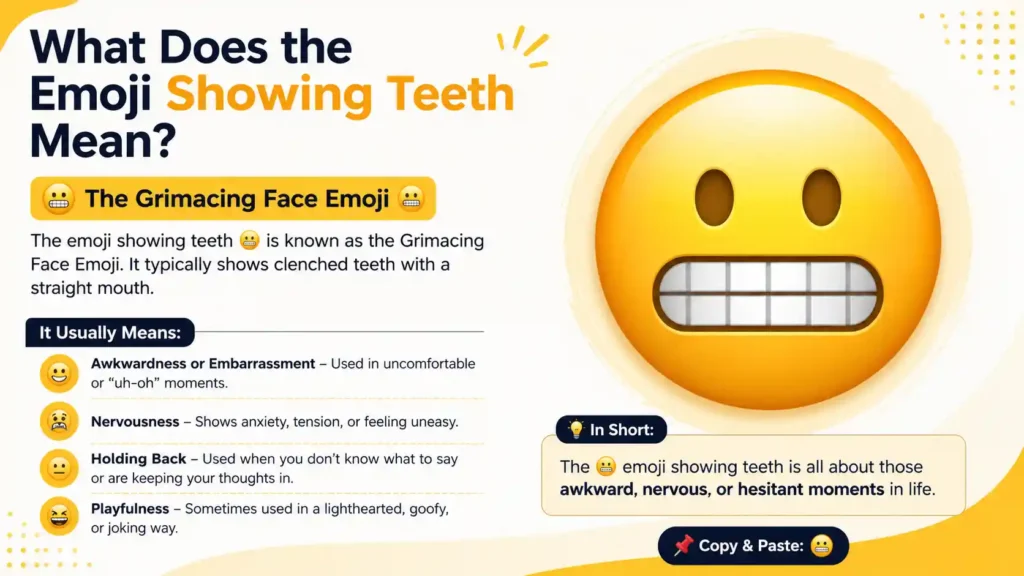
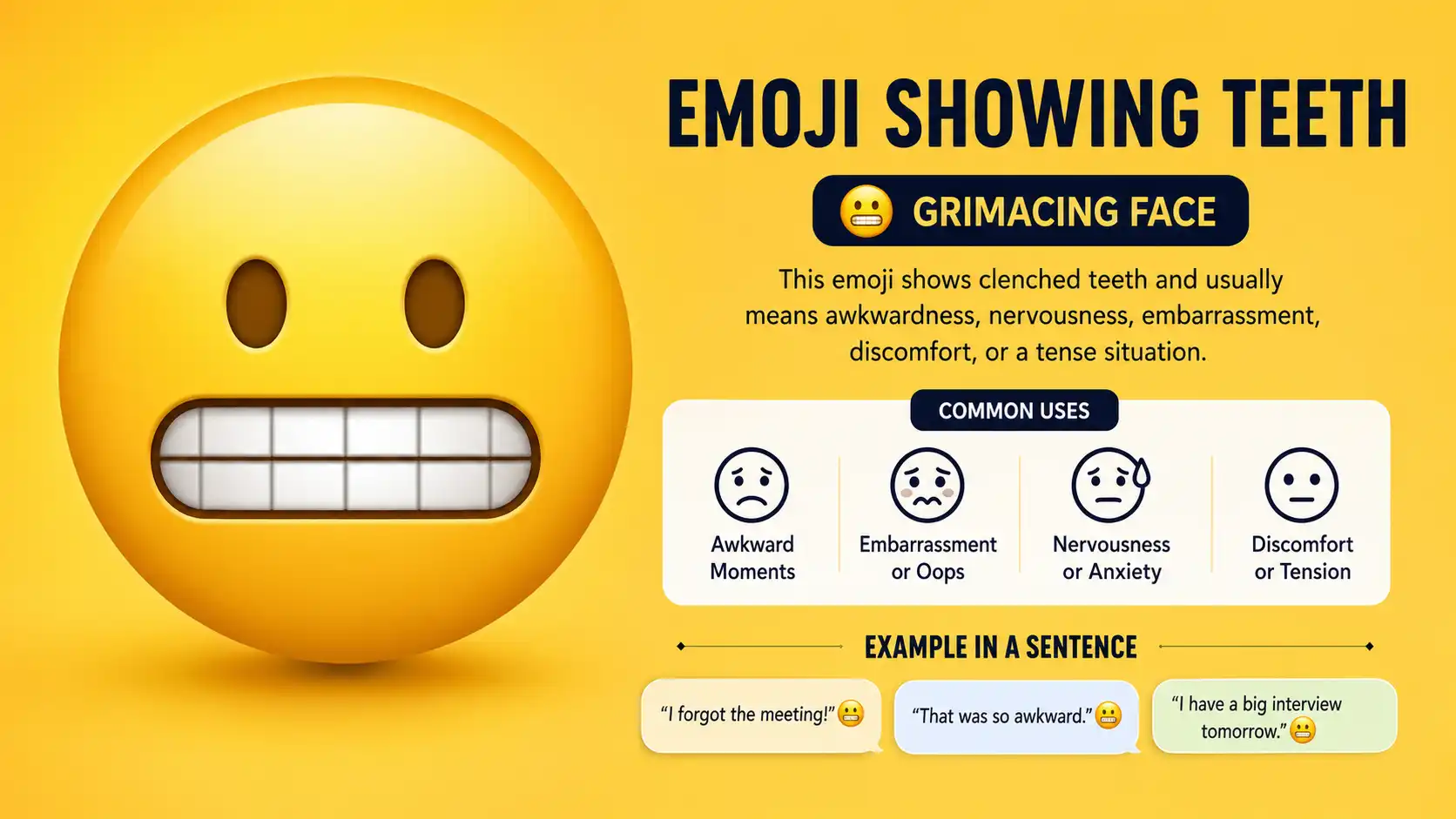
The emoji showing teeth, officially known as the Grimacing Face 😬, has a clenched jaw, wide eyes, and a visible row of upper teeth. At its core, it expresses discomfort, awkwardness, or bracing for something uncomfortable, the digital version of an “oof” or a wince. But its meaning stretches well beyond that.
In casual texting, 😬 often softens bad news. Someone might write “I might be late, sorry 😬” to acknowledge the inconvenience without sounding overly formal. It can also express secondhand embarrassment, reacting to someone else’s awkward moment with a shared cringe rather than mockery.
On social media, the tone shifts slightly. In comments, 😬 frequently signals nervous excitement rather than pure discomfort, like reacting to a bold outfit choice or a risky life update with a mix of “wow” and “yikes.” Context always decides which reading applies.
It’s easy to confuse 😬 with cheerful grinning emojis like 😁, 😃, or 😄, since all of them show teeth. The difference is intent: those faces express open joy, while 😬 leans into tension or hesitation. Meanwhile, 🦷 refers literally to a tooth and shows up in dental humor or “brushing your teeth” jokes rather than emotional reactions.
Interpretation also depends heavily on relationship and platform. A close friend sending 😬 after your bad date story reads as playful sympathy. The same emoji from a boss replying to a missed deadline reads as tense acknowledgment. Wording matters too: “I forgot 😬” feels sheepish, while “That’s so bad 😬” feels like genuine secondhand cringe. No single meaning fits every situation, and that flexibility is exactly why the emoji showing teeth stays so popular.
Meaning Table
| Emoji | Core meaning | Possible misread | Best used when |
|---|---|---|---|
| 😬 | Awkwardness, bracing for discomfort | Read as anger or disgust | Softening bad news or cringe reactions |
| 😁 | Genuine happiness, open excitement | Read as sarcasm if overused | Celebrating good news |
| 😃 | Big, enthusiastic joy | Can feel too intense for small updates | Announcing exciting plans |
| 😄 | Warm, relaxed happiness | Rarely misread | Friendly greetings, casual joy |
| 😆 | Amused, laughing reaction | Can seem mocking without context | Reacting to something genuinely funny |
| 😅 | Relief mixed with mild embarrassment | Confused with sadness | Admitting a small mistake |
| 🦷 | Literal tooth, dental topics | Rarely used emotionally | Dental jokes, oral care content |
Emoji Cards
😬 Grimacing Face:
Meaning: Awkwardness, bracing for something uncomfortable, or nervous cringe.
Example 1: I told her the truth 😬
Example 2: Just walked into the wrong meeting 😬
😁 Beaming Face with Smiling Eyes:
Meaning: Warm, genuine happiness with a wide, toothy smile.
Example 1: We finally got the apartment 😁
Example 2: See you this weekend 😁
😃 Grinning Face with Big Eyes:
Meaning: Enthusiastic, energetic excitement.
Example 1: I got the job offer 😃
Example 2: Road trip starts tomorrow 😃
😄 Grinning Face with Smiling Eyes:
Meaning: Relaxed, easygoing happiness.
Example 1: Good morning, ready for today 😄
Example 2: That movie was so good 😄
😆 Grinning Squinting Face:
Meaning: Genuine laughter or amusement.
Example 1: That video is hilarious 😆
Example 2: Can’t believe you actually said that 😆
😅 Grinning Face with Sweat:
Meaning: Relief mixed with mild embarrassment.
Example 1: Made it just in time 😅
Example 2: Forgot to hit send earlier 😅
🦷 Tooth:
Meaning: Literal reference to teeth or dental care.
Example 1: Dentist appointment at noon 🦷
Example 2: Finally got my braces off 🦷
😀 Grinning Face :
Meaning: Simple, friendly happiness.
Example 1: Thanks for the help today 😀
Example 2: Excited for the weekend 😀
😊 Smiling Face with Smiling Eyes:
Meaning: Gentle, sincere warmth.
Example 1: Really appreciate you 😊
Example 2: Hope your day is going well 😊
😝 Squinting Face with Tongue:
Meaning: Playful teasing or silliness.
Example 1: Beat you again 😝
Example 2: You’ll never guess what happened 😝
How to Use the Emoji Showing Teeth the Right Way
WhatsApp 💬
In personal chats, 😬 works well for admitting small mistakes or cushioning awkward requests, like “Can I borrow your charger again 😬” In family group chats, it often signals gentle embarrassment rather than seriousness, so relatives don’t read it as actual distress. On status updates, it’s commonly paired with a relatable “rough day” caption rather than anything alarming.
Instagram 📸
In captions, the emoji showing teeth shows up on posts about messy moments, funny fails, or “this could have gone better” updates. 😁In comments, it reacts to someone else’s bold or nerve-wracking decision, like a big haircut or a risky outfit. In bios, it’s less common, since bios lean toward the cheerful grinning emojis like 😁 instead. On Reels, 😬 frequently appears in comment sections reacting to cringe-worthy or suspenseful clips.
TikTok 🎵
TikTok comments use 😬 heavily for reaction humor, especially under videos involving awkward encounters, workplace drama, or relationship red flags. It’s a quick way to say “I felt that” without writing a full sentence. Creators also use it ironically, leaning into exaggerated discomfort for comedic effect rather than genuine distress.
On Facebook, 😬 appears in posts about life updates that carry mixed feelings, like a big move or a career change. In comments, it often reacts to news that’s surprising but not necessarily bad. In Messenger, it’s used casually the same way as WhatsApp, softening awkward or last-minute messages.
Dos and Don’ts
Do:
- Use 😬 to soften awkward or uncomfortable news.
- Consider your relationship with the receiver before sending it.
- Pay attention to the wording around the emoji.
- Match the emoji to the actual tone of your message.
- Check how it renders on different devices before assuming intent.
Don’t:
- Use 😬 randomly without connecting it to the message.
- Assume everyone reads it the exact same way.
- Overload a serious or formal message with reaction emojis.
- Combine unrelated emojis with 😬 just for decoration.
- Assume it always means something negative.
Why Do Emoji Showing Teeth Look Different on iPhone and Android?
All emojis, including 😬, 😁, and 🦷, are based on Unicode standards, which means every platform agrees on what character is being sent. However, companies like Apple, Google, Samsung, and Microsoft design their own visual versions of that character.
This means the shape, color, and expression can vary. Apple’s grimacing face tends to look tighter and more anxious, while some Android versions render it with a slightly different eye shape or jaw tension. The size and overall style can differ too, especially between older and newer OS versions.
None of these design differences change what the emoji technically represents. A message sent from an iPhone will still show up as the same Unicode character on an Android phone, even if the artwork looks a little different. So if a grimacing face looks more stressed on one screen and more startled on another, that’s simply a design choice, not a different meaning.
Best Emoji Showing Teeth Combos: Copy & Paste
Romantic ❤️
1.👉 😬❤️ — Use this for a nervous but sweet confession.
2.👉 😊😬 — Use this when admitting you’ve been thinking about someone.
3.👉 😬😅 — Use this for a shy, first-date kind of message.
Cute 🥰
1.👉 😬😊 — Use this for an endearing, slightly shy reaction.
2.👉 😁😬 — Use this for excited but nervous good news.
3.👉 😆😬 — Use this for a playful “oops, that was cute” moment.
Flirty 😉
1.👉 😬😝 — Use this for a teasing, borderline flirty comment.
2.👉 😅😬 — Use this when playfully admitting you’re a little nervous around them.
3.👉 😁😊 — Use this for a warm, confident flirty reply.
Missing Someone 💭
1.👉 😬💭 — Use this when admitting you overthink texting them.
2.👉 😊💭 — Use this for a soft “thinking of you” message.
3.👉 😅💭 — Use this when confessing you’ve reread their messages.
Good Night 🌙
1.👉 😊🌙 — Use this for a warm, simple goodnight message.
2.👉 😬🌙 — Use this after admitting you stayed up too late again.
3.👉 😄🌙 — Use this for an upbeat, cheerful sign-off.
Trending Emoji Showing Teeth in 2026
The grimacing face 😬 continues to be commonly used in casual online conversations, especially in comment sections reacting to awkward or unexpected content. It’s frequently seen paired with short captions where someone wants to react without overexplaining, a quick visual “yikes” that still feels friendly rather than harsh.
😅 remains popular for messages involving small mistakes or last-minute plans, since it captures relief and mild embarrassment in one glance. 😁 and 😄 stay steady favorites for genuinely happy updates, especially in captions announcing good news. 🦷 shows up more often in lighthearted dental or self-care content, sometimes used humorously rather than literally.
Creators frequently lean on 😬 in reaction videos and duet-style content, where a single emoji reply captures a viewer’s secondhand cringe faster than typing a full comment.
| Emoji | Why trending | Who uses it | Platform |
|---|---|---|---|
| 😬 | Quick, relatable cringe reaction | Comment sections, casual texters | TikTok, Instagram |
| 😅 | Captures relief and light embarrassment | Friends, everyday chatters | WhatsApp, Messenger |
| 😁 | Genuine excitement in captions | Creators sharing good news | Instagram, Facebook |
| 🦷 | Lighthearted self-care humor | Casual posters, dental jokes | TikTok, Instagram |
Overall, emoji usage keeps shifting alongside how people communicate online, with reaction-style emojis like 😬 staying popular because they say a lot in very little space.
Emoji Showing Teeth Meaning in Different Contexts
In romantic conversations, 😬 usually signals nervous vulnerability, like admitting a feeling before knowing how it’ll land. Among friends, it reads as shared cringe or lighthearted teasing, especially after an embarrassing story. In family chats, it softens news that might otherwise sound tense, like rescheduling plans last minute.
In professional or semi-formal settings, 😬 is generally best avoided, since tone can be harder to judge and colleagues may not share the same casual context.😬 In texting, it often pairs with short, direct admissions. On social media comments, it tends to react to someone else’s situation rather than the sender’s own. In captions, it frames a post with self-aware humor, acknowledging that something didn’t go perfectly.
How to Copy and Paste Emoji Showing Teeth
Copying the emoji showing teeth is simple. Just select the emoji below, copy it, and paste it wherever you need it.
Copy this: 😬
You can paste it directly into WhatsApp chats, Instagram captions or comments, TikTok comments, or Facebook posts and Messenger conversations. Most phone keyboards also let you search “grimacing” or “teeth” in the emoji panel to find it quickly without scrolling.
FAQ:
1. What is the most popular emoji showing teeth?
The Grimacing Face 😬 is the most recognized emoji showing teeth in this way, followed closely by cheerful grinning faces like 😁 and 😃.
2. What does 😬 mean when someone sends it?
It usually signals awkwardness, nervousness, or bracing for something uncomfortable. The exact meaning depends on the conversation and relationship, not on who sent it.
3. Why do emojis look different on iPhone vs Android?
Emojis follow shared Unicode standards, but each company designs its own artwork, which is why the same emoji can look slightly different across devices.
4. Is the emoji showing teeth used differently in other countries?
Interpretation can shift slightly based on cultural communication styles and community norms, though the core sense of awkwardness or tension tends to carry across most casual online spaces.
Conclusion
The emoji showing teeth isn’t one-note, it can mean nervous, awkward, playful, or bracing, depending entirely on the message around it. Paying attention to context, relationship, and platform will always tell you more than the emoji alone. Use 😬 thoughtfully, and it’ll keep doing exactly what it does best: saying the unsaid part of your message in one small, expressive face.

Nasrullah — Emoji Strategist & Content Writer
Nasrullah is a passionate emoji enthusiast and content writer who loves exploring the meanings, uses, and cultural context behind emojis. He creates simple, helpful, and easy-to-understand guides that help readers choose the right emoji for WhatsApp, Instagram, Facebook, texting, and everyday conversations.
With a focus on emoji meanings, combinations, social media usage, and modern digital communication, Nasrullah aims to make every emoji easier to understand and use with confidence. His content combines practical examples with clear explanations so readers can quickly find the meaning and usage they are looking for.
When he’s not researching emojis, Nasrullah enjoys exploring digital trends, writing useful online content, and learning about how people communicate in the digital world. 😊