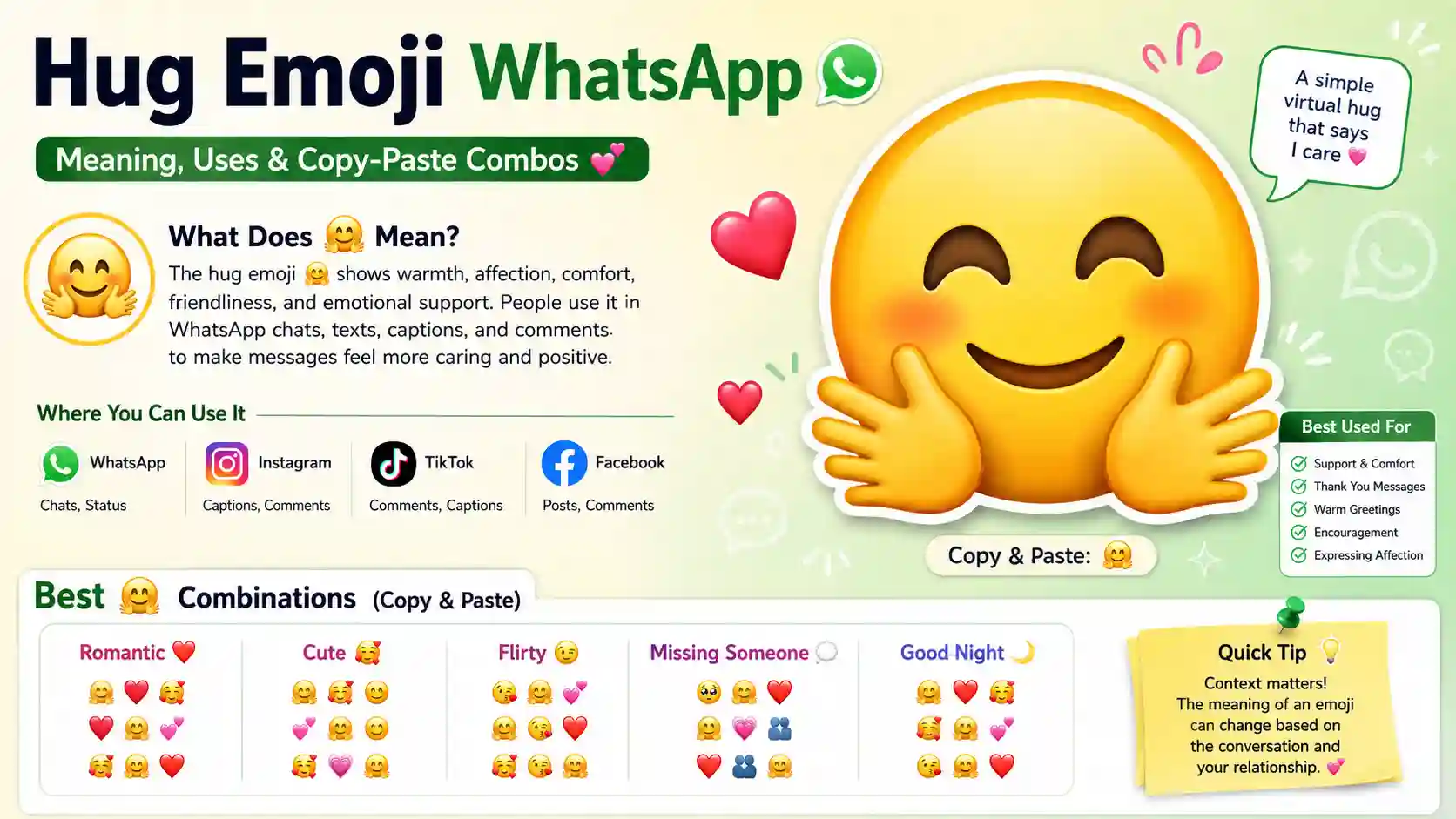
One-line Hook: One little 🤗 can make a simple WhatsApp message feel much warmer.
If someone sends you a message like “Take care 🤗” or “I’m here for you 🤗,” the hug emoji can add a completely different emotional tone. The hug emoji WhatsApp users commonly look for is 🤗, officially known as the Hugging Face emoji. It usually communicates warmth, affection, comfort, friendliness, appreciation, or emotional support.
But context matters. A 🤗 from a close friend may feel comforting, while the same emoji from someone you like can feel sweet or slightly flirty. In a family group, it may simply express love and closeness. On social media, it can make a comment feel supportive rather than formal.
That is why emoji meanings in chat are rarely fixed. The words around an emoji, your relationship with the sender, and the overall conversation can change how it feels. The 🤗 emoji can work in WhatsApp chats, Instagram comments, TikTok conversations, Facebook posts, and everyday texting without necessarily carrying a romantic meaning. 💕 😊
Sometimes 🤗 is the simplest way to make a message feel like a little virtual hug.
What Does Hug Emoji WhatsApp Mean?
The 🤗 emoji generally represents a hug, warmth, affection, friendliness, comfort, or emotional support. It is often used when someone wants their message to sound caring rather than cold or distant.
On WhatsApp, 🤗 can appear after a casual greeting, a supportive message, a thank-you, or an emotional conversation. For example, “Hope you feel better soon 🤗” sounds more caring than the same sentence without an emoji.
In texting, the emoji may suggest that the sender is being friendly and approachable. It can also communicate appreciation, especially when someone has helped or encouraged you.
On Instagram and TikTok, 🤗 can work as a supportive reaction. Someone might comment “So happy for you 🤗” under a positive announcement. In this setting, it does not automatically mean romance.
There are also related emojis that can shift the tone:
🤗 often feels warm, friendly, comforting, and affectionate.
🫂 shows a more literal or direct sense of hugging and emotional support.
❤️ can make a message feel more loving or emotionally intense.
🥰 often adds a stronger sense of fondness or adoration.
😊 gives a softer, cheerful, friendly feeling.
💕 can add sweetness and affection.
The relationship between the people also matters. A close friend sending “You did great 🤗” is likely offering encouragement. Someone you are dating might use “Good night 🤗” as a warm sign-off. A family member may use it simply to show love.
Even the wording can change the interpretation. “Thanks 🤗” may sound appreciative and friendly, while “I wish you were here 🤗” can feel much more emotionally intimate.
Emoji Core meaning Possible misread Best used
🤗 Warmth, hugs, affection Can seem overly cheerful in a serious chat Support, greetings, friendly affection
🫂 Hugging, comfort, emotional support May feel more emotionally direct Comforting someone
❤️ Love, care, strong affection Can be read as romantic Close relationships and heartfelt messages
🥰 Fondness, adoration, warmth May seem romantic Sweet or affectionate conversations
😊 Happiness, kindness, friendliness Can sometimes soften a serious statement too much Friendly chats and appreciation
💕 Sweet affection and closeness May seem romantic Loving or cute messages
💗 Growing affection and warmth Can feel more romantic Sweet personal conversations
😘 Affection, a kiss, playful warmth Often interpreted as flirty Romantic or very close conversations
🥹 Emotional tenderness or being touched May suggest strong emotion Heartfelt reactions
👋 Greeting, goodbye, acknowledgment Can feel casual or final Starting or ending conversations
🤗 Hugging Face
Meaning: Warmth, friendliness, comfort, affection, or a virtual hug.
Example 1: You’ve got this, don’t worry 🤗
Example 2: Thanks for always being there 🤗
🫂 People Hugging
Meaning: A direct expression of giving or receiving a hug and emotional support.
Example 1: Sending you a big hug 🫂
Example 2: I wish I could give you a hug 🫂
❤️ Red Heart
Meaning: Love, deep care, affection, and emotional connection.
Example 1: Thank you for everything ❤️
Example 2: You mean so much to me ❤️
🥰 Smiling Face with Hearts
Meaning: Strong fondness, adoration, sweetness, and affectionate happiness.
Example 1: That was such a sweet message 🥰
Example 2: You always know how to make me smile 🥰
😊 Smiling Face with Smiling Eyes
Meaning: Friendly happiness, kindness, warmth, and gentle positivity.
Example 1: It was really nice talking to you 😊
Example 2: Hope you have a lovely day 😊
💕 Two Hearts
Meaning: Sweet affection, closeness, love, and a gentle romantic tone.
Example 1: Aww, that made my day 💕
Example 2: Sending you lots of love 💕
💗 Growing Heart
Meaning: Warm affection, emotional closeness, and feelings that are becoming stronger.
Example 1: That message was so sweet 💗
Example 2: You really made me happy today 💗
😘 Face Blowing a Kiss
Meaning: A kiss, affection, playful closeness, or romantic warmth.
Example 1: Good night, talk tomorrow 😘
Example 2: Take care of yourself 😘
🥹 Face Holding Back Tears
Meaning: Tender emotion, gratitude, being touched, or feeling deeply moved.
Example 1: That was incredibly kind of you 🥹
Example 2: I can’t believe you remembered 🥹
👋 Waving Hand
Meaning: A greeting, goodbye, friendly acknowledgment, or casual hello.
Example 1: Hey, how are you? 👋
Example 2: See you tomorrow 👋
How to Use Hug Emoji WhatsApp the Right Way
The 🤗 emoji is flexible, which makes it useful in everyday messaging. The key is to let the words carry the main meaning and use the emoji to reinforce the tone.
WhatsApp 💬
In personal chats, 🤗 can make supportive or affectionate messages feel more natural.
Examples:
“Don’t stress, everything will be okay 🤗”
“Thanks for helping me today 🤗”
“You finally finished it! So proud of you 🤗”
With family, it can add warmth without sounding romantic:
“Take care and call me when you get home 🤗”
In friendships, it can show appreciation:
“Glad we got to catch up today 🤗”
For emotional conversations, 🤗 can soften a reassuring sentence:
“I’m always here if you need someone to talk to 🤗”
It can also work nicely in a WhatsApp Status when the message is positive, thankful, or supportive.
Instagram 📸
On Instagram, 🤗 is especially useful in comments and captions where you want to show friendliness without writing a long response.
For example:
“So happy for you 🤗”
“This is beautiful 🤗”
“Sending lots of love 🤗”
A creator might use it in a caption to make an announcement feel personal. A follower can use it in a comment as a supportive reaction.
TikTok:
TikTok conversations are often casual, humorous, emotional, or trend-driven, so 🤗 can take on different tones.
A sincere comment such as “This made my day 🤗” feels warm and supportive. In a humorous context, the same emoji can sometimes make a deliberately awkward or overly cheerful statement feel playful.
The important thing is context. 🤗 does not automatically signal flirting or romance just because it appears in a TikTok comment.
On Facebook, 🤗 can work in posts, comments, and Messenger conversations. It is useful for congratulations, encouragement, greetings, and supportive replies.
For example:
“Congratulations on the new job 🤗”
“Hope you’re feeling better soon 🤗”
“Lovely family photo 🤗”
Because Facebook conversations include friends, relatives, acquaintances, and broader communities, the surrounding words are particularly important.
Dos and Don’ts:
Do:
Use 🤗 to support the emotional tone of your message.
Consider your relationship with the receiver.
Pay attention to the words surrounding the emoji.
Match the emoji with the seriousness of the conversation.
Use 🤗 when a warm, friendly tone feels natural.
Check how an emoji may appear on different devices.
Don’t:
Assume 🤗 always means romance.
Use it randomly in a highly formal or serious message.
Assume everyone interprets emojis in exactly the same way.
Combine many unrelated emojis just to make a message look colorful.
Treat an emoji as a substitute for clear communication.
Assume the sender’s intention from the emoji alone.
Why Do Hug Emoji WhatsApp Look Different on iPhone and Android?
You may notice that 🤗 does not look exactly the same on every phone. This is normal.
Emojis are standardized through Unicode, which allows different devices and software systems to recognize the same underlying emoji character. However, companies such as Apple, Google, Samsung, Microsoft, and others can create their own visual designs for those characters.
That means the 🤗 emoji can vary slightly depending on the device or platform. Its face, hands, colors, proportions, and overall style may look different. The differences can be especially noticeable when someone sends a screenshot or when you compare emoji artwork across operating systems.
The same basic principle applies to many WhatsApp emojis. A person using an iPhone and someone using Android can receive the same Unicode emoji while seeing somewhat different artwork.
The visual design does not necessarily change the intended meaning. If both people recognize 🤗 as the Hugging Face emoji, they are generally referring to the same underlying character even if the artwork is different.
So if your friend’s 🤗 looks slightly different from yours, there is usually no reason to think they intentionally sent a different emoji.
Best Hug Emoji WhatsApp Combos, Copy & Paste
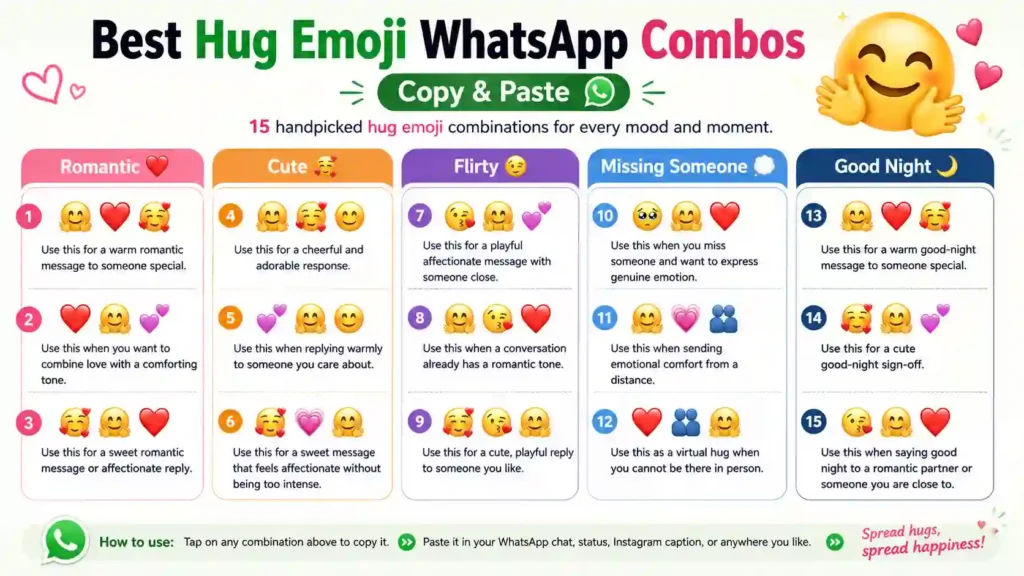
1.👉 🤗❤️🥰 – Use this for a warm, affectionate message to someone special.
2.👉 ❤️🤗💕 – Use this when you want to combine love with a comforting tone.
3.👉 🥰🤗❤️ – Use this for a sweet romantic message or affectionate reply.
Cute 🥰
1.👉 🤗🥰😊 – Use this for a cheerful and adorable response.
2.👉 💕🤗😊 – Use this when replying warmly to someone you care about.
3.👉 🥰💗🤗 – Use this for a sweet message that feels affectionate without being too intense.
Flirty 😉
1.👉 😘🤗💕 – Use this for a playful affectionate message with someone close.
2.👉 🤗😘❤️ – Use this when a conversation already has a romantic tone.
3.👉 🥰😘🤗 – Use this for a cute, playful reply to someone you like.
Missing Someone 💭
1.👉 🥹🤗❤️ – Use this when you miss someone and want to express genuine emotion.
2.👉 🤗💗🫂 – Use this when sending emotional comfort from a distance.
3.👉 ❤️🫂🤗 – Use this as a virtual hug when you cannot be there in person.
Good Night 🌙
1.👉 🤗❤️🥰 – Use this for a warm good-night message to someone special.
2.👉 🥰🤗💕 – Use this for a cute good-night sign-off.
3.👉 😘🤗❤️ – Use this when saying good night to a romantic partner or someone you are close to.
Trending Hug Emoji WhatsApp in 2026:
In 2026, 🤗 remains useful in casual online communication because it expresses warmth without requiring a long explanation. Related emojis such as 🫂, 🥰, ❤️, and 😊 are also commonly seen when people want their messages to feel supportive, affectionate, or emotionally expressive.
The exact frequency of individual emojis changes across communities and platforms, so it is better to describe these as commonly used rather than assign an unsupported ranking.
On WhatsApp, 🤗 frequently appears in personal conversations, encouragement, greetings, and emotional messages. Instagram users can use it in comments and captions when they want to sound supportive. TikTok users may use it for reactions ranging from sincere appreciation to playful humor.
Emoji Why trending Who uses it Platform:
🤗 Friendly warmth and support Friends, families, everyday users WhatsApp, Instagram
🫂 Direct emotional comfort Friends, partners, supportive communities WhatsApp, TikTok
🥰 Strong fondness and sweetness Couples, friends, creators Instagram, WhatsApp
❤️ Familiar expression of care and love Broad audiences WhatsApp, Instagram, Facebook
One noticeable pattern in modern digital communication is that people increasingly combine emojis to create a more specific emotional tone. Instead of relying on one symbol, users may pair 🤗 with ❤️, 🥰, or 🫂 to make the message feel more personal.
Emoji usage continues to evolve through online communities, messaging habits, memes, captions, and everyday conversations, so context remains more useful than trying to assign one permanent meaning.
Hug Emoji WhatsApp Meaning in Different Contexts
Romantic Conversations
When someone you are dating sends 🤗, it can communicate affection, comfort, or closeness. If it appears alongside ❤️, 🥰, or 😘, the overall message may feel more romantic.
For example:
“Good luck today 🤗❤️”
The combination sounds affectionate, but the exact meaning still depends on the relationship.
Friendship
Between friends, 🤗 commonly communicates warmth without romance.
“Thanks for listening to me 🤗”
This usually feels like appreciation and emotional support.
Family
Family members can use 🤗 as a virtual hug or expression of care.
“Call me when you get home 🤗”
Here, the emoji adds warmth to a practical message.
Professional or Casual Communication
In a casual workplace conversation, 🤗 can make a friendly message feel less formal, but it may not fit every professional situation. When communicating with someone you do not know well, consider the existing tone of the conversation before using it.
Texting
In ordinary texting, 🤗 is often a gentle way to show that a message is friendly or supportive. It can be particularly useful when written words might otherwise sound too short.
“Thank you for understanding 🤗”
Social Media Comments
In comments, 🤗 can communicate encouragement without requiring a long reply.
“Proud of you 🤗”
“Such a beautiful moment 🤗”
Captions
In captions, the emoji can reinforce a warm or personal mood.
“Grateful for the people who make life better 🤗”
The key is not to treat 🤗 as having one fixed emotional category. Its tone develops from the conversation around it.
How to Copy and Paste Hug Emoji WhatsApp
If you simply want the primary emoji, copy this:
🤗
Select the emoji, copy it, and paste it wherever you need it. You can use it in WhatsApp messages, WhatsApp Status updates, Instagram captions, Instagram comments, TikTok captions, TikTok comments, Facebook posts, Messenger, or other apps that support the character.
You can also copy the combinations from this guide and paste them directly into a message.
Remember that the appearance may change when you paste 🤗 into another app or onto another device. That does not necessarily mean you copied the wrong emoji.
FAQ:
- What is the most popular hug emoji WhatsApp?
The 🤗 Hugging Face emoji is one of the most recognizable ways to express a virtual hug, warmth, friendliness, or affection in WhatsApp chats. The 🫂 emoji is another direct option when the intention is specifically to show hugging or emotional comfort.
- What does 🤗 mean when someone sends it?
It usually communicates warmth, friendliness, affection, comfort, or support. The meaning depends on the conversation and relationship between the sender and receiver, rather than on gender stereotypes or a single universal interpretation.
- Why do emojis look different on iPhone vs Android?
Unicode provides the underlying emoji character, while companies such as Apple and Google create their own visual designs. As a result, 🤗 can have slightly different artwork, proportions, colors, or facial details on different devices.
- Are hug emoji WhatsApp used differently in other countries?
Emoji interpretation can vary between communities, languages, cultures, and personal communication styles. However, broad assumptions are not always reliable. The safest approach is to consider the surrounding message, relationship, and context rather than assigning one universal cultural meaning.
Conclusion
The 🤗 hug emoji is a simple way to add warmth, comfort, friendliness, and affection to a digital message. On WhatsApp, Instagram, TikTok, Facebook, and everyday texting, its meaning depends heavily on context.
Use it when you want your words to feel a little more human and caring, while remembering that different people may read emojis differently. 🤗💕

Nasrullah — Emoji Strategist & Content Writer
Nasrullah is a passionate emoji enthusiast and content writer who loves exploring the meanings, uses, and cultural context behind emojis. He creates simple, helpful, and easy-to-understand guides that help readers choose the right emoji for WhatsApp, Instagram, Facebook, texting, and everyday conversations.
With a focus on emoji meanings, combinations, social media usage, and modern digital communication, Nasrullah aims to make every emoji easier to understand and use with confidence. His content combines practical examples with clear explanations so readers can quickly find the meaning and usage they are looking for.
When he’s not researching emojis, Nasrullah enjoys exploring digital trends, writing useful online content, and learning about how people communicate in the digital world. 😊