You get good news, your friend sends an exciting update, or someone finally agrees with you, and suddenly 🙌 feels like the perfect response. The happy hands emoji is often used to express celebration, excitement, praise, gratitude, relief, or a simple “yes!” without needing a long explanation.
But what does the happy hands emoji actually mean in texting? That depends on the conversation. In one chat, 🙌 can mean “I’m so happy for you.” In another, it can mean “We did it!” or “Thank goodness.” On WhatsApp, Instagram, TikTok, Facebook, and other platforms, people also use it for cheering, encouragement, and enthusiastic reactions.
Its meaning can shift depending on the words around it, the relationship between two people, and even the tone of the conversation. Understanding that context makes it much easier to use 🙌 naturally instead of accidentally making a message feel exaggerated.
What Does the Happy Hands Emoji Mean?
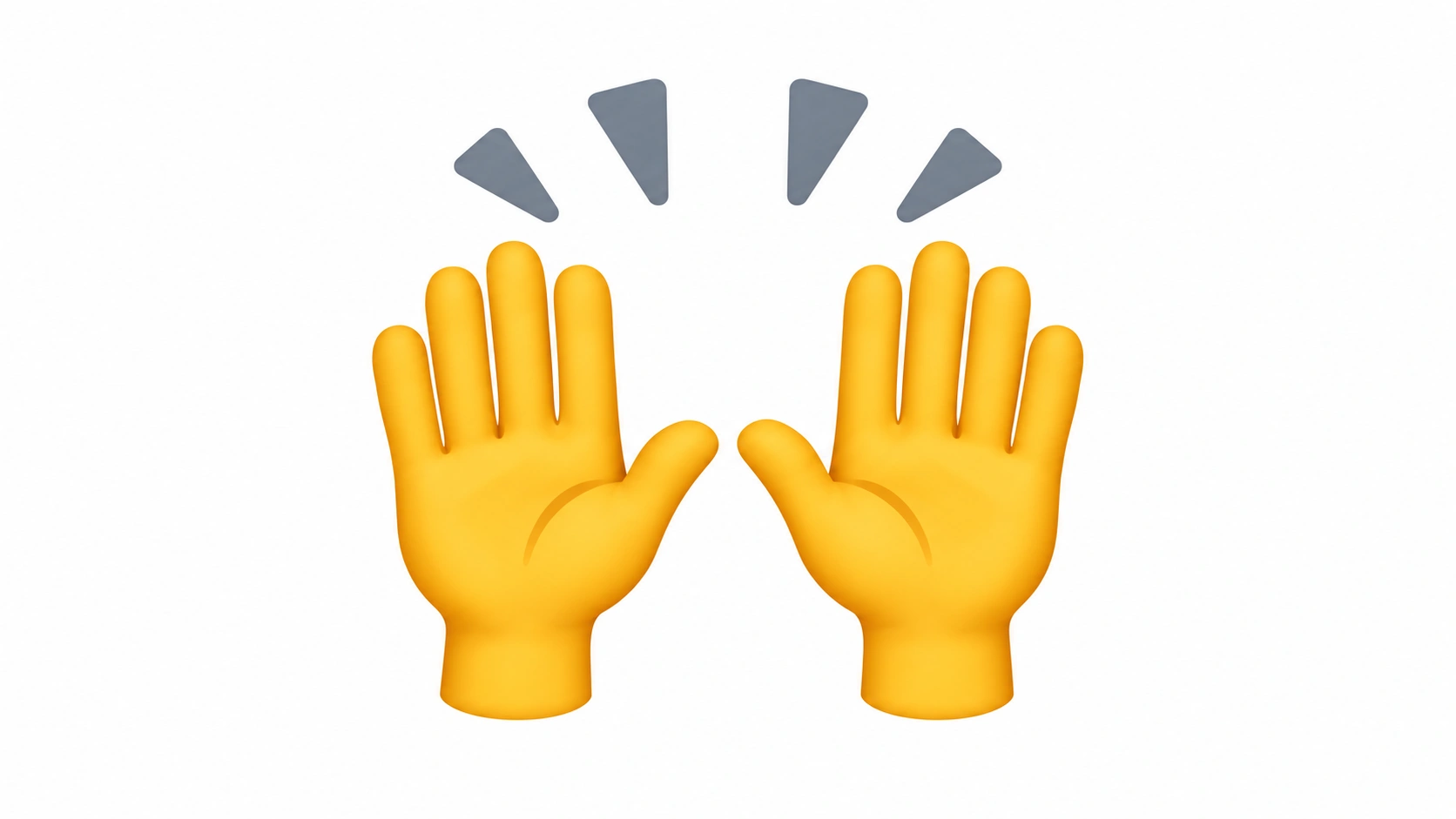
The happy hands emoji 🙌 generally represents raised hands and is commonly used to communicate celebration, excitement, praise, appreciation, or enthusiastic agreement. It can feel like saying “Woohoo!”, “Yes!”, “We did it!”, or “I’m celebrating with you!” The exact interpretation depends heavily on context.
In texting, 🙌 is often a quick positive reaction. If someone says, “I finally passed my exam,” replying “🙌” can show genuine excitement for them. If a friend says, “Our vacation is booked,” the same emoji can communicate anticipation and happiness. In social media comments, it can work as a supportive reaction to a success, achievement, announcement, performance, or inspiring post.
There are several closely related emojis that can create slightly different tones. 👏 often suggests applause or praise, while 🎉 makes the celebration more obvious. 🥳 adds a playful party mood. 🫶 can make a response feel warmer and more affectionate. 🙏 may communicate gratitude or appreciation, although some people interpret it differently depending on context.
Other hand gestures can also influence how a message feels. 👐 may suggest openness, welcome, or offering support. 🤲 can convey an open-handed gesture, giving, receiving, or a sincere emotional tone.
Importantly, 🙌 does not automatically mean romance. Someone sending it to you may simply be excited, supportive, relieved, or celebratory. The relationship between sender and receiver matters. A close friend may use it casually, while a coworker might use it to celebrate completing a project.
Culture, wording, and platform design can also influence interpretation. The safest approach is to read the emoji together with the surrounding message rather than assigning it one fixed definition.
Meaning Table:-
| Emoji | Core meaning | Possible misread | Best used when |
|---|---|---|---|
| 🙌 | Celebration, excitement, praise | Prayer or surrender | Sharing good news |
| 👏 | Applause, approval | Sarcasm in some contexts | Praising an achievement |
| 🎉 | Celebration, party | Too festive for serious news | Announcements and milestones |
| 🥳 | Fun, excitement, partying | Overly playful | Happy celebrations |
| 🫶 | Love, support, affection | Romantic meaning | Warm supportive messages |
| 👐 | Openness, welcome | Surprise or uncertainty | Welcoming someone |
| 🤲 | Giving, receiving, sincerity | Prayer-like gesture | Gratitude or heartfelt messages |
| 🙏 | Thanks, appreciation, hope | Prayer | Thank-you messages |
| 🤝 | Agreement, teamwork | Formal tone | Deals and cooperation |
| 👋 | Greeting, goodbye | Casual dismissal | Hello or goodbye |
Emoji Cards:
🙌 Raising Hands:
Meaning: Celebration, excitement, praise, relief, or enthusiastic agreement.
Example 1: We finally finished the project 🙌
Example 2: That is amazing news for you 🙌
👏 Clapping Hands:
Meaning: Applause, approval, appreciation, or recognition.
Example 1: You absolutely nailed that presentation 👏
Example 2: Everyone deserves credit for this 👏
🎉 Party Popper:
Meaning: Celebration, achievement, exciting news, or a festive moment.
Example 1: Congratulations on your new job 🎉
Example 2: The big day is finally here 🎉
🥳 Partying Face:
Meaning: Playful celebration, excitement, fun, and party energy.
Example 1: It is your birthday, so enjoy every minute 🥳
Example 2: We are officially on vacation 🥳
🫶 Heart Hands:
Meaning: Love, care, affection, appreciation, and emotional support.
Example 1: Thank you for always being there 🫶
Example 2: Sending you lots of love today 🫶
👐 Open Hands:
Meaning: Openness, welcome, support, or an inviting gesture.
Example 1: Come over whenever you are free 👐
Example 2: I am always here to support you 👐
🤲 Palms Up Together:
Meaning: Giving, receiving, openness, sincerity, or a heartfelt gesture.
Example 1: I appreciate everything you have done 🤲
Example 2: Sending you my best wishes 🤲
🙏 Folded Hands:
Meaning: Gratitude, appreciation, hope, respect, or a sincere request.
Example 1: Thank you so much for helping me 🙏
Example 2: I really appreciate your kindness 🙏
🤝 Handshake:
Meaning: Agreement, cooperation, teamwork, or mutual understanding.
Example 1: Looks like we have a deal 🤝
Example 2: Great working with you 🤝
👋 Waving Hand:
Meaning: Greeting, goodbye, friendliness, or acknowledging someone.
Example 1: Hey, how are you? 👋
Example 2: Talk to you later 👋
How to Use the Happy Hands Emoji the Right Way:
WhatsApp 💬
On WhatsApp, 🙌 works especially well when the conversation has positive energy. You can use it with friends, family, classmates, or coworkers when the relationship is comfortable enough for casual emoji use.
For personal chats, it can celebrate good news: “I got the tickets 🙌.” With family, it can express relief or excitement: “Mom is finally coming home 🙌.” Friends might use it after making plans, finishing something difficult, or sharing an inside joke.
It also works in WhatsApp Status updates. A short line such as “Weekend starts now 🙌” communicates excitement without needing a long caption.
Instagram 📸
On Instagram, 🙌 can appear in captions, comments, Reels, and casual replies. A creator might use it after reaching a milestone, while a follower might comment it to show encouragement.
For example, “New chapter begins today 🙌” feels celebratory without being overly formal. In comments, a simple “You did it 🙌” can support someone’s achievement.
TikTok 🎵
TikTok conversations often move quickly, so 🙌 can function as an instant emotional reaction. It may appear in comments celebrating a funny moment, impressive result, relatable situation, or exciting trend.
The surrounding text matters. “Finally someone said it 🙌” communicates strong agreement, while “That ending 🙌” can praise a particularly satisfying moment.
On Facebook, 🙌 works in posts, comments, and Messenger conversations. It can celebrate birthdays, announcements, accomplishments, family moments, community achievements, or personal milestones.
The main rule is simple: use it when you genuinely want the message to feel positive, supportive, or celebratory. In professional communication, use it more selectively, especially when the conversation is formal.
Do and Don’t:
Do:
- Use 🙌 to reinforce a positive message.
- Match it to the emotional tone of the conversation.
- Consider your relationship with the recipient.
- Use related emojis when they genuinely add meaning.
- Remember that different platforms may display it differently.
Don’t:
- Assume 🙌 always has exactly one interpretation.
- Add it to every sentence.
- Use a large collection of emojis when one is enough.
- Assume it automatically has a romantic meaning.
- Use a playful emoji reaction when the situation is clearly serious.
Why Does the Happy Hands Emoji Look Different on iPhone and Android?
You may notice that the happy hands emoji 🙌 does not look exactly the same on every phone. That is normal. Emojis are standardized through Unicode, which gives devices a shared character that can be recognized across different systems. However, Unicode does not force Apple, Google, Samsung, Microsoft, or other companies to draw every emoji in exactly the same way.
As a result, the same 🙌 character can have small visual differences depending on the device, operating system, application, or font being used. The hands may appear slightly different in shape, positioning, shading, or overall style. Colors and proportions can also vary.
This does not usually mean that you are sending a different emoji. You are generally sending the same underlying Unicode character, while the recipient’s device determines how that character is visually rendered.
That distinction is useful when talking about emoji meanings. If your friend says, “Your emoji looks different from mine,” they may still be seeing the same emoji symbol. Their device is simply displaying a different artwork version.
The same principle applies to many WhatsApp emojis, Instagram emojis, and other emoji symbols. A platform can update its emoji artwork without changing the underlying character.
For example, you might select 🙌 on one phone and see a particular hand shape. A friend using another operating system could see a slightly different design. The basic idea of raised hands remains recognizable, even though the artwork is not identical.
There is no single platform that owns the universally correct visual version. The important part is the standardized character and its compatibility across systems. If an emoji looks unfamiliar after a software update, checking the surrounding message is usually more useful than assuming its meaning has changed.
Best Happy Hands Emoji Combos, Copy & Paste
Romantic ❤️
🙌 🫶 ❤️, Use this when celebrating someone you care deeply about.
🫶 🙌 ❤️, Use this for warm appreciation and affection.
🙌 ❤️ 🎉, Use this when celebrating a special relationship milestone.
Cute 🥰
🙌 🥰 🫶, Use this for an affectionate and cheerful reaction.
🥳 🙌 🫶, Use this when celebrating something adorable or exciting.
🙌 🥰 ❤️, Use this for a sweet, happy response.
Flirty 😉
🙌 🫶 😉, Use this for playful enthusiasm with someone you like.
😉 🙌 ❤️, Use this when celebrating a fun romantic conversation.
🙌 😉 🥰, Use this for a lighthearted and slightly flirty reaction.
Missing Someone 💭
🙌 🫶 ❤️, Use this when you are happy to reconnect with someone you miss.
🙏 🫶 🙌, Use this for a heartfelt message after time apart.
🙌 ❤️ 🥰, Use this when seeing or hearing from someone makes you happy.
Good Night 🌙
🙌 🫶, Use this as a warm closing before saying good night.
🙏 🙌 🫶, Use this for a grateful and caring nighttime message.
🙌 ❤️, Use this as a simple positive sign-off.
Trending Happy Hands Emoji in 2026
The happy hands emoji 🙌 remains useful in modern online communication because it is easy to understand as a positive reaction without requiring much text. It frequently appears in casual messages, comments, captions, and posts where someone wants to celebrate an outcome or show enthusiastic support.
👏 is commonly useful when the focus is praise. For example, a comment such as “What a performance 👏” puts attention on someone’s accomplishment. 🎉 is more explicitly celebratory and often appears alongside announcements, milestones, birthdays, and other happy moments. 🥳 adds a playful party feeling and can make a message feel more energetic.
🫶 is also useful when users want their celebration to carry a warmer emotional tone. It can shift a simple reaction from general excitement toward appreciation or affection.
These emojis are not limited to one platform. You may see them in WhatsApp conversations, Instagram captions, TikTok comments, Facebook posts, and everyday messaging. Their popularity is partly practical: they communicate emotion quickly and can make short messages feel more expressive.
The important thing is not to treat online emoji usage as fixed. People continually adapt emoji combinations to jokes, trends, friendships, relationships, and individual communication styles. A symbol that feels enthusiastic in one conversation might feel ironic in another.
| Emoji | Why trending | Who uses it | Platform |
|---|---|---|---|
| 🙌 | Quick celebration and support | Friends, creators, general users | WhatsApp, Instagram, TikTok |
| 👏 | Praise and approval | Everyone | Comments, posts, chats |
| 🎉 | Obvious celebration | Friends, creators, families | Social media, messaging |
| 🥳 | Playful excitement | Casual users, friends | TikTok, Instagram, chats |
Overall, emoji usage continues to evolve through everyday conversations, online communities, captions, comments, and changing communication habits.
Happy Hands Emoji Meaning in Different Contexts:
The meaning of 🙌 becomes much clearer when you consider who sent it and what was happening immediately before it.
In a romantic conversation, 🙌 can express excitement about spending time together or receiving good news from someone special. It does not automatically communicate love, though. The surrounding words determine whether the reaction is affectionate or simply enthusiastic.
Between friends, 🙌 is often much more casual. A friend might send it after you agree on weekend plans, complete a difficult task, or share exciting news. “We finally made it 🙌” feels like shared celebration.
In a family conversation, the emoji can communicate happiness, relief, or encouragement. Someone might use it after hearing that a family member reached an important milestone.
In professional communication, 🙌 can work in relaxed workplaces, especially when celebrating a team achievement. However, the tone of the workplace matters. A formal business email may call for straightforward wording instead of an enthusiastic emoji.
In texting, the emoji often functions as a compact emotional reaction. A person may send only “🙌” because the previous message already provides enough context.
In social media comments, it can signal approval or encouragement. A comment such as “You made it 🙌” clearly celebrates someone’s accomplishment, while “That was perfect 🙌” focuses on appreciation.
In captions, 🙌 can make a statement feel more upbeat. “New beginnings 🙌” suggests optimism and excitement, while “Weekend mode 🙌” is simply cheerful.
The key is context. The same emoji can feel celebratory, supportive, relieved, enthusiastic, or playful without changing its underlying symbol. Instead of asking whether 🙌 has one secret definition, look at the entire conversation.
How to Copy and Paste the Happy Hands Emoji:
Copying the happy hands emoji is simple:
🙌
Select the emoji above, copy it, and paste it wherever you want to use it.
You can paste 🙌 into:
- WhatsApp chats
- WhatsApp Status
- Instagram captions
- Instagram comments
- TikTok captions
- TikTok comments
- Facebook posts
- Messenger conversations
- Text messages
- Online comments
You can also combine it with other relevant emojis to create a stronger emotional tone. For example:
🙌 🫶 🎉
When copying emojis, remember that the visual appearance can change when you paste them into another device or platform. The underlying emoji character can remain the same even when its design looks slightly different.
FAQs:
1. What is the most popular happy hands emoji?
The emoji most closely associated with the phrase “happy hands” is 🙌, the raising hands emoji. It is commonly used for celebration, excitement, praise, support, and relief.
2. What does 🙌 mean when someone sends it?
It usually expresses a positive reaction such as excitement, celebration, encouragement, or agreement. Its meaning depends on the conversation and should not be interpreted through gender stereotypes.
3. Why do emojis look different on iPhone vs Android?
Apple, Google, Samsung, and other platforms can create their own artwork for Unicode emoji characters. Therefore, the same emoji can look slightly different while representing the same underlying character.
4. Are happy hands emojis used differently in other countries?
Emoji interpretation can vary between communities and cultures because people develop different communication habits. Context, online trends, relationships, and local conventions can all influence how a symbol is understood.
Conclusion:
The happy hands emoji 🙌 is a simple way to communicate celebration, enthusiasm, praise, support, or relief. Its meaning becomes clearer when you consider the words, relationship, and situation around it.
Use it naturally, choose combinations that match your tone, and remember that emoji meanings are flexible. Sometimes a single 🙌 is all you need to say, “Yes, we did it!” 🎉

Nasrullah — Emoji Strategist & Content Writer
Nasrullah is a passionate emoji enthusiast and content writer who loves exploring the meanings, uses, and cultural context behind emojis. He creates simple, helpful, and easy-to-understand guides that help readers choose the right emoji for WhatsApp, Instagram, Facebook, texting, and everyday conversations.
With a focus on emoji meanings, combinations, social media usage, and modern digital communication, Nasrullah aims to make every emoji easier to understand and use with confidence. His content combines practical examples with clear explanations so readers can quickly find the meaning and usage they are looking for.
When he’s not researching emojis, Nasrullah enjoys exploring digital trends, writing useful online content, and learning about how people communicate in the digital world. 😊