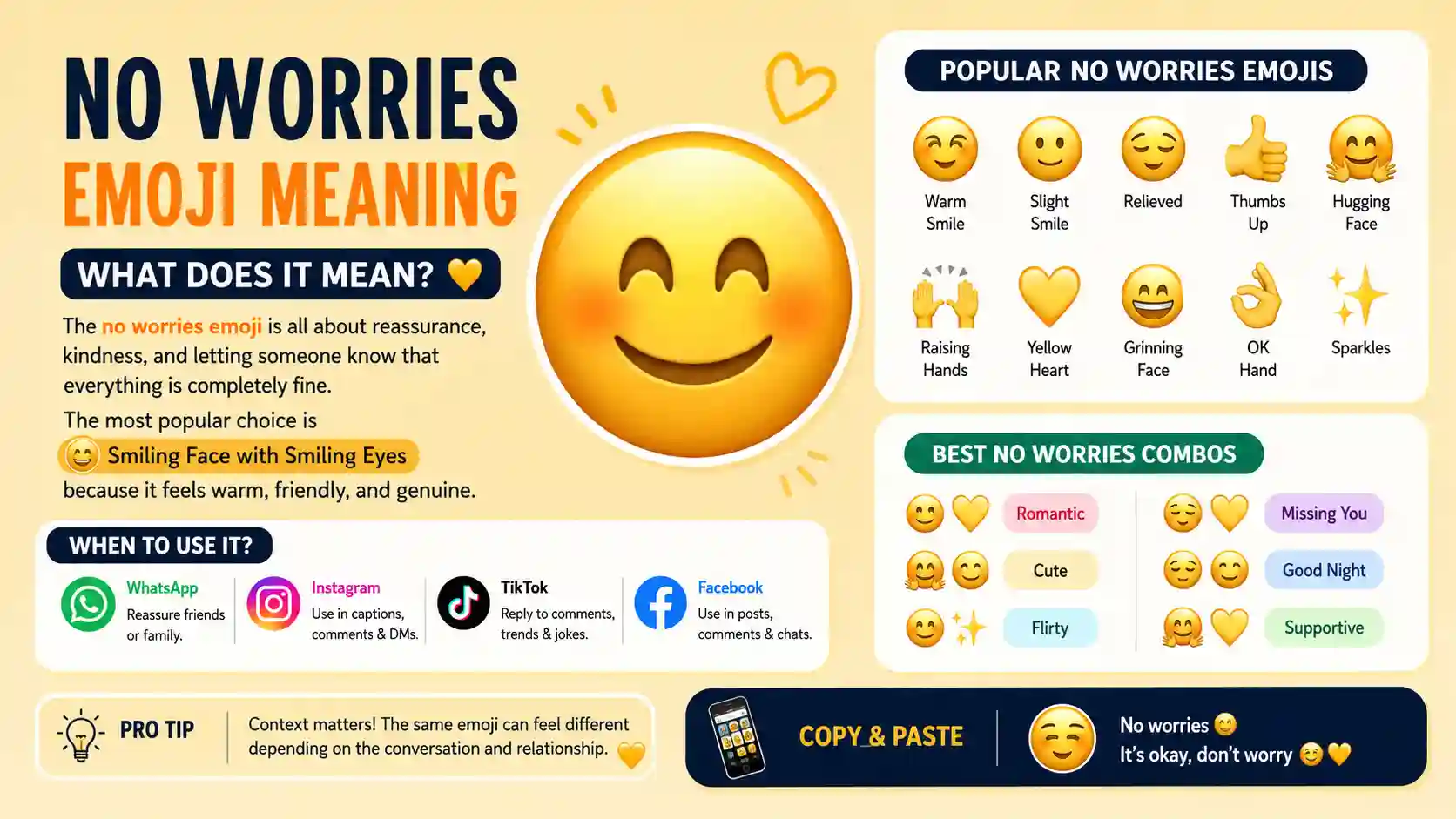
You send a friend a rushed apology text, and before you even finish typing, they reply with a single emoji. No sentence, no explanation, just 😌 or 👍. Somehow that tiny image says more than a full paragraph could. That’s the quiet power behind the no worries emoji: it closes a conversation gently, without sounding cold or dismissive.
People search for the no worries emoji because texting can feel oddly tense. A plain “no worries” in writing sometimes reads flat, even sarcastic, depending on who’s reading it. Adding the right emoji softens that tone instantly. But context still matters here. The same emoji can feel warm from a close friend and strangely distant from someone you barely know, which is exactly what this guide walks you through.
Sometimes the calmest reply isn’t a sentence at all, it’s just one relaxed little face. 😌
What Does the No Worries Emoji Mean?
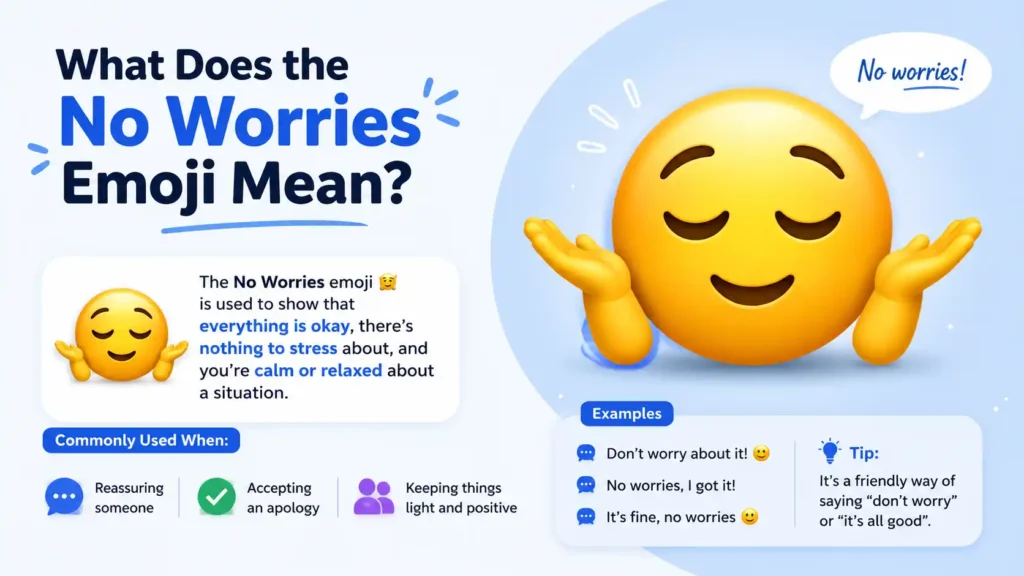
The phrase “no worries emoji” doesn’t point to a single official character. It’s really a small cluster of emojis people reach for when they want to sound calm, reassuring, or unbothered. 😌 (relieved face) is probably the closest visual match, since its soft, closed-eyed expression looks like a sigh of relief. But 👍, 🙏, and 🤙 get used the exact same way in everyday chats.
The basic meaning is reassurance. When someone apologizes, cancels plans, or asks “is this okay?”, replying with 😌 or 👍 signals that everything is genuinely fine, no hard feelings, no lingering tension. Emotionally, it works like a small exhale in text form. It says “relax” without anyone having to type the word.
In texting, the tone shifts depending on punctuation and pacing. “No worries 😌” after three messages of apology feels warm and understanding. A bare 👍 with nothing else can sometimes read as curt, especially in a longer conversation, even though that’s rarely the intent. On social media, these emojis show up more casually, often replacing a full reply in comments or DMs entirely.
Positive use is by far the most common: forgiveness, patience, calm agreement, or simply saying “I’m good with that.” The possible misread happens when tone is ambiguous. A lone 🤷 or 👌 can occasionally feel dismissive if the other person expected more emotional engagement. Context always decides this, not the emoji alone.
Meaning Table:
| Emoji | Core meaning | Possible misread | Best used when |
|---|---|---|---|
| 😌 | Calm relief, genuine reassurance | Slightly sarcastic if overused | Comforting someone after they apologize |
| 👍 | Simple agreement or acknowledgment | Cold or dismissive in emotional talks | Casual confirmations, quick replies |
| 🙏 | Gratitude, understanding, or a small plea | Overly formal or pleading | Thanking someone or asking gently |
| 😊 | Warm, friendly reassurance | Can feel generic if used constantly | Softening a message with kindness |
| ✌️ | Relaxed, breezy, “it’s all good” | Can seem too casual for serious topics | Light-hearted goodbyes or agreement |
| 🤷 | Indifference or “it doesn’t matter” | Can seem like you don’t care | Shrugging off a small mistake |
| 👌 | Confirmation, everything’s settled | Can feel abrupt without other words | Confirming plans or details |
| 😅 | Awkward relief, nervous reassurance | May read as forced or uneasy | Laughing off an awkward moment |
| 🤙 | Chill, laid-back “we’re good” | Too informal for serious contexts | Casual friend group messages |
| 💯 | Full agreement, total confidence | Can feel like overkill for small issues | Enthusiastically backing someone up |
Emoji Cards:
😌 Relieved Face:
Meaning: A calm, genuine sense that everything is fine and there’s nothing left to stress about.
Example 1: Don’t worry about being late 😌
Example 2: Glad we sorted that out 😌
👍 Thumbs Up:
Meaning: Quick agreement or acknowledgment, often used to confirm something without extra words.
Example 1: Sounds good, see you then 👍
Example 2: Got your message, all set 👍
🙏 Folded Hands:
Meaning: Gratitude, appreciation, or a soft way of asking for patience.
Example 1: Thanks for understanding 🙏
Example 2: Appreciate you being flexible 🙏
😊 Smiling Face:
Meaning: Warmth and friendliness, often added to soften a reply.
Example 1: No stress at all, take your time 😊
Example 2: Happy to help whenever 😊
✌️ Victory Hand:
Meaning: A breezy, easygoing signal that things are relaxed and casual.
Example 1: All good, catch you later ✌️
Example 2: Whatever works for you ✌️
🤷 Person Shrugging:
Meaning: Indifference, or a light “it really doesn’t matter” attitude.
Example 1: Either way is fine with me 🤷
Example 2: Not a big deal honestly 🤷
👌 OK Hand:
Meaning: A crisp signal that something is settled or confirmed.
Example 1: Perfect, see you at seven 👌
Example 2: Noted, thanks for the update 👌
😅 Grinning Face With Sweat Meaning:
A nervous but relieved reaction, often after something slightly awkward.
Example 1: Phew, thought I broke it 😅
Example 2: All good, mistakes happen 😅
🤙 Call Me Hand:
Meaning: A laid-back, friendly gesture meaning things are relaxed between close friends.
Example 1: We’re solid, don’t stress 🤙
Example 2: Hit me up whenever 🤙
💯 Hundred Points:
Meaning: Full confidence or enthusiastic agreement with what was just said.
Example 1: You’re totally fine, no worries 💯
Example 2: Trust me, it’s handled 💯
How to Use the No Worries Emoji the Right Way:
WhatsApp 💬
In personal chats, 😌 or 🙏 works well after an apology from a partner or close friend, since it reads as genuinely warm. In family group chats, 👍 tends to feel more neutral and practical, useful for quickly confirming plans without a long reply. For emotional messages, pairing 😊 with a short sentence avoids any risk of sounding curt. On WhatsApp status updates, ✌️ or 😌 alone can signal a relaxed mood without needing extra text.
Instagram 📸
😌 In captions, 😌 pairs nicely with a calm or confident vibe, like a quiet Sunday photo. In comments, 👌 or 💯 shows quick support without writing a full sentence. In bios, ✌️ can hint at an easygoing personality. On aesthetic posts, 😌 fits softer, more introspective captions, while 🤙 suits casual, fun content aimed at engagement.
TikTok 🎵
Captions often use 😅 for humor around an awkward or chaotic clip. Comments frequently feature 🤷 or 💯 as fast reactions. Irony plays a big role here too: 👍 can be used sarcastically in comment sections when a video’s outcome clearly wasn’t “fine” at all. Trends sometimes turn 😌 into a running joke about staying unbothered no matter what happens on screen.
On Facebook posts, 🙏 is common for thanking a community after support. In comments, 👍 remains the fastest way to acknowledge something. In Messenger, 😊 or 😌 keeps private conversations warm. Reactions on Facebook already include a thumbs-up button, so typed 👍 in comments usually adds a slightly more personal touch than clicking the reaction alone.
Dos and Don’ts:
Do:
- Use emojis to support your message, not replace it entirely.
- Consider how close you are with the receiver before going minimal.
- Pay attention to the conversation’s overall tone before replying.
- Match the emoji to how serious or light the topic actually is.
- Check how an emoji might render differently on another device.
Don’t:
- Use emojis randomly just to fill space.
- Assume everyone reads 👍 or 🤷 the same way you do.
- Overload a genuinely serious message with casual emojis like ✌️.
- Combine unrelated emojis without a clear reason.
- Assume 🙏 or 😊 automatically implies something romantic.
Why Do No Worries Emoji Look Different on iPhone and Android?
Emojis are built on a shared Unicode standard, which means every platform agrees on what character is being sent. But the visual design of that character isn’t standardized at all. Apple, Google, Samsung, and Microsoft each design their own artwork for the same Unicode code point, so 😌 can look noticeably different depending on where it’s viewed.
On one device, 😌 might appear with a softer blush and gentler eyes, while on another it looks slightly more neutral or flat. 👍 might have a different skin tone default or hand angle between platforms. The facial expression, color palette, and overall style can shift, yet the underlying emoji character stays exactly the same.
This is why a message that looks warm and relieved on an iPhone can occasionally look a bit more plain on an Android device, or vice versa. Neither version is “correct,” they’re just different visual interpretations of identical Unicode data, rendered by each company’s own design team.
Best No Worries Emoji Combos: Copy & Paste
Romantic ❤️
1.👉 😌🙏 — Use this for a calm, reassuring reply to someone you love.
2.👉 😊✌️ — Use this for a light, affectionate goodbye text.
3.👉 🤙😊 — Use this for a warm, casual check-in with a partner.
Cute 🥰
1.👉 😊👌 — Use this for a sweet confirmation of plans.
2.👉 😌💯 — Use this to reassure someone you truly care about.
3.👉 🙏😊 — Use this for a gentle, appreciative thank-you.
Flirty 😉
1.👉 ✌️😅 — Use this for a playful, teasing reply.
2.👉 🤙💯 — Use this for a confident, breezy flirt text.
3.👉 😌✌️ — Use this to sound relaxed yet charming.
Missing Someone 💭
1.👉 😌🙏 — Use this to send calm reassurance while apart.
2.👉 🤙😊 — Use this to say you’re thinking of them casually.
3.👉 😊💯 — Use this to express genuine warmth from a distance.
Good Night 🌙
1.👉 😌✌️ — Use this for a peaceful, relaxed goodnight.
2.👉 🙏😊 — Use this for a grateful, warm goodnight message.
3.👉 👍😌 — Use this for a simple, easygoing goodnight.
Trending No Worries Emoji in 2026:
😌, 🤙, and 💯 are commonly seen across casual online conversations right now, especially in comment sections where quick reactions matter more than full sentences. 😌 in particular shows up frequently in captions tied to slow, unbothered lifestyle content, often paired with soft aesthetics or calming visuals. 🤙 remains popular among younger users who favor short, friendly shorthand over longer replies.
Creators often lean on 💯 to back up a claim quickly, while everyday users tend to reach for 👍 and 🙏 in more practical, day-to-day exchanges like scheduling or quick check-ins. These emojis appear often in captions, comments, and messaging threads, rather than being tied to one single platform.
| Emoji | Why trending | Who uses it | Platform |
|---|---|---|---|
| 😌 | Fits “unbothered” and calm-life content | Lifestyle creators, everyday users | Instagram, TikTok |
| 🤙 | Fast, friendly, casual shorthand | Younger users, close friend groups | WhatsApp, TikTok |
| 💯 | Backs up statements with confidence | Comment section users, creators | TikTok, Instagram |
| 🙏 | Practical gratitude and quick replies | General everyday texting | WhatsApp, Facebook |
Overall, emoji usage keeps shifting alongside how people communicate day to day, and habits like these tend to change gradually rather than overnight.
No Worries Emoji Meaning in Different Contexts:
In romantic conversations, 😌 or 🙏 tends to feel intimate and reassuring, especially after a small disagreement. Among friends, ✌️ or 🤙 keeps things light and casual, matching the relaxed tone most friendships run on. With family, 👍 or 😊 often works best, staying warm without feeling overly familiar.
In professional settings, 👍 is generally the safest choice, since it reads as efficient rather than emotionally loaded. Casual work chats might allow 🙏 for a quick thank-you, but 🤙 or ✌️ usually feel too informal for that setting. In texting overall, pacing matters: an emoji sent instantly after an apology feels warmer than one sent minutes later. On social media comments and captions, these same emojis get used more loosely, often standing in for a full reaction rather than a personal reply.
How to Copy and Paste the No Worries Emoji:
Copying 😌 is simple no matter what device you’re using. On most phones and computers, you can select it directly from your keyboard’s emoji panel, or copy it from a page like this one.
Copy this: 😌
Once copied, you can paste it directly into WhatsApp chats, Instagram captions or comments, TikTok captions or comment replies, and Facebook posts or Messenger conversations. The same steps work for any of the other emojis mentioned throughout this guide.
Frequently Asked Questions:
What is the most popular no worries emoji?
😌 and 👍 are the two most commonly used choices. 😌 leans warmer and more reassuring, while 👍 feels quicker and more neutral.
What does 😌 mean when someone sends it?
It usually signals calm reassurance rather than anything gender-specific. The real meaning depends on the conversation and your relationship with the sender, not any fixed rule.
Why do emojis look different on iPhone vs Android?
Both platforms follow the same Unicode standard, but each company designs its own artwork for every emoji. The character stays identical, only the visual style changes between devices.
Are no worries emojis used differently in other countries?
Cultural habits and messaging norms can shape how casually or formally people use these emojis. Interpretation often depends more on community and personal relationships than on any single universal rule.
Conclusion:
At the end of the day, 😌, 👍, and their close relatives all do the same quiet job: they take the edge off a message and make the other person feel at ease. Pay attention to who you’re talking to and how the conversation is flowing, and the right emoji will usually feel obvious. Used thoughtfully, one small icon can carry exactly the calm you meant to send. 😊

Nasrullah — Emoji Strategist & Content Writer
Nasrullah is a passionate emoji enthusiast and content writer who loves exploring the meanings, uses, and cultural context behind emojis. He creates simple, helpful, and easy-to-understand guides that help readers choose the right emoji for WhatsApp, Instagram, Facebook, texting, and everyday conversations.
With a focus on emoji meanings, combinations, social media usage, and modern digital communication, Nasrullah aims to make every emoji easier to understand and use with confidence. His content combines practical examples with clear explanations so readers can quickly find the meaning and usage they are looking for.
When he’s not researching emojis, Nasrullah enjoys exploring digital trends, writing useful online content, and learning about how people communicate in the digital world. 😊