You receive a short text from a friend, and it ends with a smiling face. Are they happy, being polite, or trying to make a joke? A few minutes later, someone sends a crying face that could mean genuine sadness or laughter so intense that they cannot stop. That is the fun, and sometimes confusing, part of emotion emoji faces.
These expressive little symbols help people share feelings without writing long explanations. You can use them to show happiness, affection, sadness, embarrassment, frustration, surprise, or even mixed emotions. They appear in WhatsApp messages, Instagram captions, TikTok comments, Facebook posts, and everyday text conversations.
However, an emoji does not always communicate the same feeling to everyone. Your relationship with the sender, the words around it, and the conversation itself all matter. 😊 😢 😍 Understanding these differences helps you choose the right face, read messages more confidently, and avoid misunderstandings.
In this guide, you will discover common facial emoji meanings, practical examples, platform-specific uses, and easy combinations you can copy and paste.
What Do Emotion Emoji Faces Mean?
Emotion emoji faces are small digital expressions that help communicate feelings, reactions, and social signals. They can make a message sound cheerful, affectionate, playful, disappointed, or upset. Their meaning depends on how you use them, not just how they look.
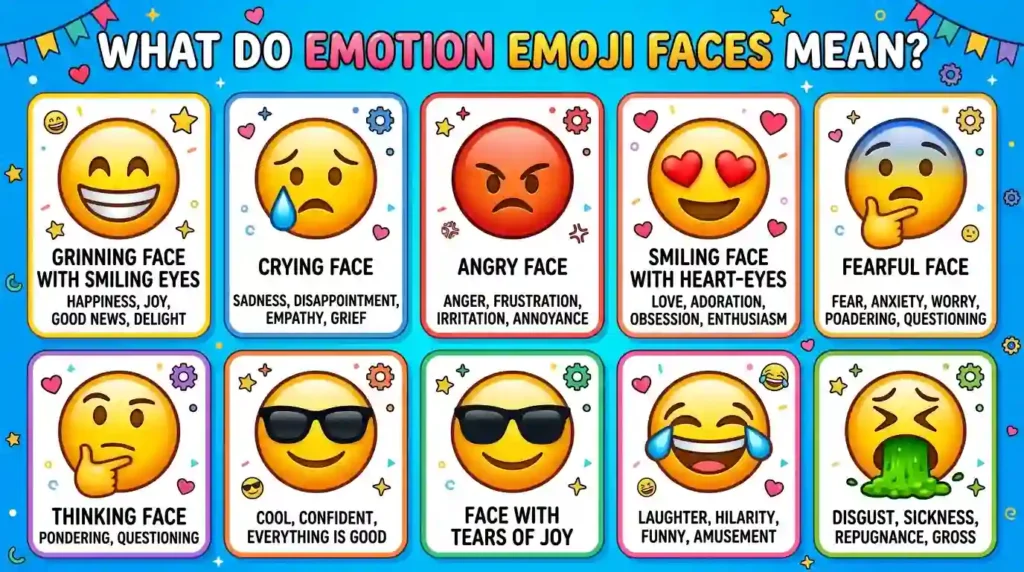
Here are six common faces and the feelings they can communicate:
- 😀 Grinning Face: Often expresses happiness, friendliness, excitement, or a positive reaction. For example, “I finally finished my project 😀” sounds cheerful and satisfied.
- 🙂 Slightly Smiling Face: Can show gentle friendliness, quiet happiness, or polite acknowledgment. Depending on the conversation, it can also feel reserved or slightly sarcastic.
- 😊 Smiling Face with Smiling Eyes: Usually communicates warmth, appreciation, shyness, or genuine happiness. It works well when thanking someone or responding to a kind message.
- 😂 Face with Tears of Joy: Commonly expresses laughter, amusement, or a reaction to something extremely funny. People also use it to make playful comments feel less serious.
- 🥹 Face Holding Back Tears: Can suggest being touched, grateful, overwhelmed, or close to tears. It may express happiness mixed with sadness.
- 😍 Smiling Face with Heart-Eyes: Often communicates admiration, delight, attraction, or affection. It can describe a person, a beautiful outfit, a favorite meal, or something you absolutely love.
Other expressions, such as 😢 and 😭, may communicate sadness, disappointment, emotional pain, or intense feelings. Meanwhile, 😳 can suggest embarrassment, shock, or surprise, and 😡 often signals anger or frustration.
In texting, these faces help clarify the emotional tone of short messages. On social media, they can add personality to captions, reactions, and comments.
Still, context matters. A smiling face from a close friend might feel affectionate, while the same face after an argument might seem distant or sarcastic. Likewise, heart-eyes can express romantic interest, but they can also simply mean that someone loves a photo or outfit.
The best approach is to read the entire message before deciding what an emoji means. Consider the sender, the relationship, the topic, and the surrounding words. These clues usually provide a better interpretation than the emoji alone.
Emotion Emoji Faces Meaning Table
| Emoji | Core meaning | Possible misread | Best used when |
|---|---|---|---|
| 😀 | Happiness and excitement | Forced enthusiasm | Sharing good news |
| 🙂 | Politeness and mild happiness | Sarcasm or annoyance | Giving a gentle response |
| 😊 | Warmth and appreciation | Romantic interest | Thanking someone |
| 😂 | Strong amusement | Laughing at someone | Reacting to a funny moment |
| 🥹 | Being touched or overwhelmed | Genuine sadness only | Expressing gratitude |
| 😢 | Sadness or disappointment | Excessive seriousness | Sharing a difficult moment |
| 😭 | Intense emotion or dramatic laughter | Literal crying only | Expressing overwhelming feelings |
| 😍 | Admiration and affection | Romantic attraction | Praising something you love |
| 😳 | Embarrassment or shock | Disapproval | Reacting to surprising news |
| 😡 | Anger or frustration | Playful annoyance | Showing clear displeasure |
Emotion Emoji Faces: 10 Useful Emoji Cards
😀 Grinning Face
Meaning: Happiness, excitement, and an upbeat attitude.
Example 1: I passed my driving test today 😀
Example 2: We are finally going on vacation!
🙂 Slightly Smiling Face
Meaning: Gentle friendliness, politeness, or a restrained reaction.
Example 1: Thanks for letting me know 🙂
Example 2: That sounds like a plan 🙂
😊 Smiling Face with Smiling Eyes
Meaning: Warmth, appreciation, and sincere happiness.
Example 1: You always know how to cheer me up 😊
Example 2: Thank you for remembering my birthday 😊
😂 Face with Tears of Joy
Meaning: Laughter, amusement, or something hilariously funny.
Example 1: That video caught me completely off guard 😂
Example 2: You really told that story with a straight face 😂
🥹 Face Holding Back Tears
Meaning: Being touched, deeply grateful, or emotionally overwhelmed.
Example 1: You remembered the little things 🥹
Example 2: This surprise means so much to me 🥹
😢 Crying Face
Meaning: Sadness, disappointment, or emotional hurt.
Example 1: I wish you could have been here today 😢
Example 2: My favorite show just ended 😢
😭 Loudly Crying Face
Meaning: Intense sadness, dramatic emotion, or overwhelming laughter in some online conversations.
Example 1: I cannot believe we have to say goodbye 😭
Example 2: That plot twist was too much for me 😭
😍 Smiling Face with Heart-Eyes
Meaning: Strong admiration, affection, delight, or attraction.
Example 1: You look amazing in that picture 😍
Example 2: Freshly baked cookies straight from the oven 😍
😳 Flushed Face
Meaning: Embarrassment, surprise, nervousness, or being caught off guard.
Example 1: You read my message out loud? 😳
Example 2: Wait, that was supposed to be a secret 😳
😡 Pouting Face
Meaning: Anger, frustration, or strong displeasure.
Example 1: The game crashed right before I saved 😡
Example 2: You ate the last slice without asking? 😡
How to Use Emotion Emoji Faces the Right Way?
Emotion emoji faces work best when they support the message you want to send. A simple smile can make a thank-you sound warmer, while a crying face can show disappointment without a long explanation. The key is to match your expression to the situation.
WhatsApp 💬
WhatsApp conversations are often personal, so facial emojis can help friends and family understand your tone.
- Personal chats: Use 😊 when thanking someone or showing appreciation. For example, “That was so thoughtful of you 😊.”
- Family conversations: Add 😀 when sharing good news or celebrating a small achievement.
- Friendships: Use 😂 when a friend sends a funny story or makes a joke.
- Emotional messages: Choose 🥹 when something touches your heart, or 😢 when you want to express disappointment.
- Status updates: A smiling face can accompany a happy life update, while 😭 may fit an emotional or humorously dramatic post.
Remember that not every message needs an emoji. Sometimes, clear words are enough.
Instagram 📸
Instagram emojis often complement visual content. They can help communicate your reaction to a picture, reel, or personal milestone.
- Captions: Add 😊 to a cheerful everyday photo.
- Comments: Use 😍 to express admiration for someone’s outfit, artwork, or photography.
- Bios: A carefully chosen face can reflect a friendly or playful personality.
- Reels: Use 😂 to react to relatable comedy or an unexpected moment.
- Aesthetic posts: Choose an expression that matches the mood of the image rather than adding one simply for decoration.
For example, “This outfit came together perfectly 😍” makes your admiration clear without requiring a lengthy comment.
TikTok 🎵
TikTok conversations frequently include playful reactions, exaggerated feelings, and humorous commentary. Here, an emoji may communicate more than its literal facial expression.
- Captions: Use 😂 when introducing a funny or relatable video.
- Comments: Add 😳 when a plot twist or unexpected reveal surprises you.
- Reactions: Use 🥹 for a touching story or an emotional reunion.
- Humor and irony: A simple 🙂 can sometimes convey dry humor, especially when the written message sounds deliberately understated.
- Trends: Follow the tone of the video or conversation instead of assuming that every emoji has a fixed meaning.
For example, “I said I would go to bed early, and now it is 2 a.m. 😂” uses the face to reinforce a relatable joke.
On Facebook, emotion emoji faces work in posts, comments, Messenger conversations, and everyday reactions. Use 😊 to thank someone for a kind comment, 😍 to compliment a photograph, or 😢 to respond sympathetically to difficult news.
In Messenger, consider the seriousness of the conversation before using a playful expression. In public comments, remember that people outside your immediate circle may interpret the same face differently.
Do’s and Don’ts of Emotion Emoji Faces
A few simple habits can make your messages easier to understand.
Do
- Match the feeling: Use 😊 for warmth and 😂 for genuine amusement.
- Think about the receiver: A close friend may understand your humor better than a new acquaintance.
- Read the context: Look at the words and conversation before interpreting an emoji.
- Keep your tone consistent: A cheerful message usually works better with a cheerful expression.
- Check device differences: If an expression is important, make your words clear too.
Don’t
- Use faces randomly: Choose expressions that contribute something to the message.
- Assume everyone agrees: Personal preferences and community habits vary.
- Overload serious messages: Too many playful faces can make an apology or difficult conversation seem insincere.
- Create confusing combinations: Stick to expressions that support the same general feeling.
- Assume romance: 😍 can show attraction, but it can also express enthusiasm for an object, photo, or experience.
A useful rule is to let the words carry the main message and use the emoji to reinforce the tone.
Why Do Emotion Emoji Faces Look Different on iPhone and Android?
Have you ever sent a smiling face from an iPhone and noticed that it looks slightly different on a friend’s Android phone? That is normal. Emoji characters have standardized identities, but their artwork can vary between platforms.
The Unicode Standard provides the system used to identify emoji characters and their sequences. Companies such as Apple, Google, Samsung, and Microsoft can design their own artwork to display those characters.
As a result, the same emoji may have differences in:
- Shape: Eyes, mouths, eyebrows, and facial outlines can vary.
- Color: Skin tones, shading, and other colors may look different.
- Expression: One design might look warmer, while another appears more exaggerated.
- Size and style: Some designs are glossy and detailed, while others look flatter or simpler.
- Rendering: Operating systems, apps, fonts, and software versions can affect how an emoji appears.
For example, 🙂 may look like a gentle smile on one device but seem more restrained on another. The underlying character is still the same, even if the artwork creates a slightly different impression.
These differences do not mean that one company’s design is automatically correct and another is wrong. Each company follows the relevant character standard while making its own visual choices.
If a conversation is sensitive, avoid relying on a facial emoji alone to communicate something important. Add a few words to explain your feelings. This is especially helpful when a joke, apology, or affectionate message could otherwise be misunderstood.
Best Emotion Emoji Faces Combos: Copy and Paste
Combining facial expressions can add nuance to a message. The following combinations use the same core emoji family and are easy to copy into chats, captions, and comments.
Romantic ❤️
- 👉 😊😍: Use this for a sweet compliment to someone you care about.
- 👉 🥹😊: Share this when a thoughtful gesture makes you emotional.
- 👉 😍😊: Add this to a warm, affectionate message.
Cute 🥰
- 👉 😊🥹: Use this for a touching moment or a thoughtful surprise.
- 👉 😀😊: Share this when you are in a cheerful mood.
- 👉 🥹😍: Use this to react to something especially adorable.
Flirty 😉
- 👉 😳😊: Send this when a compliment catches you off guard.
- 👉 😍😳: Use this for playful surprise at someone’s appearance.
- 👉 🙂😍: Add this to a lighthearted, admiring message.
Missing Someone 💭
- 👉 🥹😢: Use this when you feel emotional about being apart.
- 👉 😢😭: Share this to express intense sadness about a goodbye.
- 👉 😊🥹: Use this when remembering a person brings both happiness and emotion.
Good Night 🌙
- 👉 😊🙂: Send this as a gentle, friendly sign-off.
- 👉 🥹😊: Use this after a meaningful conversation before bed.
- 👉 😍😊: Add this to a warm good-night message for someone special.
Tip: These combinations do not have official, universal meanings. Your message and relationship with the recipient help determine how they are understood.
Trending Emotion Emoji Faces in 2026
Facial expressions remain a natural part of everyday online communication because they are quick, recognizable, and flexible. In 2026, people continue to use familiar faces to add emotional detail to messages, react to videos, and give short comments a clearer tone.
The examples below describe common usage patterns, not a measured ranking of the year’s most popular emojis.
😊 Warm and Friendly Expressions
The smiling face with smiling eyes is useful when a message needs warmth without becoming overly dramatic. People use it in WhatsApp conversations, Instagram comments, thank-you messages, and friendly replies.
For example, “Really appreciate your help 😊” sounds welcoming and appreciative.
😂 Humorous Reactions
The face with tears of joy remains recognizable as an expression of laughter. It fits funny videos, relatable situations, amusing stories, and playful conversations.
Creators and viewers may use it in TikTok comments or Instagram captions to reinforce a joke. In some contexts, it can also soften teasing.
🥹 Emotional Responses
The face holding back tears suits touching stories, kind gestures, reunions, and moments of gratitude. It allows people to communicate that something has affected them emotionally without writing a long response.
For instance, “They saved me a seat even though I was late 🥹” communicates appreciation and being touched.
😍 Expressions of Admiration
The heart-eyes face appears naturally in compliments, fan reactions, photos, and posts featuring something a person loves. It can express enthusiasm for a beautiful view, a favorite outfit, or a romantic interest.
The surrounding words make the intended feeling clearer.
| Emoji | Why trending | Who uses it | Platform |
|---|---|---|---|
| 😊 | Adds warmth to short messages | Friends and everyday users | WhatsApp, Instagram |
| 😂 | Communicates amusement quickly | Viewers, creators, and friends | TikTok, Facebook |
| 🥹 | Expresses an emotional response | Storytellers and audiences | Instagram, TikTok |
| 😍 | Shows admiration and enthusiasm | Fans, friends, and couples | Instagram, WhatsApp |
These examples reflect recognizable communication habits rather than verified live trend rankings. Emoji use continues to evolve as online communities develop their own ways of expressing feelings.
Emotion Emoji Faces Meaning in Different Contexts
The same facial emoji can communicate different feelings depending on the situation. Instead of memorizing one definition, consider how the expression fits the conversation.
Romantic Conversations
In romantic chats, 😊 can make a compliment feel gentle, while 😍 may communicate attraction or excitement. The 🥹 face can express how much a thoughtful message means to you.
Example: “You made my day 😊”
However, one affectionate emoji does not automatically prove that someone has romantic feelings. Look at the overall conversation.
Friendship
Friends often use 😂 to react to jokes, 😀 to celebrate achievements, and 😳 to respond to surprising news.
Example: “You actually remembered that story? 😂”
Among close friends, exaggerated expressions can become part of an inside joke.
Family Conversations
Family chats often include smiles, laughter, and emotional reactions. 😊 works well for appreciation, while 🥹 can express gratitude when someone shares meaningful news.
Example: “Thank you for always checking on me 🥹”
Professional and Casual Communication
In casual workplace chats, a simple 😀 or 😊 can make a friendly message feel approachable. However, professional expectations vary by workplace and relationship.
Example: “Thanks for sending the updated file 😊”
For formal complaints, sensitive feedback, or serious discussions, clear wording is usually more helpful than relying on facial expressions.
Texting and Social Media Comments
In text messages, facial emojis help clarify tone when there is no voice or body language. On social media, they can communicate an immediate reaction to photos, videos, jokes, and personal updates.
For example, 😍 beneath a friend’s photography post may be a compliment rather than a romantic signal. Similarly, 🙂 after a sarcastic sentence may indicate irony, politeness, or genuine friendliness.
Captions
When writing a caption, choose a face that supports the moment. Use 😀 for a happy achievement, 😂 for a funny memory, or 🥹 for a meaningful milestone.
The simplest way to avoid confusion is to make your wording and facial emoji work together.
How to Copy and Paste Emotion Emoji Faces
Copying an emotion emoji face takes only a few seconds. You can use the same character in messages, captions, comments, and status updates.
Copy-paste line:
😀 🙂 😊 😂 🥹 😢 😭 😍 😳 😡
Select the faces you want, then copy and paste them wherever supported.
Copy all faces Copy 😊 Copy 😂
Follow these steps:
- Select the emoji or combination you want.
- Copy it using your device’s copy command or the buttons above.
- Open WhatsApp, Instagram, TikTok, or Facebook.
- Paste the emoji into your message, caption, comment, or status.
- Read the complete message once before sending it.
You can also open your phone’s emoji keyboard and search for an expression by its name or general feeling.
If a face looks slightly different after pasting, the app or device may be displaying its own artwork. The intended character can remain the same.
Frequently Asked Questions
1. What is the most popular emotion emoji face?
There is no single face that is universally the most popular across every platform and audience. 😊 and 😂 are familiar choices for warmth and laughter, while 😍 is widely recognizable as an expression of admiration.
2. What does an emotion emoji face mean when someone sends it?
Its meaning depends on the conversation, the sender’s usual communication style, and your relationship. For example, 😍 may express romantic interest or simply admiration for a picture. Consider the accompanying words rather than assuming a specific intention.
3. Why do emojis look different on iPhone vs Android?
Unicode standardizes emoji characters, while Apple, Google, Samsung, and other companies create their own artwork. Differences in facial features, colors, and proportions can change how an expression appears without necessarily changing its underlying character.
4. Are emotion emoji faces used differently in other countries?
Yes, interpretations can vary across languages, cultures, age groups, and online communities. However, differences are not identical for everyone within a country. When communicating across cultures, pay attention to context and ask for clarification if a message seems ambiguous.
Conclusion
Emotion emoji faces make everyday conversations more expressive, helping you communicate feelings with just a small symbol. 😊
Choose expressions that match your words, relationship, and situation rather than relying on a single fixed meaning.
Whether you are chatting privately or posting publicly, a little context can prevent misunderstandings and make your messages feel more natural.

Nasrullah — Emoji Strategist & Content Writer
Nasrullah is a passionate emoji enthusiast and content writer who loves exploring the meanings, uses, and cultural context behind emojis. He creates simple, helpful, and easy-to-understand guides that help readers choose the right emoji for WhatsApp, Instagram, Facebook, texting, and everyday conversations.
With a focus on emoji meanings, combinations, social media usage, and modern digital communication, Nasrullah aims to make every emoji easier to understand and use with confidence. His content combines practical examples with clear explanations so readers can quickly find the meaning and usage they are looking for.
When he’s not researching emojis, Nasrullah enjoys exploring digital trends, writing useful online content, and learning about how people communicate in the digital world. 😊