You have exciting news, you finally finish a difficult task, or you cannot wait to tell a friend something amazing. Instead of typing a long message, you might reach for a jumping emoji to show exactly how you feel. But what does the jump emoji actually mean, and which version should you use?
The jump emoji can represent excitement, celebration, physical activity, freedom, or the feeling of being unable to sit still. Its meaning depends on the specific emoji, the words around it, and the conversation. For example, 🏃 can suggest running toward a goal, while 🤸 often brings a playful, energetic feeling. A jumping person can also make a caption feel more lively or help a friend understand your excitement. 🎉
In this guide, you will learn how jumping emojis work in texting, WhatsApp, Instagram, TikTok, and Facebook. You will also find practical examples, copy-and-paste combinations, and tips for choosing an emoji that fits your message.
From celebrating a little victory to showing unstoppable energy, a jumping emoji can make your message feel instantly more alive. 🤸
What Does the Jump Emoji Mean?
The jump emoji usually represents excitement, happiness, movement, celebration, or a burst of energy. However, there is no single universal emoji officially named the “jump emoji.” People may use different human-activity emojis to express jumping, depending on what they want to communicate. The person cartwheeling emoji 🤸 is especially relevant to physical jumping and playful movement, while 🏃 often suggests running, rushing, or moving toward something.
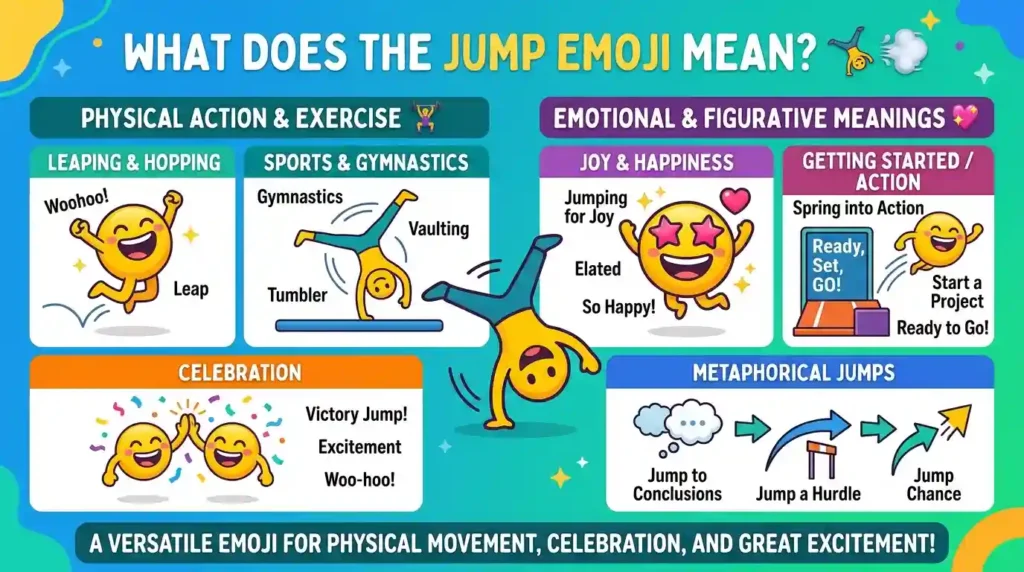
Here are six closely related emojis and how they can work in everyday conversations.
- 🤸 Cartwheeling: Often suggests gymnastics, energetic movement, playful excitement, or showing off a physical skill.
- 🏃 Running: Can communicate urgency, exercise, determination, or getting away from a situation. In a funny chat, it might suggest running away from responsibilities.
- 🏃♀️ Woman Running: Can represent fitness, speed, an active lifestyle, or someone rushing to finish something.
- 🏃♂️ Man Running: Often appears in workout conversations, race updates, or jokes about being in a hurry.
- 🙌 Raising Hands: Commonly expresses celebration, relief, success, or excitement. It works well alongside a jumping figure.
- 🎉 Party Popper: Adds a celebratory feeling to achievements, announcements, birthdays, and happy news.
In texting, the jumping emoji can communicate something like, “I am so excited!” or “I finally did it!” On social media, it can add energy to a fitness video, dance clip, celebration photo, or achievement post.
Context matters, too. If a friend says, “I passed my exam 🤸,” the emoji may suggest excitement. If someone uses it beneath a gymnastics video, the physical activity may be the main point. Meanwhile, a playful combination such as “Weekend is finally here 🏃” could communicate eagerness to leave work behind.
The sender’s relationship with the receiver also influences interpretation. A close friend might understand the emoji as a joke, while someone unfamiliar with your style might interpret it literally. The surrounding words, platform, culture, and personal habits all help determine its intended meaning.
Jump Emoji Meaning Table
| Emoji | Core meaning | Possible misread | Best used when |
|---|---|---|---|
| 🤸 | Acrobatics, playful energy | Showing off | Gymnastics or excitement |
| 🏃 | Running, urgency | Escaping a problem | Exercise or rushing |
| 🏃♀️ | Running, activity | Literal running only | Fitness updates |
| 🏃♂️ | Speed, determination | Being in a hurry | Workout or race posts |
| 🤸♀️ | Gymnastics, movement | Competitive sport only | Active lifestyle content |
| 🤸♂️ | Acrobatics, physical skill | Showing off | Sports and playful chats |
| 🦘 | Hopping, bouncing | An animal reference only | Jumping or Australia-related content |
| 💃 | Dancing, lively energy | A dance-only reference | Celebrations and fun |
| 🕺 | Dancing, confidence | A performance reference | Parties and playful messages |
| 🙌 | Celebration, relief | A religious gesture | Good news and achievements |
10. Jump-Related Emoji Cards
🤸 Cartwheeling Person
Meaning: Playful movement, gymnastics, and energetic excitement.
Example 1: Finally trying that gymnastics class 🤸
Example 2: That trick was incredible 🤸
🏃 Person Running
Meaning: Speed, exercise, urgency, or moving toward a goal.
Example 1: Getting my morning run done 🏃
Example 2: The bus is here, and I am not ready 🏃
🏃♀️ Woman Running
Meaning: Fitness, determination, and active movement.
Example 1: Training for my first race 🏃♀️
Example 2: A little exercise before the day begins 🏃♀️
🏃♂️ Man Running
Meaning: Running, athletic effort, or rushing somewhere.
Example 1: Back on the running track 🏃♂️
Example 2: Me heading toward the weekend 🏃♂️
🤸♀️ Woman Cartwheeling
Meaning: Gymnastics, flexibility, and lively movement.
Example 1: Practicing a new routine 🤸♀️
Example 2: Feeling energetic after a great workout 🤸♀️
🤸♂️ Man Cartwheeling
Meaning: Acrobatics, physical skill, and playful energy.
Example 1: That move took serious practice 🤸♂️
Example 2: Ready to learn another gymnastics trick 🤸♂️
🦘 Kangaroo
Meaning: Hopping, bouncing, and kangaroo-related references.
Example 1: Bouncing into the weekend 🦘
Example 2: My favorite animal at the wildlife park 🦘
💃 Woman Dancing
Meaning: Dancing, celebration, confidence, and fun.
Example 1: The music is too good to sit still 💃
Example 2: Celebrating the end of exams 💃
🕺 Man Dancing
Meaning: Dancing, confidence, and a carefree mood.
Example 1: Someone put on my favorite song 🕺
Example 2: Bringing some energy to the party 🕺
🙌 Raising Hands
Meaning: Celebration, excitement, relief, or shared success.
Example 1: We finally finished the project 🙌
Example 2: Friday is almost here 🙌
How to Use the Jump Emoji the Right Way?
The best way to use a jump emoji is to match it with the feeling or action you want to express. Think about whether your message is about physical activity, excitement, a celebration, or a funny situation. The same symbol can feel different depending on the words surrounding it.
WhatsApp 💬
On WhatsApp, jumping emojis work well in personal conversations because they add emotion without requiring a long explanation.
- Personal chats: Share excitement about good news. Example: “I got the tickets! 🤸”
- Family conversations: Celebrate a family achievement or a happy announcement. Example: “We are all meeting this weekend 🙌”
- Friendships: Make everyday messages feel playful. Example: “Only two more days until our trip 🏃”
- Emotional messages: Show relief after something stressful is finally over. Example: “The results are finally out 🙌”
- Status updates: Pair a jumping or running figure with a short update about exercise, a personal goal, or an exciting day.
For instance, “I finished everything before the deadline 🏃” might suggest a frantic rush, while “I finished everything before the deadline 🙌” focuses more on relief and achievement.
Instagram 📸
Instagram emojis often appear alongside photos, Reels, fitness updates, and short captions. A jumping figure can help communicate movement and enthusiasm.
- Captions: “Chasing goals, one step at a time 🏃”
- Comments: “That move was so smooth 🤸”
- Bios: A running figure can support a simple fitness or sports identity.
- Aesthetic posts: Use one relevant emoji to complement an action shot instead of overwhelming the image.
- Reels: Add a jumping figure to a gymnastics clip, workout montage, dance video, or celebratory moment.
- Engagement: Respond to a friend’s achievement with “You did it! 🙌” to show support.
The caption should still make sense without the emoji. The symbol adds personality, but the photo or video provides the main context.
TikTok 🎵
TikTok is particularly suited to movement-related emojis because so much content involves dancing, sports, comedy, challenges, and quick reactions.
You might use 🤸 under an impressive acrobatics clip or 🏃 in a joke about running away from an awkward situation. A caption such as “Me leaving when someone says we have extra homework 🏃” creates a humorous image without needing a long explanation.
These emojis can also support dance videos, fitness transformations, personal milestones, and playful reactions. However, an emoji alone does not establish that a clip belongs to a particular trend. The video’s audio, caption, and surrounding conversation help viewers understand the joke.
On Facebook, jumping emojis can make posts, comments, and Messenger conversations feel more expressive.
Use 🙌 when congratulating a friend on a new job, 🤸 when reacting to a gymnastics achievement, or 🏃 when sharing an update about a race. In family groups, these symbols can add enthusiasm to good news. In public comments, a relevant emoji can make a short response feel warmer.
The main rule is simple: choose an emoji that supports your message rather than forcing the reader to guess what you mean.
Do’s and Don’ts of Jump Emojis
A little attention to context makes emoji communication clearer.
Do
- Use 🤸 when a message involves acrobatics, gymnastics, or playful energy.
- Consider your relationship with the receiver before choosing a teasing or humorous interpretation.
- Match 🏃 with a running, exercise, or rushing-related message.
- Use 🙌 to celebrate a genuine achievement or express relief.
- Check how the emoji looks on your device if visual accuracy matters.
Don’t
- Assume that every jumping figure has exactly the same meaning.
- Use a playful emoji to replace a thoughtful response to serious news.
- Combine several movement emojis without a clear purpose.
- Assume a running figure always means someone is physically exercising.
- Expect every recipient to understand an inside joke immediately.
For example, “I am leaving now 🏃” is clear enough in most casual chats. In a professional conversation, however, “I am heading out now” may be more appropriate without any emoji. Emojis are useful communication tools, but they cannot always replace precise wording.
Why Do Jump Emojis Look Different on iPhone and Android?
Have you ever sent an emoji from your phone and noticed that it looks slightly different on a friend’s screen? That is normal. Emojis are encoded using Unicode standards, but the companies that build operating systems and applications can create their own visual designs.
Apple, Google, Samsung, Microsoft, and other providers may draw the same emoji character with different shapes, proportions, colors, and styling. One version may look more detailed, while another may appear simpler or more cartoon-like.
For jumping and movement emojis, the differences may be especially noticeable in body posture, clothing, hair, facial details, and the position of the arms or legs. The same person-running emoji may look slightly different between two devices even when both represent the same Unicode character.
Here is what can vary:
- Shape: Limbs and body proportions may be drawn differently.
- Color: Clothing, skin tones, and other visual details can vary.
- Expression: Where a face is visible, its appearance may differ.
- Style: Some designs look more realistic, while others use a simplified illustration.
- Size: The emoji’s apparent size can depend on the app, font, and display.
For example, you might send 🏃♀️ from an iPhone to someone using Android. The receiver may see a different illustration, but the underlying character is still intended to represent the same emoji.
There are also practical exceptions. An older operating system might not support a newer emoji, so it could display as a blank box or another placeholder. Some applications may use their own emoji artwork, too.
Neither Apple’s nor Google’s design is automatically the universally correct visual version. Unicode helps standardize the characters, while platform designers determine how those characters look. If a particular pose or detail matters, adding a few descriptive words alongside the emoji is a good idea.
Best Jump Emoji Combos: Copy and Paste
Jump-related emoji combinations can add energy to messages, captions, and comments. Choose a combination that matches the situation, whether you are celebrating a win, joking with a friend, or talking about an upcoming adventure.
Romantic ❤️
- 🤸🙌: Use this for an excited reaction to a lovely surprise.
- 🏃💃: Use this for a playful message about rushing to meet your partner and dance together.
- 🙌💃: Use this to celebrate a special date or happy relationship milestone.
Cute 🥰
- 🤸🦘: Use this for a playful, bouncy mood.
- 🏃🙌: Use this when you are excited to see a friend.
- 💃🤸: Use this for a cheerful message about dancing around the room.
Flirty 😉
- 🕺💃: Use this when suggesting a fun dance date.
- 🏃🙌: Use this to playfully show how excited you are about meeting someone.
- 🤸💃: Use this for a lively reaction to a fun invitation.
Missing Someone 💭
- 🏃🙌: Use this when you are eagerly heading toward a reunion.
- 🏃💃: Use this for a playful message about meeting again and having fun.
- 🙌🤸: Use this when you cannot wait to catch up with someone.
Good Night 🌙
- 🏃🙌: Use this to celebrate finishing the day’s tasks before bed.
- 🤸🕺: Use this for a playful message after an energetic evening.
- 💃🙌: Use this to end a fun night on a cheerful note.
These are creative combinations rather than fixed emoji definitions. Their interpretation depends on your message, so add a few words when the intended meaning is not obvious.
Trending Jump Emojis in 2026
Movement and activity emojis remain useful in everyday online communication because they can express actions, moods, and reactions in a compact way. In 2026, you can encounter them in fitness posts, dance videos, sports conversations, achievement updates, and playful captions. However, there is no single verified trend ranking that establishes one jump-related emoji as the most popular across all platforms.
Four relevant choices offer different ways to express energy.
🤸 for playful movement: This emoji fits gymnastics clips, acrobatic performances, and messages about trying something new. It can also make a reaction feel energetic rather than formal.
🏃 for urgency and action: People can use a running figure in workout updates, race captions, and jokes about rushing away from an awkward situation. The surrounding text determines whether the tone is serious or humorous.
🙌 for celebrations: This symbol works well in congratulations, milestone announcements, and supportive comments. It focuses on the excitement of a moment rather than a specific physical action.
💃 for dance and fun: A dancing figure suits party photos, music-related posts, dance videos, and lively social gatherings. It can also make a simple caption feel more expressive.
These uses are practical examples, not claims about official rankings or measured popularity.
| Emoji | Why it is useful | Who uses it | Platform |
|---|---|---|---|
| 🤸 | Shows movement and playful energy | Gymnasts, sports fans, casual users | Instagram, TikTok |
| 🏃 | Expresses activity or urgency | Runners, fitness fans, friends | WhatsApp, Instagram |
| 🙌 | Celebrates success and shared excitement | Friends, families, creators | Facebook, WhatsApp |
| 💃 | Adds a lively dance-related touch | Dancers, music fans, creators | TikTok, Instagram |
Creators may use these emojis in captions to complement a video, while everyday users often add them to short reactions and messages. The same symbol can be sincere in one conversation and humorous in another.
Emoji usage continues to evolve as people adapt familiar symbols to new conversations, communities, and online formats.
Jump Emoji Meaning in Different Contexts
The jump emoji does not communicate the same feeling in every situation. The words around it, your relationship with the recipient, and the platform all influence how people understand it.
Romantic conversations
In a romantic chat, a movement emoji can express excitement about meeting, going on a date, or sharing a happy moment. For example, “Only one more day until I see you 🙌” communicates anticipation. It does not automatically mean romantic attraction, though. Your existing relationship and conversation matter more than the emoji alone.
Friendship
Friends often use movement emojis to make ordinary messages more playful. “We are finally going on that trip 🏃” might suggest excitement about leaving soon. A cartwheeling figure can also be a lighthearted reaction to a friend’s funny story.
Family conversations
In family chats, these emojis can celebrate achievements, announce plans, or share enthusiasm about an upcoming gathering. A parent might use 🏃 when discussing a morning run, while another family member might use 🙌 to celebrate good news.
Professional and casual communication
In a casual workplace chat, a running figure might joke about finishing a busy day. However, in formal emails or serious discussions, clear language is usually more effective than an emoji. Consider your workplace culture before using playful symbols with colleagues.
Texting and social media comments
In texting, the emoji often complements a short sentence. In public comments, it can react to an impressive athletic move or a funny video. Captions may use it to reinforce a theme, such as fitness, movement, or personal progress.
For example, “New personal best today 🏃” fits a running update, while “That ending had me jumping around 🙌” expresses excitement about a surprising result.
The most helpful approach is to read the entire message instead of interpreting one symbol in isolation.
How to Copy and Paste the Jump Emoji
Copying a jump-related emoji takes only a few seconds. Start with this selection:
Copy and paste emojis
Choose a symbol that matches your message.
🤸
CartwheelingCopy
🏃
RunningCopy
🙌
CelebrationCopy
After copying your preferred symbol, open WhatsApp, Instagram, TikTok, Facebook, or your messaging application. Select the message box, caption field, comment area, or status editor, then paste the emoji where you want it.
You can also copy an entire combination, such as 🤸🙌, and paste it into a message. On a phone, your keyboard’s emoji panel is another convenient option. On a computer, you can copy a symbol from this guide and paste it directly into your chosen application.
Remember that the appearance can change between devices. If you are writing something important, use words alongside the emoji to make your meaning clear.
Frequently Asked Questions
1. What is the most popular jump emoji?
There is no single officially designated jump emoji. 🤸 is a relevant choice for gymnastics and playful movement, while 🏃 is useful for running, exercise, and urgency. Choose the one that best fits your message.
2. What does the jump emoji mean when someone sends it?
It may express excitement, energetic movement, celebration, or a playful reaction. Its meaning depends on the message and relationship, not on the sender’s gender. If the context is unclear, ask what they meant.
3. Why do jump emojis look different on iPhone and Android?
Unicode standardizes the underlying emoji characters, but Apple, Google, Samsung, and other providers design their own artwork. As a result, the same emoji can look different across devices and applications.
4. Are jump emojis used differently in other countries?
Interpretations can vary between cultures, communities, and individual users. A jumping figure may be understood literally as physical activity or figuratively as excitement. Consider the conversation rather than assuming everyone shares the same interpretation.
Conclusion
The jump emoji is a useful way to express movement, excitement, celebration, and playful energy in everyday conversations. Choose a symbol that matches your message, whether you are chatting on WhatsApp, posting on Instagram, or reacting to a TikTok video.
Use the surrounding words to make your intention clear, especially when the context could be misunderstood. A well-chosen emoji can make a simple message feel more lively and personal. 🤸🙌
Do you like this personality?

Nasrullah — Emoji Strategist & Content Writer
Nasrullah is a passionate emoji enthusiast and content writer who loves exploring the meanings, uses, and cultural context behind emojis. He creates simple, helpful, and easy-to-understand guides that help readers choose the right emoji for WhatsApp, Instagram, Facebook, texting, and everyday conversations.
With a focus on emoji meanings, combinations, social media usage, and modern digital communication, Nasrullah aims to make every emoji easier to understand and use with confidence. His content combines practical examples with clear explanations so readers can quickly find the meaning and usage they are looking for.
When he’s not researching emojis, Nasrullah enjoys exploring digital trends, writing useful online content, and learning about how people communicate in the digital world. 😊