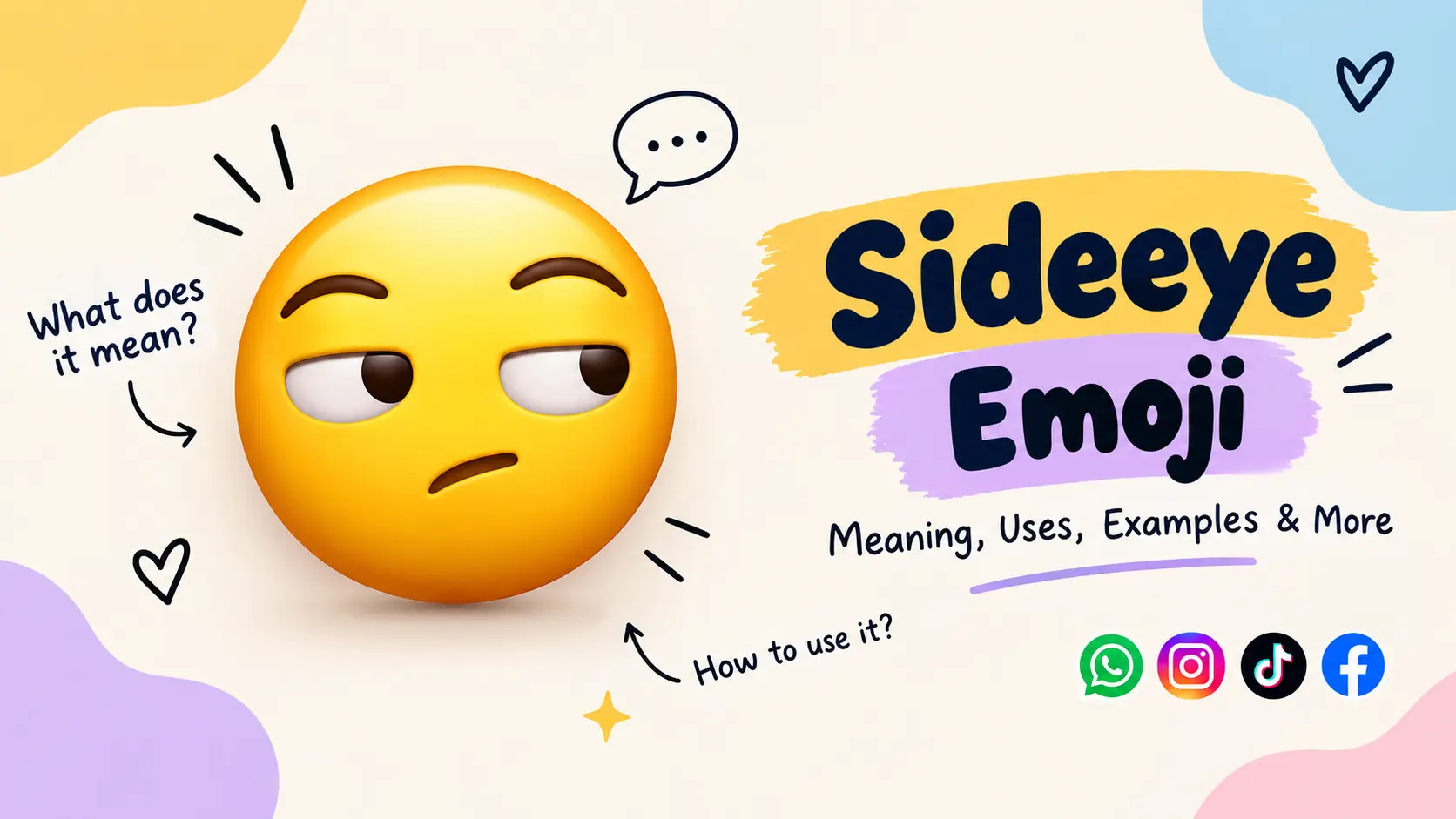
You are chatting with a friend, reading a suspicious comment, or seeing a post that sounds a little too good to be true. Then you notice the sideeye emoji: 👀. Suddenly, the conversation feels more playful, doubtful, or even a little awkward.
The sideeye emoji is commonly used to express suspicion, skepticism, judgment, curiosity, or quiet disbelief. It can also suggest teasing, flirtation, or the feeling that someone knows something they are not saying. Its exact meaning depends on the message around it and the relationship between the people communicating.
On WhatsApp, it can turn a simple reply into a playful reaction. On Instagram and TikTok, it often adds humor or hints at drama in comments and captions. However, not every sideways look is negative. Sometimes it simply means, “I noticed that!”
In this guide, you will learn how people use the sideeye emoji, how to combine it with related emojis, and how to copy and paste it into your favorite apps. 👀
Sometimes the sideeye emoji says, “I have questions, but I will let you explain.” 👀
What Does the Sideeye Emoji Mean? 👀
The sideeye emoji is most commonly represented by 👀, officially called the Eyes emoji. People often use it as a digital sideways glance, especially when they want to show that something looks suspicious, surprising, interesting, or worth paying attention to. Although the symbol does not literally show a sideways-facing head, its meaning can resemble the expression people make when they are quietly judging a situation.
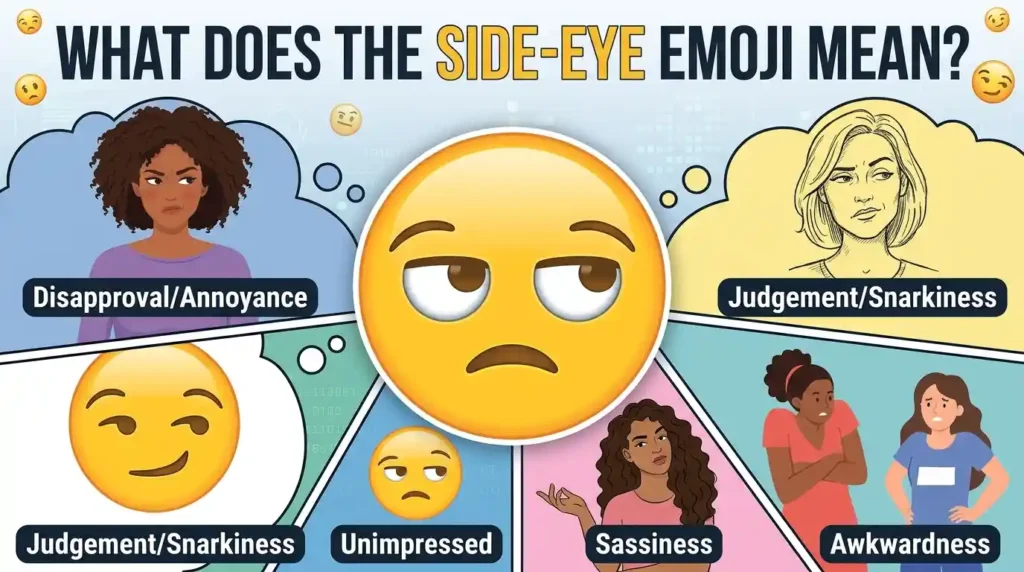
One common interpretation is suspicion. If someone tells you an unbelievable story and you reply with 👀, you might be suggesting that you are not entirely convinced. It can also express curiosity when something unexpected happens.
Another interpretation is playful judgment. Imagine your friend saying they will start eating healthily immediately after finishing a large dessert. A reply of 👀 might communicate your amused disbelief without sounding too serious.
The emoji can also signal gossip or hidden information. For example, “So, you two were together last night? 👀” suggests that the sender has noticed something and wants to hear more.
Common sideeye emoji interpretations
- Suspicion: Something does not seem quite right.
- Curiosity: You want to know what happens next.
- Judgment: You have noticed questionable behavior.
- Playful teasing: You are joking with someone you know well.
- Flirtation: You have noticed someone attractive or an interesting hint.
- Surprise: Something unexpected has caught your attention.
Related emojis can help make the intended tone clearer. 😒 can express annoyance or disapproval, while 🙄 often communicates exasperation. 🤨 suggests questioning or doubt, and 😏 can add a knowing or flirtatious tone. Meanwhile, 🫣 can convey nervous curiosity about something you almost do not want to watch.
Context matters more than the symbol alone. A friend sending 👀 after your funny confession may be teasing you, while a coworker using it in a serious discussion could seem skeptical. Even then, you cannot know someone’s exact intention from an emoji alone.
The safest interpretation comes from reading the complete message, considering your relationship, and noticing what happened just before the emoji appeared. 👀 is a flexible reaction, not a guaranteed sign of anger, jealousy, romance, or judgment.
Sideeye Emoji Meaning Table
| Emoji | Core meaning | Possible misread | Best used when |
|---|---|---|---|
| 👀 | Attention, curiosity, suspicion | Spying or staring | You notice something interesting |
| 😒 | Annoyance or disapproval | Serious anger | You are unimpressed |
| 🙄 | Exasperation or sarcasm | Disrespect | You react to something frustrating |
| 🤨 | Doubt or questioning | Accusation | You want clarification |
| 😏 | Knowing look or playful confidence | Arrogance | You are teasing or flirting |
| 😬 | Awkwardness or discomfort | Nervousness | A situation feels uncomfortable |
| 🫣 | Nervous curiosity | Fear | You cannot resist looking |
| 😑 | Flat or unimpressed reaction | Indifference | You have no enthusiastic response |
| 🤔 | Thoughtfulness or doubt | Confusion | You are considering a claim |
| 😳 | Surprise or embarrassment | Shock | Something catches you off guard |
Ten Emoji Cards
👀 Eyes Emoji
Meaning: Attention, curiosity, or suspicion.
Example 1: Wait, what happened after I left? 👀
Example 2: I saw that comment you deleted 👀
😒 Unamused Face
Meaning: Disappointment, irritation, or disapproval.
Example 1: You said five minutes, and it has been an hour 😒
Example 2: Another meeting that could have been an email 😒
🙄 Face with Rolling Eyes
Meaning: Sarcasm, frustration, or exasperation.
Example 1: He explained the same thing for the fourth time 🙄
Example 2: Of course, the internet stopped working again 🙄
🤨 Face with Raised Eyebrow
Meaning: Doubt, suspicion, or a request for explanation.
Example 1: You finished the whole project overnight? 🤨
Example 2: That sounds a little too convenient 🤨
😏 Smirking Face
Meaning: A knowing expression, confidence, or flirtation.
Example 1: I think you already know the answer 😏
Example 2: Maybe I have a surprise for you 😏
😬 Grimacing Face
Meaning: Awkwardness, tension, or discomfort.
Example 1: I accidentally sent that message to the wrong group 😬
Example 2: That conversation got uncomfortable quickly 😬
🫣 Face with Peeking Eye
Meaning: Nervous curiosity or reluctance to look.
Example 1: I am checking my exam results now 🫣
Example 2: I cannot watch, but I need to know what happens 🫣
😑 Expressionless Face
Meaning: A blank, unimpressed, or emotionally flat reaction.
Example 1: The same excuse for the third time 😑
Example 2: I have no words left for this situation 😑
🤔 Thinking Face
Meaning: Thoughtfulness, uncertainty, or questioning.
Example 1: I am not sure that explanation makes sense 🤔
Example 2: Let me think about your suggestion 🤔
😳 Flushed Face
Meaning: Surprise, embarrassment, or being caught off guard.
Example 1: You told everyone about my secret? 😳
Example 2: I was not expecting that announcement 😳
How to Use the Sideeye Emoji the Right Way?
The sideeye emoji works best when your message already gives the reader a clue about your tone. It can make a short reply funnier, add curiosity to a question, or show that you have noticed something unusual. However, because it can also look judgmental, think about your audience before sending it.
WhatsApp 💬
On WhatsApp, 👀 is useful in private conversations, family groups, and chats with friends. It can suggest that you want more details without asking a long question.
- Personal chats: “You need to tell me the full story 👀”
- Family conversations: “Who finished the cake already? 👀”
- Friendships: “You have been unusually quiet today 👀”
- Emotional messages: “You said you were fine, but are you really? 👀”
- Status updates: “Big news coming soon 👀”
For emotional conversations, use it thoughtfully. A friend who is already upset might interpret it as judgment instead of concern. If you genuinely want to help, a direct question may be clearer.
Instagram 📸
Instagram emojis often help creators and everyday users communicate tone in captions, comments, bios, and Reels. The sideeye emoji is especially useful when a post hints at something without explaining everything.
Examples include:
- Caption: “There is a story behind this picture 👀”
- Comment: “You cannot just post this and say nothing 👀”
- Reel reaction: “That ending caught me off guard 👀”
- Playful comment: “Someone has been keeping secrets 👀”
In a bio, it may suggest curiosity or a playful personality, although the meaning depends on the rest of the profile. In engagement-focused posts, it can invite followers to look more closely or share their guesses. Still, the emoji alone cannot guarantee more engagement.
TikTok 🎵
TikTok is a natural setting for reactions, jokes, unexpected reveals, and playful commentary. Here, 👀 can signal that viewers have noticed a detail or suspect something interesting is happening.
Try examples such as:
- “The way they looked at each other 👀”
- “Wait until you notice the background 👀”
- “That plot twist deserves an explanation 👀”
It can also work with irony. For example, commenting 👀 on a video where someone makes a questionable excuse may suggest disbelief. When used on a trend or inside a joke, its meaning may be understood through the video rather than the emoji itself.
On Facebook, the sideeye emoji can appear in posts, comments, Messenger conversations, and casual reactions. You might use it when a friend shares surprising news or when a family member posts a mysterious update.
For example, “You have some explaining to do 👀” can sound playful among close friends. In a public discussion, though, the same comment may seem confrontational. Consider the audience and the subject before using it.
Do’s and Don’ts
Do:
- Match the emoji to the tone of your message.
- Consider how well you know the recipient.
- Use 👀 when you want to suggest curiosity or playful suspicion.
- Read the conversation before deciding what someone else’s emoji means.
- Check the appearance of emojis on different devices when clarity matters.
Don’t:
- Assume everyone interprets 👀 in the same way.
- Use it carelessly during a sensitive conversation.
- Add several reactions when one would communicate your point.
- Assume that it automatically signals romantic interest.
- Treat a single emoji as proof that someone is angry, jealous, or hiding something.
The goal is to make your message easier to understand, not to leave the other person wondering whether you are joking or criticizing them.
Why Does the Sideeye Emoji Look Different on iPhone and Android?
Have you ever sent an emoji that looked slightly different on your phone from the way it appeared on a friend’s screen? That is normal. Emojis are based on the Unicode standard, which assigns standardized characters so devices and applications can recognize them.
However, Unicode does not require every company to draw each emoji in exactly the same way. Apple, Google, Samsung, Microsoft, and other technology companies can create their own artwork for supported emojis.
As a result, the sideeye emoji 👀 may have small differences in its eye shape, highlights, proportions, color, or overall visual style depending on the device, operating system, font, or application.
The same principle applies to related reactions. An unamused face may look slightly more annoyed on one platform, while another design might appear more neutral. Those visual differences can influence how a person feels about the message, even when the underlying character is the same.
Here are three useful things to remember:
- Shape and color: The design can vary between platforms.
- Expression: Small visual details can affect the perceived emotion.
- Character identity: A supported Unicode emoji generally remains the same character even when its artwork changes.
For example, if you send 👀 from an iPhone to an Android user, you are not sending a different meaning simply because the artwork looks different. Both devices are displaying their interpretation of the same emoji character.
Applications may also render emojis differently from one another, and older devices may not support every newer emoji. In some cases, unsupported characters appear as empty boxes or other placeholder symbols.
The practical takeaway: Focus on the conversation and the surrounding words instead of assuming that a small design difference changes the sender’s intention. No single platform’s artwork is automatically the correct visual version.
Best Sideeye Emoji Combos: Copy and Paste
Combining related emojis can make your reaction more specific. These combinations use the established emoji group and work well in casual messages, captions, and comments.
Romantic ❤️
- 👀 😏: Use this for a playful hint when flirting with someone.
- 😏 👀: Add this when you notice a romantic signal and want to tease gently.
- 👀 😳: Use this when someone’s unexpected compliment catches you off guard.
Cute 🥰
- 👀 🫣: Use this when you are shyly checking out something adorable.
- 👀 😳: Add this when a sweet surprise leaves you speechless.
- 🫣 👀: Use this when you are nervous but curious to see what happens.
Flirty 😉
- 👀 😏: Send this when a conversation includes a playful hint.
- 🤨 😏: Use this when teasing someone about a suspiciously charming excuse.
- 😏 😳: Add this when the flirting becomes unexpectedly bold.
Missing Someone 💭
- 👀 🥹: Use this when you are hoping to hear from someone you miss.
- 👀 🤔: Send this when you are wondering when someone will message you.
- 🫣 😳: Use this for a shy reaction to seeing someone you have been thinking about.
Good Night 🌙
- 👀 😴: Use this when you are still awake and checking for one last message.
- 😏 👀: Add this to a playful late-night conversation.
- 🫣 😴: Use this when you are trying to stay awake but are getting sleepy.
These combinations are suggestions, not fixed definitions. The wording around them can change whether they feel romantic, funny, curious, or awkward.
Trending Sideeye Emoji in 2026
The sideeye emoji 👀 remains a familiar reaction in everyday digital communication because it conveys attention and curiosity without requiring a long explanation. In 2026, it fits naturally into the kinds of online conversations built around surprising reveals, humorous observations, playful suspicion, and reactions to unexpected moments.
However, there is no need to assume that every appearance reflects a new trend or viral challenge. Emoji usage changes across communities, and popularity can vary by platform, topic, and audience.
Here are four related emojis that are useful for understanding this style of online expression.
| Emoji | Why it appears in conversations | Who uses it | Platform |
|---|---|---|---|
| 👀 | Highlights a detail or hints at a reveal | Friends, creators, commenters | Instagram, TikTok, WhatsApp |
| 🤨 | Questions a claim or suggests doubt | Casual users, meme audiences | TikTok, Facebook, messaging |
| 😏 | Adds a knowing or teasing tone | Friends, couples, creators | Instagram, TikTok, WhatsApp |
| 🫣 | Expresses nervous curiosity | Meme fans, friends, everyday users | TikTok, Instagram, chats |
Creators may place 👀 in captions to tease an upcoming announcement, while viewers use it in comments when they spot an unexpected detail. Friends may also use it to ask for more information without directly demanding an explanation.
On TikTok, its interpretation often depends on the video, audio, and surrounding comments. On Instagram, it may accompany a mysterious caption or a surprising photo. In private messages, the same symbol can feel more personal because both people understand the conversation’s background.
The other reactions add different shades of expression. 🤨 can make a question feel more skeptical, 😏 can make it feel teasing, and 🫣 can suggest that the sender is nervous about what they are seeing.
These are examples of common usage patterns, not verified rankings of the most popular emojis in 2026. Emoji habits continue to evolve as online communities develop new jokes, expressions, and ways of communicating.
Sideeye Emoji Meaning in Different Contexts
The same emoji can communicate different feelings depending on who sends it and what is happening in the conversation. Before deciding what someone means, consider these common situations.
Romantic conversations
When someone you like sends 👀 after you mention going out, they might be curious about your plans or teasing you about a possible date. It could also simply mean they noticed something interesting.
Example:
“You looked really good in that picture 👀”
This may sound flirtatious, but the emoji alone does not confirm romantic interest. Look at the person’s words and the wider conversation.
Friendship
Among friends, the emoji often works as a humorous reaction to gossip, surprising news, or an unexpected confession.
Example:
“You said you were staying home, but I saw your pictures 👀”
Depending on your friendship, this might be a harmless joke rather than a serious accusation.
Family conversations
In family chats, it can suggest curiosity about an announcement or playful suspicion about what someone has been doing.
Example:
“Who finished the last piece of cake? 👀”
The tone is likely lighthearted when everyone understands the joke.
Professional and casual communication
In a relaxed team chat, the emoji might react to an unexpected update. In a formal workplace discussion, however, it may appear sarcastic or judgmental.
Example:
“The deadline has changed again 👀”
For an important work message, clear wording is usually safer than relying on an ambiguous reaction.
Texting and social media comments
In texting, 👀 can make a short reply feel more expressive. In public comments, it can hint that a person noticed a detail or wants others to pay attention.
For example, “Read the second paragraph 👀” suggests that something noteworthy appears there.
Captions
A caption such as “Something interesting is coming 👀” creates curiosity without revealing the details immediately. It works best when the post genuinely contains a surprise, announcement, or playful hint.
Across all these contexts, remember that interpretation is personal. The same reaction can feel funny to one reader and uncomfortable to another.
How to Copy and Paste the Sideeye Emoji?
Copy the sideeye emoji below and paste it wherever you want to use it.
👀
Copy the sideeye emoji Copy 👀
You can also copy it manually by selecting the symbol and pressing Ctrl + C on Windows or Command + C on a Mac.
Then open WhatsApp, Instagram, TikTok, or Facebook and paste it into a message, caption, comment, or status using Ctrl + V or Command + V.
On mobile, press and hold the emoji, choose Copy, then press and hold the text field and select Paste. If the symbol does not display correctly, check whether your device or application supports it.
Frequently Asked Questions:
1. What is the most popular sideeye emoji?
The eyes emoji 👀 is the most recognizable symbol commonly associated with the sideeye reaction in casual online conversations. Its meaning depends on the message and the people using it.
2. What does 👀 mean when someone sends it?
It can suggest curiosity, suspicion, surprise, teasing, or interest. The sender’s gender does not determine its meaning. Consider the conversation and relationship before interpreting the reaction.
3. Why do emojis look different on iPhone vs Android?
Unicode provides standardized emoji characters, but Apple, Google, Samsung, and other companies design their own artwork. As a result, the same emoji can have slightly different visual details across devices.
4. Are sideeye emojis used differently in other countries?
Yes, interpretation can vary with language, culture, community jokes, and personal communication habits. However, there is no single meaning that applies to everyone in a country. When unsure, consider the context or ask the sender what they meant.
Conclusion
The sideeye emoji 👀 is a versatile way to express curiosity, suspicion, playful judgment, or interest without writing a long message.
Use it thoughtfully, especially when the conversation is sensitive or the relationship is unfamiliar.
When in doubt, let your words clarify your intention so your emoji adds personality rather than confusion.

Nasrullah — Emoji Strategist & Content Writer
Nasrullah is a passionate emoji enthusiast and content writer who loves exploring the meanings, uses, and cultural context behind emojis. He creates simple, helpful, and easy-to-understand guides that help readers choose the right emoji for WhatsApp, Instagram, Facebook, texting, and everyday conversations.
With a focus on emoji meanings, combinations, social media usage, and modern digital communication, Nasrullah aims to make every emoji easier to understand and use with confidence. His content combines practical examples with clear explanations so readers can quickly find the meaning and usage they are looking for.
When he’s not researching emojis, Nasrullah enjoys exploring digital trends, writing useful online content, and learning about how people communicate in the digital world. 😊