You’re chatting with a friend who just landed in Montevideo, or maybe you’re cheering during a football match, and you drop a single 🇺🇾 into the conversation. Suddenly the message feels personal, specific, and full of context words alone couldn’t carry. That’s the quiet power of the uruguay flag emoji it says “this place matters” without needing a sentence.
People search for this emoji’s meaning for a few different reasons: some want to confirm it’s actually Uruguay and not another South American flag, others want to know how it lands in a casual chat, and some are simply picking emojis for a caption and want to get the tone right. Like most flag emojis, its meaning shifts depending on who’s sending it, why, and where. ☀️⚽
What Does 🇺🇾 Mean?
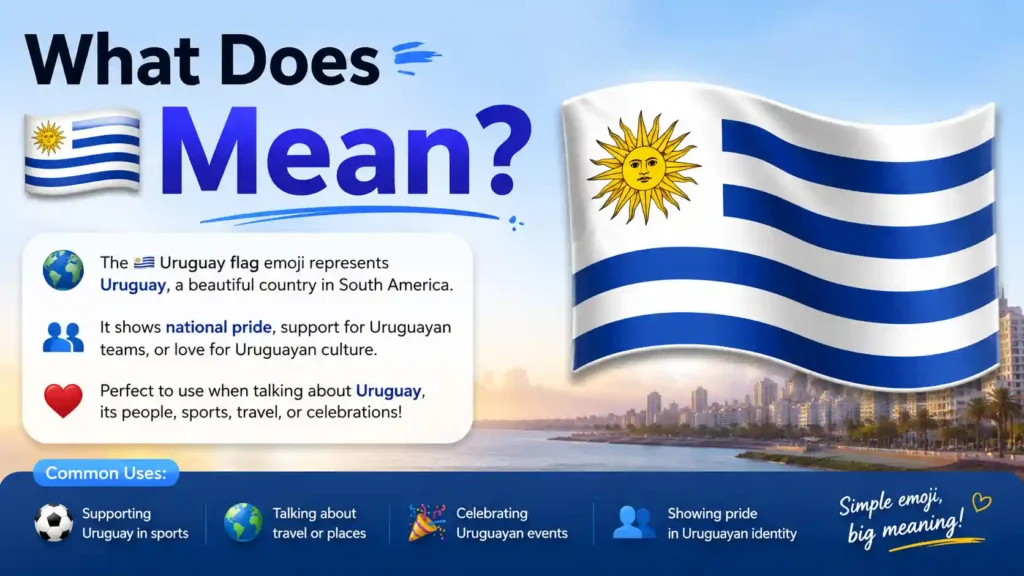
At its core, the uruguay flag emoji represents the country of Uruguay its identity, culture, and people. It’s built from nine horizontal stripes and a golden sun in the top-left corner, a nod to the country’s official flag and the “Sun of May” symbol tied to its independence.
In everyday texting, it rarely needs a big explanation. Someone might send 🇺🇾 to say “I’m here” while traveling, to show support during a match, or to mark a personal connection to the country, like family roots or a recent trip. On social media, it often shows up in bios or captions as a quick way of saying “this is where I’m from” or “this is where I’ve been.”
Emotionally, the flag tends to carry pride, nostalgia, or excitement rather than anything negative. A student abroad might use it to express homesickness, while a traveler might use it to mark a bucket-list moment. Context does most of the work here: the same 🇺🇾 in a football chat means something different than 🇺🇾 in a message to a pen pal.
A few other emojis often ride alongside it. ⚽ signals football and national pride, especially around matches. ☀️ echoes the sun on the flag itself and can add warmth to a message. ✈️ points to travel and arrival. 🌎 broadens the context to “somewhere in the world,” useful when talking about geography or travel plans. 🏆 shows up around competitions and wins. None of these have one fixed meaning they lean on the words around them.
Meaning Table
| Emoji | Core meaning | Possible misread | Best used when |
|---|---|---|---|
| 🇺🇾 | Uruguay, national identity, pride | Assumed to be another country’s flag | Talking about Uruguay, travel, roots, or football |
| ⚽ | Football, competition, team spirit | Thought to be unrelated to the topic | Match days, sports chats, fan support |
| ☀️ | Warmth, positivity, the flag’s sun symbol | Read as just “nice weather” | Adding brightness or optimism to a message |
| ✈️ | Travel, departure or arrival | Confused with vacation-only context | Announcing a trip or landing somewhere |
| 🌎 | Global context, “somewhere out there” | Seen as vague or generic | Talking broadly about geography or travel |
| 🏆 | Achievement, winning, celebration | Assumed to be only about sports | Marking a win, milestone, or proud moment |
Exactly 10 Emoji Cards
🇺🇾 Uruguay Flag:
Meaning: National pride, identity, and connection to the country of Uruguay.
Example 1: Landed in Montevideo 🇺🇾
Example 2: My family is from here 🇺🇾
☀️ Sun
Meaning: Warmth, positivity, and a nod to the sun on Uruguay’s flag.
Example 1: Perfect beach day today ☀️
Example 2: Feeling good this morning ☀️
⚽ Soccer Ball
Meaning: Football, competition, and team spirit.
Example 1: Match starts in an hour ⚽
Example 2: Let’s go, we’ve got this ⚽
✈️ Airplane :
Meaning: Travel, departure, or arrival somewhere new.
Example 1: Boarding now ✈️
Example 2: See you next week ✈️
🌎 Globe Showing Americas :
Meaning: A broader sense of place, geography, or the wider world.
Example 1: So many places to see 🌎
Example 2: Planning our next trip 🌎
🏆 Trophy
Meaning: Achievement, victory, or a proud milestone.
Example 1: We actually did it 🏆
Example 2: Congrats on the win 🏆
👋 Waving Hand
Meaning: A greeting, farewell, or friendly hello.
Example 1: Hey, good to see you 👋
Example 2: Talk soon, take care 👋
❤️ Red Heart :
Meaning: Affection, love, or a strong personal connection.
Example 1: Missing this place already ❤️
Example 2: So happy you’re here ❤️
🥳 Partying Face :
Meaning: Celebration, excitement, and shared joy.
Example 1: We’re celebrating tonight 🥳
Example 2: Best day ever 🥳
🎉 Party Popper:
Meaning: A festive, celebratory moment worth marking.
Example 1: It’s finally happening 🎉
Example 2: Cheers to new beginnings 🎉
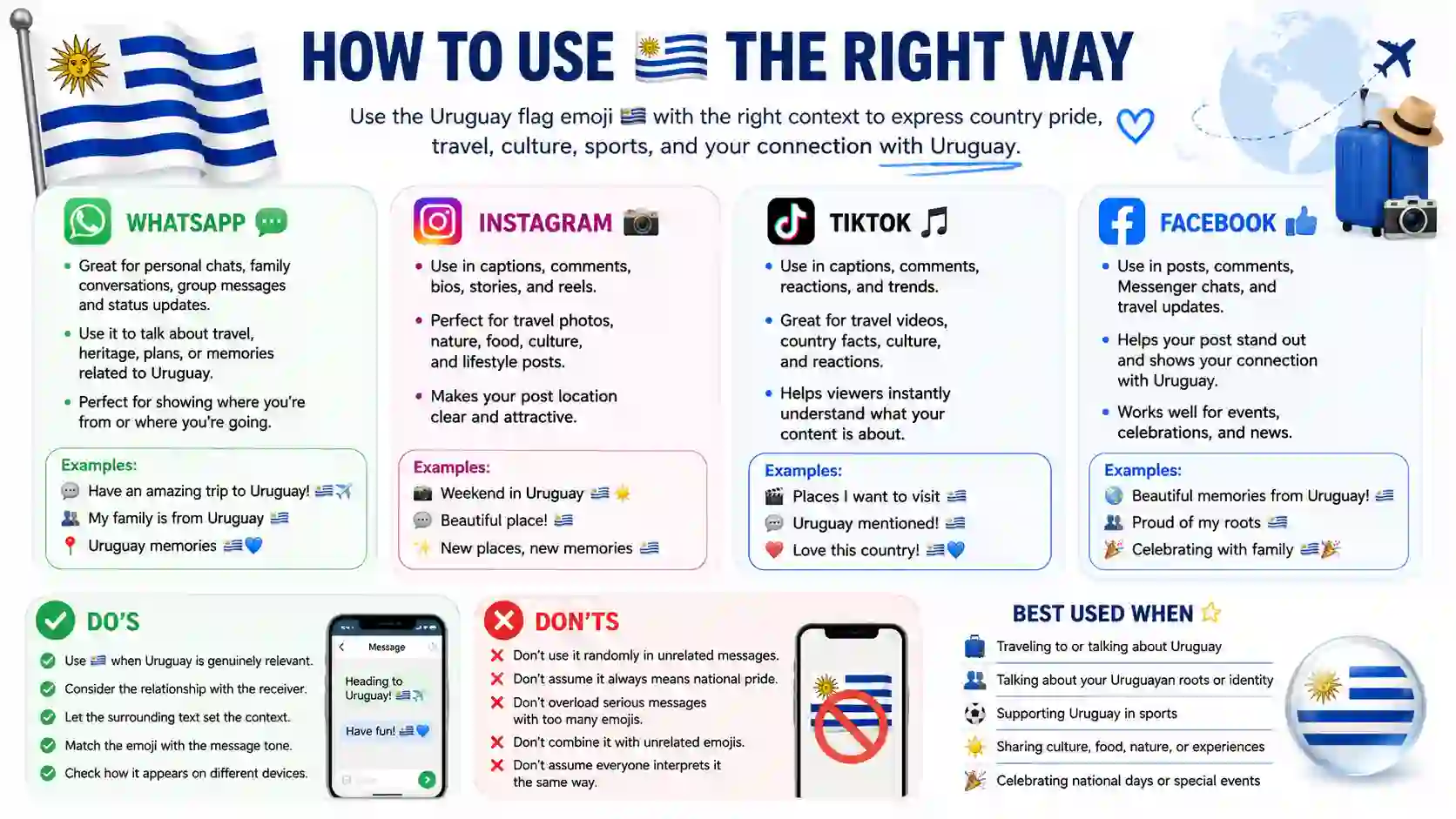
How to Use 🇺🇾 the Right Way
WhatsApp 💬
In personal chats, 🇺🇾 usually pops up when someone’s talking about travel plans, a family visit, or a match they’re watching. ❤️In family group chats, it can mark shared roots or an upcoming reunion. In emotional messages — like telling someone you finally landed or that you’re missing home — it adds a quiet layer of meaning without extra words. It also works well in status updates when someone wants to show where they currently are.
Instagram 📸
On Instagram, the flag often lands in captions under travel photos, in bios to signal nationality or heritage, or in aesthetic posts about a specific place. In comments, it’s a quick way to react to someone’s trip or hometown post. On Reels, especially around football season, 🇺🇾 paired with ⚽ shows up constantly in highlight clips and fan reactions, boosting that sense of shared excitement.
TikTok 🎵
TikTok users lean on 🇺🇾 in captions for travel diaries, cultural content, or football commentary. It shows up in comments as a quick reaction sometimes sincere, sometimes playful or ironic, especially during viral trends where users tag their location for fun. Humor aside, it’s rarely used to mock; it’s more often a badge of pride or a simple location marker.
On Facebook, 🇺🇾 tends to appear in posts about travel, family events, or sports. In comments, it’s a fast way to show support, especially during matches. In Messenger, it works similarly to WhatsApp a casual, personal touch in one-on-one conversations. As a reaction, it’s less common than the built-in reaction icons but still shows up when someone wants to be specific about why they’re reacting.
Dos and Don’ts
Do:
- Use 🇺🇾 to support your message, not replace it.
- Consider your relationship with the person you’re messaging.
- Pay attention to the surrounding context and wording.
- Match the emoji to the tone of the conversation.
- Check how it renders on different devices before assuming intent.
Don’t:
- Use the flag randomly just to add color to a message.
- Assume everyone will read it the same way you do.
- Overload a serious message with unrelated emojis.
- Combine it with unrelated symbols without a clear reason.
- Assume it automatically signals romance or flirtation.
Why Do 🇺🇾 Look Different on iPhone and Android?
Every emoji, including flag emojis, is based on a shared Unicode standard. That standard defines what the emoji represents, but not exactly how it should look. Companies like Apple, Google, Samsung, and Microsoft each design their own visual style for that same underlying character.
That’s why 🇺🇾 might look slightly more rounded on one phone and slightly flatter or more rectangular on another. The stripes and sun symbol stay recognizable, but the exact shading, proportions, and finishing touches can differ. The emoji character itself hasn’t changed only the artwork representing it has. Neither version is “more correct”; they’re just different design interpretations of the same symbol.
Best 🇺🇾 Combos — Copy & Paste
Romantic ❤️
1.👉 🇺🇾❤️✈️ : Use this for a message about meeting someone special there.
2.👉 ❤️☀️🇺🇾 : Use this for a warm, affectionate travel message.
3.👉 🇺🇾❤️👋 : Use this when saying goodbye with love attached.
Cute 🥰
1.👉 🇺🇾🥳🎉 : Use this for a lighthearted, upbeat caption.
2.👉 ☀️🇺🇾👋 : Use this for a cheerful hello from a sunny day.
3.👉 🇺🇾🎉❤️ : Use this for a sweet, celebratory update.
Flirty 😉
1.👉 🇺🇾✈️❤️ : Use this when hinting at a trip together.
2.👉 ☀️🇺🇾🥳 — Use this for a playful, teasing message.
3.👉 🇺🇾👋❤️ : Use this for a flirty greeting with warmth.
Missing Someone 💭
1.👉 🇺🇾❤️🗺️ : Use this when longing for a specific place or person.
2.👉 ✈️🇺🇾👋 Use this to say you wish you were there.
3.👉 🇺🇾☀️❤️ : Use this for a nostalgic, homesick message.
Good Night 🌙
1.👉 🇺🇾🌙❤️ : Use this to close out the day with warmth.
2.👉 ☀️🇺🇾👋 Use this for a gentle, sleepy goodnight.
3.👉 🇺🇾❤️🥳 : Use this after a great day worth celebrating before bed.
Trending 🇺🇾 in 2026
Flag emojis like 🇺🇾 tend to spike around predictable moments football tournaments, travel season, and cultural celebrations. Around match days, it’s commonly seen paired with ⚽ and 🏆 in comments and captions as fans show support. Travelers frequently use it alongside ✈️ and 🌎 when documenting trips, and it’s a popular touch in bios for people highlighting their heritage or hometown.
Creators making travel or football content often lean on 🇺🇾 to quickly signal location without lengthy captions, while everyday users use it more personally marking family visits, homesickness, or pride in a shared identity. It frequently appears in captions and comments rather than as a standalone post, working best as an accent rather than the whole message.
| Emoji | Why trending | Who uses it | Platform |
|---|---|---|---|
| 🇺🇾 | Tied to travel and football seasons | Travelers, fans, diaspora communities | Instagram, TikTok |
| ⚽ | Frequently used during match coverage | Sports fans, commentators | TikTok, Facebook |
| ✈️ | Common in travel documentation | Travelers, content creators | Instagram, WhatsApp |
| 🏆 | Appears around wins and milestones | Fans, athletes, event organizers | Facebook, TikTok |
Overall, emoji usage around national flags continues to evolve alongside how people talk about identity, travel, and sports online — shifting naturally with whatever’s happening in the world at any given moment.
🇺🇾 Meaning in Different Contexts
In romantic conversations, 🇺🇾 usually points to shared experiences a trip taken together or plans to visit. Among friends, it’s often lighter, marking banter about a match or a joke about someone’s travel plans.🥳 In family chats, it leans toward heritage and connection, especially around visits or reunions.
In professional or more casual work settings, it’s typically used sparingly, mostly to note a location or a colleague’s background rather than to express emotion. In texting generally, it adds specificity to an otherwise vague message. On social media, comments and captions use it to react quickly, while longer posts might use it once to anchor the whole piece around a place.
How to Copy and Paste 🇺🇾
Copying the uruguay flag emoji is simple. Just select it below, copy it, and paste it wherever you’re chatting or posting:
🇺🇾
You can paste it directly into a WhatsApp message, drop it into an Instagram caption or comment, add it to a TikTok caption, or use it in a Facebook post or Messenger chat. No special keyboard setup is usually needed — most phones and computers already support flag emojis by default.
FAQ:
1. What is the most popular Uruguay flag emoji?
There’s only one official version, 🇺🇾, though its exact appearance varies slightly by device and platform.
2. What does 🇺🇾 mean when someone sends it?
It usually reflects context rather than any fixed rule travel, pride, football, or personal connection, depending on the conversation.
3. Why do emojis look different on iPhone vs Android?
Emojis follow a shared Unicode standard, but each company designs its own visual style, so the same emoji can look slightly different across devices.
4. Are uruguay flag emoji used differently in other countries?
Cultural context can shape how it’s read someone with ties to Uruguay may use it more personally, while others may use it simply to reference the country or a match. Neither use is more “correct” than the other.
Conclusion:
At the end of the day, 🇺🇾 is a small symbol carrying a lot of context pride, travel, sport, or home, depending on who’s typing it. Paying attention to tone and relationship will always tell you more than the emoji alone. Use it thoughtfully, and it’ll say exactly what you mean. ☀️🇺🇾

Nasrullah — Emoji Strategist & Content Writer
Nasrullah is a passionate emoji enthusiast and content writer who loves exploring the meanings, uses, and cultural context behind emojis. He creates simple, helpful, and easy-to-understand guides that help readers choose the right emoji for WhatsApp, Instagram, Facebook, texting, and everyday conversations.
With a focus on emoji meanings, combinations, social media usage, and modern digital communication, Nasrullah aims to make every emoji easier to understand and use with confidence. His content combines practical examples with clear explanations so readers can quickly find the meaning and usage they are looking for.
When he’s not researching emojis, Nasrullah enjoys exploring digital trends, writing useful online content, and learning about how people communicate in the digital world. 😊