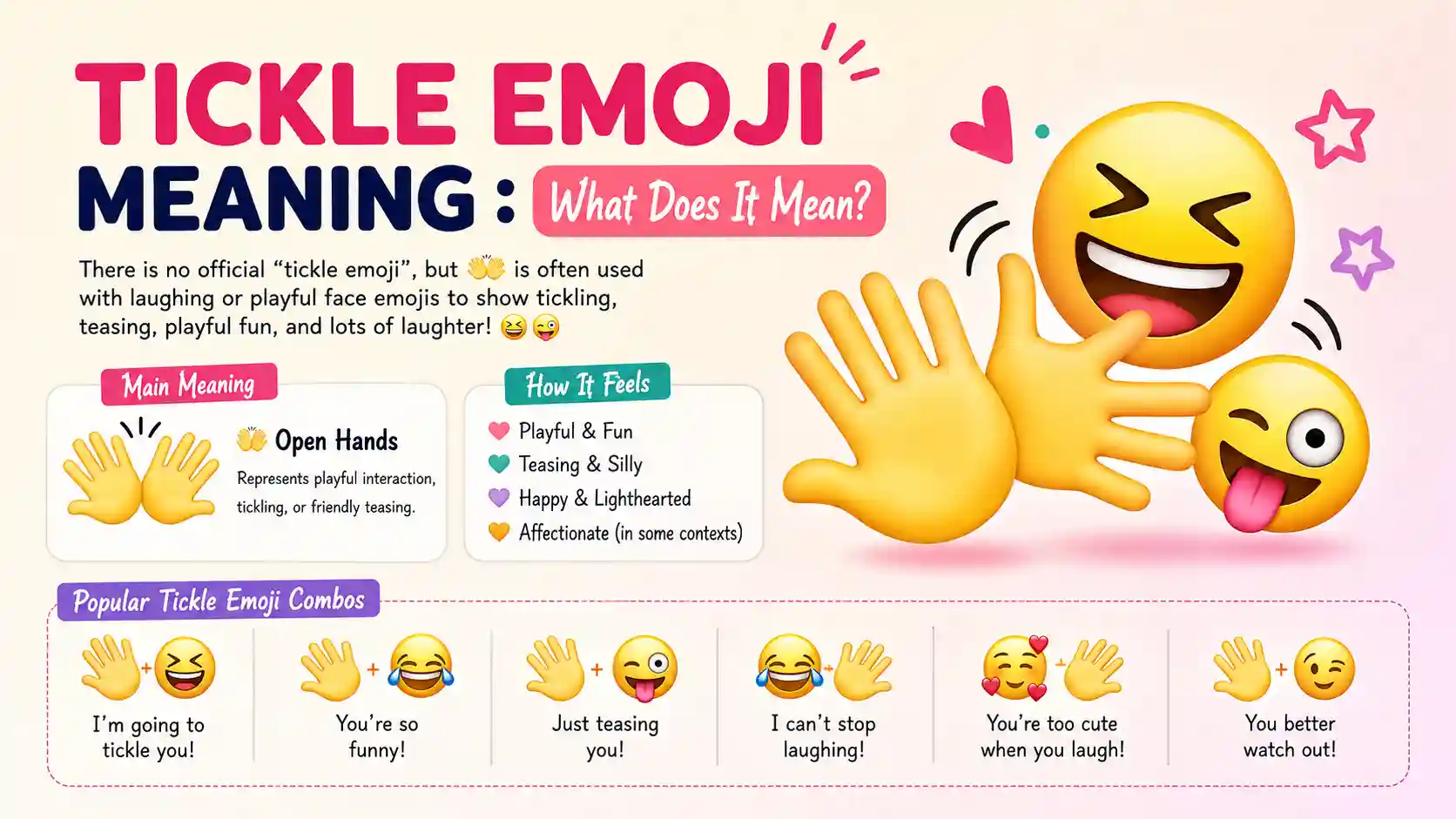
You may have seen someone use 👐 with 😆, 😂, or 😜 and wondered, “Is that supposed to mean tickling?” The answer is usually yes, but there is an important detail: there is no official Unicode emoji specifically called the “tickle emoji.” The phrase is generally used online to describe emojis or combinations that suggest tickling, playful touching, teasing, or laughter. Unicode’s official emoji charts list individual emoji characters and their standardized names, while real-world meanings can develop through everyday communication.
In practice, 👐 can work as the closest visual shorthand for playful hands, especially when paired with a laughing face. A combination such as 👐😆 can suggest “I’m tickling you” or “this is getting silly.” Meanwhile, 😜 can make the message more teasing, and 😂 can make the laughter much stronger.
Context matters a lot. A friend may use these emojis simply to joke around, while someone you like may use them to create a playful or slightly flirty mood. The words around the emoji usually provide the biggest clue.
Sometimes a playful emoji says “I’m just teasing you” without needing another explanation. 👐😆
What Does the Tickle Emoji Mean?
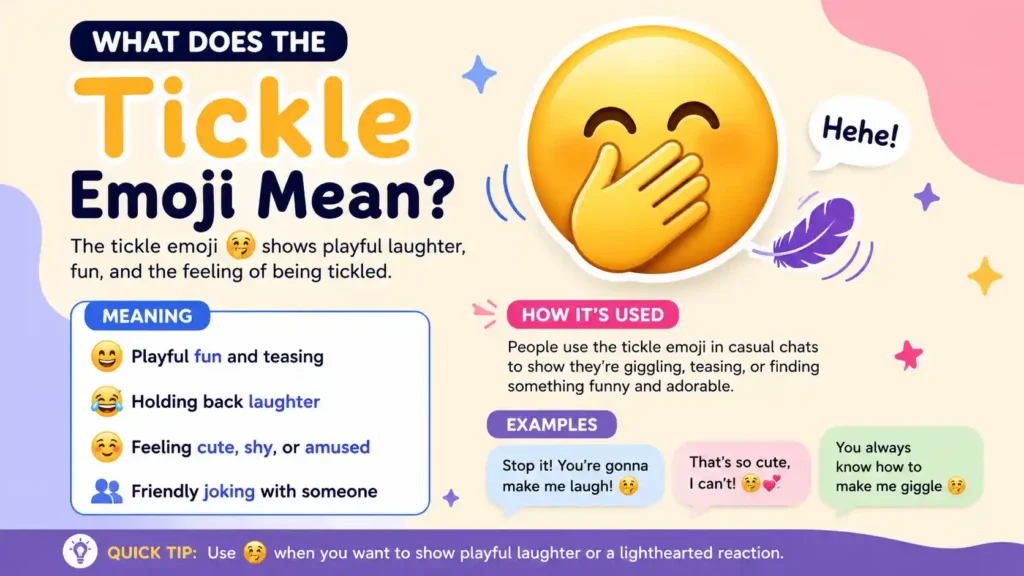
When people search for the tickle emoji, they usually mean an emoji or emoji combination that communicates tickling, playful teasing, silliness, laughter, or a fun physical interaction. There is no single official Unicode character assigned the name “tickle emoji.” Instead, 👐 is often a useful visual choice because its open hands can suggest reaching toward someone, while laughing faces such as 😆, 😂, and 🤣 communicate the reaction. Unicode specifically explains that emoji are not limited to one universal meaning, and their interpretation can change according to language, culture, and context.
In texting, 👐😆 can feel like “I’m going to tickle you,” while 😂👐 may suggest that the person is laughing at a tickling situation. Adding 😜 makes the message more mischievous, whereas 😉 can give it a teasing or playful tone. 😅 can soften the interaction when the sender wants to show laughter mixed with awkwardness.
The relationship between the people matters too. Between close friends, a tickle-related emoji combination may simply be silly. Between family members, it can suggest playful affection. Between romantic partners, 👐🥰 or 👐😉 may feel more affectionate or flirtatious. None of those interpretations is automatic, though.
On Instagram and TikTok, the same combinations can appear in comments or captions describing a funny, playful moment. A creator might use 😆👐 to react to a joke, a funny video, or a playful interaction without literally meaning someone was tickled.
The key is to read the whole message. “Stop 😂” after a joke is different from “I’m coming for you 👐😜.” The first emphasizes laughter, while the second more clearly suggests playful teasing. Emojipedia likewise emphasizes that emoji interpretation involves intended meaning, common usage, alternative meanings, and cross-platform design.
Meaning Table:
| Emoji | Core meaning | Possible misread | Best used when |
|---|---|---|---|
| 👐 | Playful hands, openness | Literal gesture | Suggesting playful interaction |
| 😆 | Strong happy laughter | Overexcitement | Funny or ticklish moments |
| 😂 | Intense amusement | Laughing at someone | Very funny situations |
| 🤣 | Uncontrollable laughter | Overdramatic reaction | Extremely funny moments |
| 😜 | Mischief, teasing | Flirting | Playful jokes |
| 😉 | Wink, playful hint | Romantic interest | Light teasing |
| 😄 | Cheerful happiness | Simple friendliness | Warm reactions |
| 😅 | Nervous or relieved laughter | Embarrassment | Awkward funny moments |
| 🤭 | Suppressed laughter | Shyness | Secretive or silly reactions |
| 🥰 | Affection, warmth | Romantic interest | Sweet playful messages |
👐 Open Hands:
Meaning: Playful hands, openness, or a gesture that can suggest reaching toward someone.
Example 1: Come here, I have a surprise 👐
Example 2: I’m about to tickle you 👐
😆 Grinning Squinting Face:
Meaning: Strong laughter, excitement, or a genuinely funny reaction.
Example 1: That tickle attack was too much 😆
Example 2: I can’t stop laughing 😆
😂 Face With Tears of Joy:
Meaning: Intense amusement and laughter.
Example 1: You actually tickled me 😂
Example 2: That was hilarious 😂
🤣 Rolling on the Floor Laughing:
Meaning: Very intense, uncontrollable laughter.
Example 1: I’m still laughing about that 🤣
Example 2: You had me laughing for five minutes 🤣
😜 Winking Face With Tongue:
Meaning: Mischief, silliness, teasing, or playful behavior.
Example 1: You know I’m only teasing 😜
Example 2: Just wait until I catch you 😜
😉 Winking Face:
Meaning: A playful hint, wink, or lighthearted tease.
Example 1: You better watch out 😉
Example 2: I know what you’re planning 😉
😄 Grinning Face With Smiling Eyes:
Meaning: Cheerful happiness and friendly amusement.
Example 1: That was such a fun moment 😄
Example 2: You always make me laugh 😄
😅 Grinning Face With Sweat:
Meaning: Nervous laughter, relief, or an awkward but funny reaction.
Example 1: I wasn’t ready for that tickle attack 😅
Example 2: Okay, okay, you got me 😅
🤭 Face With Hand Over Mouth:
Meaning: Suppressed laughter, embarrassment, or a playful secret.
Example 1: I probably shouldn’t laugh, but 🤭
Example 2: Don’t tell anyone I started it 🤭
🥰 Smiling Face With Hearts:
Meaning: Warm affection, fondness, or a sweet emotional reaction.
Example 1: You’re too cute when you laugh 🥰
Example 2: That little moment made my day 🥰
How to Use the Tickle Emoji the Right Way:
The easiest way to use the tickle emoji idea is to treat it as a playful combination rather than a fixed emoji definition. Since 👐 is not officially named “tickle,” the surrounding emoji and words help communicate your intention. A message like “I’m coming to tickle you 👐😆” is much clearer than sending 👐 alone.
WhatsApp 💬
On WhatsApp, tickle-related emoji combinations work especially well in casual conversations. With friends, you can use 👐😆 after joking about someone’s reaction. In family chats, 👐😂 can describe a silly moment without making the message too serious.
For someone you’re close to, a message such as “You are way too easy to tease 😜” can create a playful tone. If the relationship is romantic, 👐🥰 can make a playful message warmer. Still, don’t assume that a particular combination automatically communicates romance.
WhatsApp Status updates can also use these emojis when sharing a funny or playful memory. For example: “Today’s mood: laughing at everything 😆👐.”
Instagram 📸
Instagram captions and comments often use emojis to add personality without writing a long explanation. If someone posts a funny reel about being tickled, 👐🤣 can work as a quick reaction.
In a caption, you might write: “When your friend knows your weak spot 👐😂.” In comments, 😆👐 can suggest that the moment was funny and playful.
TikTok 🎵
TikTok comments often depend heavily on tone and shared humor. A combination such as 🤣👐 can react to a funny clip, while 😜👐 may suggest playful teasing.
Because TikTok communication is highly contextual, the same combination can be interpreted differently depending on the video. Look at the caption, comments, and overall joke before deciding what an emoji means.
On Facebook, these emojis can appear in comments, Messenger chats, captions, and casual posts. They are most natural when the conversation is already friendly or humorous.
The safest rule across all platforms is simple: use words when your intention could be misunderstood. Emojis add tone, but they do not replace context.
Do’s and Don’ts:
Do:
- Use 👐 with a laughing emoji when you want the tickling idea to be clearer.
- Consider your relationship with the receiver.
- Match 😆, 😂, or 🤣 to the intensity of the joke.
- Use 😜 or 😉 when the conversation is already playful.
- Remember that different people can interpret emoji combinations differently.
Don’t:
- Assume 👐 automatically means “tickle.”
- Use playful combinations in a serious conversation without considering the mood.
- Assume a tickle-related emoji combination is automatically romantic.
- Mix unrelated symbols simply to make a message look more expressive.
- Forget that the words surrounding an emoji usually provide important context.
Why Do Tickle Emoji Look Different on iPhone and Android?
If you search for a tickle emoji and see slightly different artwork on different devices, that is normal. The important distinction is between the underlying Unicode character and the visual design shown by a platform. Unicode provides the standardized character system, while companies such as Apple, Google, Samsung, and Microsoft can create their own emoji artwork. Unicode’s emoji charts show vendor-specific images precisely because the same character can have different visual presentations.
This is particularly important with the tickle emoji concept because there is no official single “tickle” character. If someone uses 👐, the underlying character is the same across supported systems, but the hands may have slightly different shapes, colors, proportions, or visual styling.
Facial emojis can also vary. 😆 might look a little different on an iPhone than on an Android phone. The expression remains recognizable, but the eyes, mouth, shading, and overall design can change.
Size and spacing can vary as well. An emoji displayed inside WhatsApp may not look exactly like the same character shown in a browser, social media app, or text message.
This does not mean one platform has the “correct” version. The Unicode character is standardized, while the artwork is created by individual vendors.
So if someone sends 👐😆 and your version looks slightly different from theirs, the meaning has not necessarily changed. It is usually just a difference in platform design. The surrounding message remains the best clue to what the sender intended.
Best Tickle Emoji Combos, Copy & Paste:
Romantic ❤️
1.👉 👐🥰, Use this for a sweet, affectionate playful moment.
2.👉 👐😉, Use this for lighthearted teasing between people who already share that tone.
3.👉 🥰👐😆, Use this when affection and playful laughter go together.
Cute 🥰
1.👉 👐😄, Use this for a cheerful playful interaction.
2.👉 👐🤭, Use this for a shy or silly tickling moment.
3.👉 😆👐🥰, Use this when something playful also feels adorable.
Flirty 😉
1.👉 👐😜, Use this for mischievous teasing.
2.👉 😉👐, Use this as a playful “watch out” reaction.
3.👉 😜👐🥰, Use this when teasing has a warm affectionate tone.
Missing Someone 💭
1.👉 🥰👐, Use this when you miss someone’s playful personality.
2.👉 😄👐, Use this when remembering a funny moment together.
3.👉 🤭👐🥰, Use this for a sweet memory that makes you smile.
Good Night 🌙
1.👉 🥰👐, Use this for a warm playful good-night message.
2.👉 😆👐, Use this after joking around before bed.
3.👉 😉👐🥰, Use this for a playful affectionate sign-off.
Trending Tickle Emoji in 2026:
There is no official “tickle emoji” trend ranking, so it is better to describe current usage without inventing statistics. In 2026, playful emoji communication continues to rely heavily on combinations rather than treating every emoji as a literal dictionary symbol. Unicode itself notes that emoji can be repurposed over time and that meaning depends on context.
For tickle-related conversations, 👐 works particularly well when paired with expressive faces. 😆 and 😂 make the laughter obvious, while 😜 can shift the message toward teasing. 🥰 adds affection when the conversation is warm or personal.
| Emoji | Why trending | Who uses it | Platform |
|---|---|---|---|
| 👐 | Suggests playful interaction | Friends and couples | WhatsApp, TikTok |
| 😆 | Clear joyful reaction | Everyday users | WhatsApp, Instagram |
| 😂 | Strong humorous response | Broad audiences | Instagram, Facebook |
| 😜 | Adds mischievous energy | Friends and creators | TikTok, messaging |
Creators often use these emojis in comments because a short visual reaction can communicate humor quickly. Everyday users use them in private chats when they want their words to sound less serious.
The important point is that “trending” does not mean an emoji has one newly assigned meaning. Online communities constantly adapt existing emoji to new jokes, situations, and conversational styles. Emoji usage continues to evolve as people combine familiar symbols in creative ways.
Tickle Emoji Meaning in Different Contexts:
The same tickle-related emoji combination can communicate different feelings depending on who sends it and why.
In a romantic conversation, 👐🥰 may suggest affectionate playfulness. It can feel like an invitation to share a silly moment rather than a literal statement about tickling.
Between friends, 👐😆 is usually much more casual. It may accompany a joke, playful threat, or funny memory. If someone writes, “You are so annoying 👐😂,” the emojis can make the sentence clearly playful instead of genuinely angry.
In a family conversation, 😆👐 may describe a child’s laughter or a funny moment between relatives. The meaning is generally affectionate and light.
In professional communication, these combinations should be used carefully. A playful emoji may be fine in a very casual team chat, but 👐😜 could feel too personal in a formal message. When there is uncertainty, choose clearer and more neutral wording.
In texting, context is especially important because there are no facial expressions or gestures. An emoji can soften a sentence, add humor, or make teasing easier to recognize.
On social media, the same symbols can become reactions to a video or caption. A comment such as “I can’t handle this 😂👐” may have nothing to do with literal tickling. It can simply mean the content is hilariously playful.
The safest interpretation always comes from the complete message, the relationship, and the surrounding conversation.
How to Copy and Paste the Tickle Emoji:
Because there is no official Unicode character named “tickle emoji,” the easiest option is to copy a useful tickle-related emoji combination.
Copy and paste: 👐😆
You can select the emojis above, copy them, and paste them directly into WhatsApp, Instagram, TikTok, Facebook, comments, captions, or text messages.
If you want the playful meaning to be clearer, use 👐 with 😆, 😂, or 😜. If you want a sweeter tone, 🥰 can help make the message feel more affectionate.
On a phone, you can also open your regular emoji keyboard and search for the individual emoji. On desktop devices, emoji pickers provide another quick way to insert them.
Remember that copying the same characters does not guarantee identical artwork across devices. The underlying Unicode character can stay the same while its visual design changes between platforms.
FAQ:
1. What is the most popular tickle emoji?
There is no single official tickle emoji. 👐 is a useful visual shorthand for playful hands, especially when combined with 😆, 😂, or 😜 to make the tickling or teasing idea clearer.
2. What does 👐 mean when someone sends it?
👐 can suggest open hands, a welcoming gesture, playful interaction, or reaching toward someone. In a tickle-related conversation, it may suggest playful tickling, but the exact meaning depends on the message and relationship.
3. Why do emojis look different on iPhone vs Android?
Unicode standardizes the underlying emoji characters, but companies create their own artwork. As a result, the same emoji can have different shapes, expressions, colors, or styling on different devices.
4. Are tickle emojis used differently in other countries?
They can be. Emoji meanings may shift according to language, culture, community, and online context. Unicode specifically notes that emoji meanings can vary and can change over time, so a combination should not automatically be given one universal interpretation.
Conclusion:
The tickle emoji is best understood as a playful emoji idea rather than one official Unicode character. 👐 becomes especially useful when paired with 😆, 😂, or 😜 to suggest tickling, teasing, or laughter.
Use the combination that matches your relationship and the mood of the conversation. A little context can make a playful emoji much easier to understand. 👐😆

Nasrullah — Emoji Strategist & Content Writer
Nasrullah is a passionate emoji enthusiast and content writer who loves exploring the meanings, uses, and cultural context behind emojis. He creates simple, helpful, and easy-to-understand guides that help readers choose the right emoji for WhatsApp, Instagram, Facebook, texting, and everyday conversations.
With a focus on emoji meanings, combinations, social media usage, and modern digital communication, Nasrullah aims to make every emoji easier to understand and use with confidence. His content combines practical examples with clear explanations so readers can quickly find the meaning and usage they are looking for.
When he’s not researching emojis, Nasrullah enjoys exploring digital trends, writing useful online content, and learning about how people communicate in the digital world. 😊