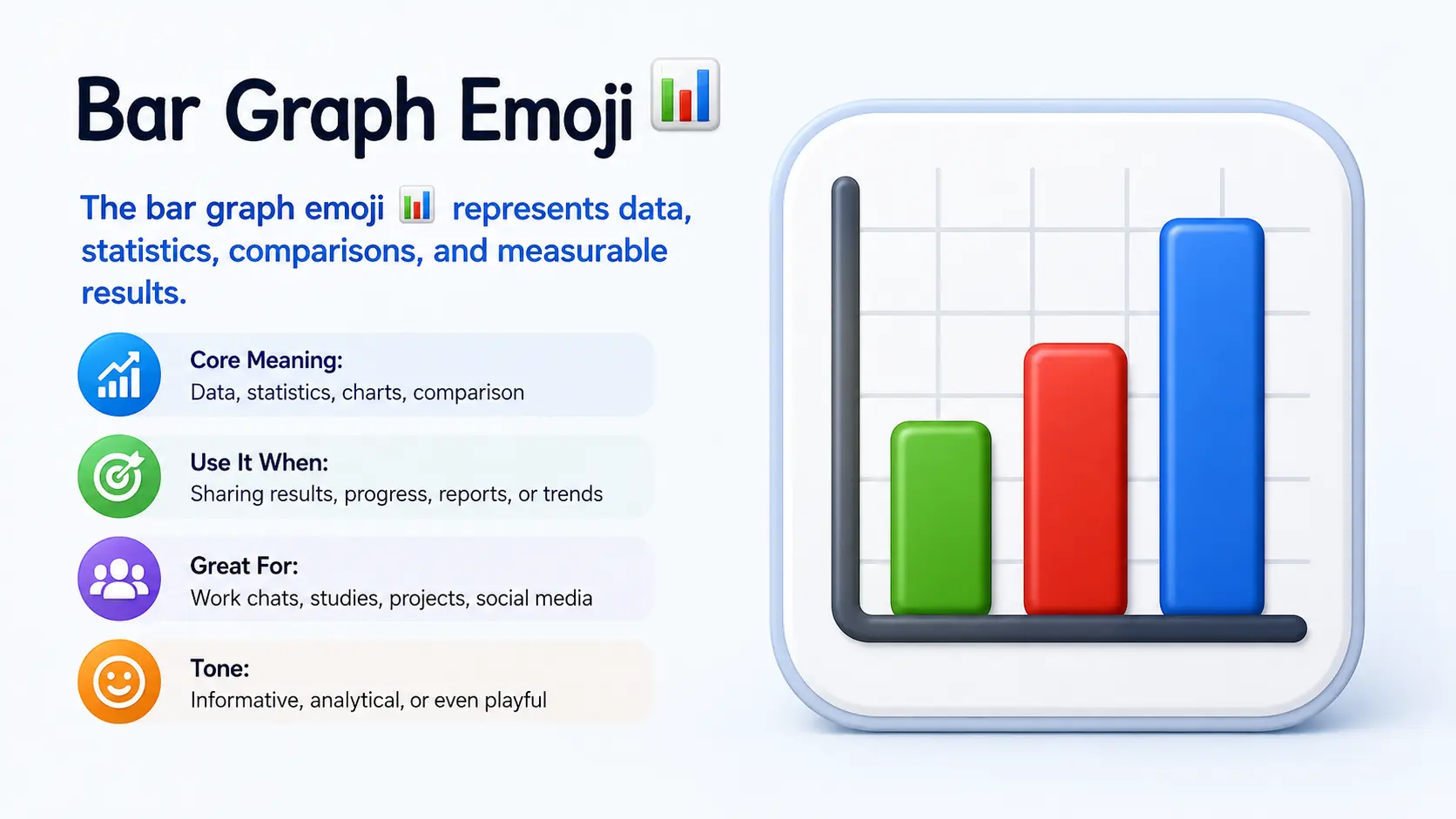
You are talking about sales, grades, progress, money, statistics, or even how productive your week has been, and you want to make the point without writing a whole paragraph. That is where the bar graph emoji 📊 can fit naturally.
The symbol shows a chart with vertical bars at different heights, so its most obvious connection is with data, statistics, comparison, measurement, and progress. But like many emoji symbols, its meaning can stretch beyond the literal image. Someone might use 📊 in a work chat to discuss performance, while another person might add it to a social media caption simply to make a post feel analytical, productive, or data-focused.
The bar graph emoji meaning in texting therefore depends heavily on the surrounding words and the relationship between the people communicating. On WhatsApp, Instagram, TikTok, Facebook, or ordinary text messages, it can be serious, playful, sarcastic, or motivational.
Knowing that context makes it much easier to understand what someone actually means when they send 📊.
Sometimes 📊 says “let the numbers speak” without needing a full explanation.
What Does the Bar Graph Emoji Mean?
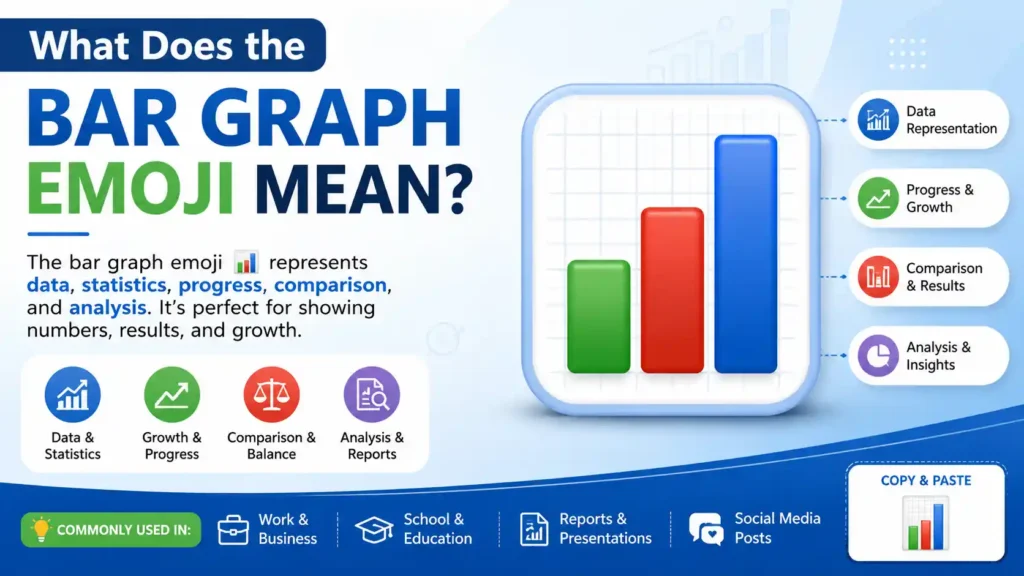
The bar graph emoji 📊 generally represents data, statistics, charts, comparisons, results, measurement, or performance. Its visual design makes it especially useful whenever someone wants to communicate that numbers, trends, or measurable results are involved. In a work conversation, for example, “Our sales improved this month 📊” can make the message feel more visually connected to performance data. In everyday texting, however, the same symbol can be used much more loosely.
A common emotional interpretation is progress or achievement. Someone sharing a fitness goal, study routine, business milestone, or personal improvement might use 📊 to suggest that the numbers are moving in a good direction. It does not automatically mean success, though. The actual wording determines whether the chart represents growth, decline, comparison, or simply information.
The emoji can also have a playful meaning. A friend might say, “My productivity this week 📊” before showing a joke about getting very little done. In that situation, 📊 works almost like a visual punchline.
Several related symbols can help create different nuances. 📈 commonly suggests growth or an upward trend, while 📉 can suggest decline or falling numbers. 💹 can add a stronger financial or market-related feeling. 🧮 points more toward calculations, while 🔢 focuses on numbers themselves. 📋 can suggest reports or organized information.
Context matters especially in relationships. A colleague may use 📊 literally, while a friend may use it humorously. Someone you like could use it while discussing your “relationship statistics,” but the emoji itself does not automatically make a message romantic. Read the surrounding words first.
Meaning Table:
| Emoji | Core meaning | Possible misread | Best used when |
|---|---|---|---|
| 📊 | Data, charts, statistics | Too formal | Discussing measurable information |
| 📈 | Growth, increase, progress | May imply guaranteed success | Showing an upward trend |
| 📉 | Decline, decrease | Can sound negative | Discussing falling numbers |
| 💹 | Financial or market data | Too business-focused | Talking about markets or finance |
| 🧮 | Calculation, math | Can feel academic | Discussing calculations |
| 🔢 | Numbers or numerical information | May seem random | Referring to figures |
| 📋 | Report, list, organized information | May imply paperwork | Sharing structured details |
| 💰 | Money or financial value | May sound materialistic | Discussing finances |
| 💵 | Cash or money | Too literal | Referring to currency |
| 🎯 | Target, goal, objective | Can imply achievement | Discussing goals or results |
Emoji Cards:
📊 Bar Chart:
Meaning: Data, statistics, comparisons, or measurable results.
Example 1: The results are finally in 📊
Example 2: Here is this month’s progress 📊
📈 Chart Increasing:
Meaning: Growth, improvement, or an upward trend.
Example 1: Sales are looking better this month 📈
Example 2: Slowly getting closer to my goal 📈
📉 Chart Decreasing:
Meaning: Falling numbers, decline, or a downward trend.
Example 1: My screen time needs serious work 📉
Example 2: Those numbers were not what we expected 📉
💹 Chart Increasing with Yen:
Meaning: Financial movement, markets, or business-related figures.
Example 1: Watching the market today 💹
Example 2: The finance report is ready 💹
🧮 Abacus:
Meaning: Calculations, mathematics, or working with numbers.
Example 1: Give me a minute to calculate it 🧮
Example 2: Time to check the numbers 🧮
🔢 Input Numbers:
Meaning: Numerical information, figures, or number-focused details.
Example 1: Double-check those figures 🔢
Example 2: Enter the numbers carefully 🔢
📋 Clipboard:
Meaning: A list, report, notes, or organized information.
Example 1: I have the final checklist 📋
Example 2: Sending over the report now 📋
💰 Money Bag:
Meaning: Money, financial value, or wealth.
Example 1: Let’s see what the budget looks like 💰
Example 2: That project finally paid off 💰
💵 Dollar Banknote:
Meaning: Cash, currency, payment, or financial matters.
Example 1: We need to discuss the budget 💵
Example 2: How much did everything cost? 💵
🎯 Bullseye:
Meaning: A goal, target, accuracy, or hitting an objective.
Example 1: We finally reached the target 🎯
Example 2: That number is exactly what we needed 🎯
How to Use the Bar Graph Emoji the Right Way:
The easiest way to use 📊 is to connect it with something measurable. It works especially well when your message involves numbers, results, comparisons, progress, or a report.
WhatsApp 💬
In WhatsApp chats, 📊 can make practical information easier to recognize. You might use it with coworkers when discussing sales, project results, attendance, survey findings, or monthly performance.
For friends and family, it can become more playful. For example, “My sleep schedule this week 📊” can introduce a funny explanation. A status update could also use 📊 to suggest personal progress without making the post overly serious.
Examples include:
“Monthly results are ready 📊”
“Study progress is looking good 📊”
“My productivity today 📊”
Instagram 📸
On Instagram, 📊 can work nicely in captions for business posts, educational content, progress updates, statistics, or data-driven reels. A creator discussing audience growth might add the emoji to make the caption visually match the topic.
It can also be used ironically. A humorous post about comparing everyday habits can use 📊 as a visual signal that a “serious analysis” is coming.
TikTok 🎵
TikTok users can use 📊 in captions and comments when talking about rankings, comparisons, statistics, personal progress, or jokes involving numbers. It can also add an intentionally analytical tone to a funny video.
On Facebook, 📊 works naturally in posts, comments, Messenger conversations, business updates, and community discussions. It can help signal that a message involves measurable information rather than a purely emotional opinion.
The key is simple: let the words establish the context, then use 📊 as visual support.
Why Does the Bar Graph Emoji Look Different on iPhone and Android?
If you copy the bar graph emoji 📊 from one device and send it to someone using another device, you may notice that the chart does not look exactly the same. That is normal.
Emojis are standardized through Unicode, which gives each supported emoji a defined underlying character. However, Unicode does not force Apple, Google, Samsung, Microsoft, or other platforms to draw every emoji in exactly the same visual style. Each company can create its own emoji artwork while keeping the same underlying character.
As a result, 📊 may have small visual differences depending on the device, operating system, application, or font being used. The bars might look slightly different in width or height. The colors may vary. The overall chart design may have a different style, and its size can appear somewhat different inside different apps.
These differences do not normally mean that you and the other person are using different emojis. You are usually seeing different artwork for the same Unicode emoji.
For example, you might send 📊 from an iPhone and see one design, while a friend using Android sees another version. The basic concept remains a bar chart.
This is worth remembering when interpreting emoji meanings. Visual details can influence how an emoji feels, but the underlying symbol remains the same. One platform might make it look more colorful or polished, while another might give it a simpler appearance.
There is no single platform design that should automatically be treated as the “correct” version. Emoji rendering is part of each company’s visual language.
Best Bar Graph Emoji Combos, Copy & Paste:
Romantic ❤️
1.📊 🎯 💰, Use this playfully when talking about shared goals or financial plans.
2.📊 📈 💹, Use this for a couple discussing positive progress with work or finances.
3.📊 💵 🎯, Use this around a shared savings goal or practical future plan.
Cute 🥰
1.📊 🔢 🎯, Use this for a playful “look at our numbers” message.
2.📊 🧮 📋, Use this when joking about being overly organized.
3.📊 📈 🎯, Use this for celebrating a small personal win.
Flirty 😉
1.📊 🎯 📈, Use this jokingly when suggesting someone is making progress with you.
2.📊 🔢 🎯, Use this for playful “the numbers don’t lie” teasing.
3.📊 💹 🎯, Use this when joking that someone’s chances are improving.
Missing Someone 💭
1.📊 🔢 💰, Use this humorously when counting days, plans, or memories.
2.📊 📋 🎯, Use this when making a playful plan to see someone again.
3.📊 📈 🎯, Use this to suggest that your excitement is increasing.
Good Night 🌙
1.📊 📉 🧮, Use this jokingly when your energy is dropping before bed.
2.📊 📋 🎯, Use this when checking off everything before sleeping.
3.📊 📉 🎯, Use this for a playful “battery is going down” style message.
Trending Bar Graph Emoji in 2026:
The bar graph emoji 📊 continues to fit naturally into digital conversations where people discuss statistics, performance, productivity, business, money, school, and personal progress. It is particularly useful because its meaning is visually obvious without requiring much explanation.
In 2026, online communication often mixes ordinary language with visual shorthand. A person discussing a monthly goal may use 📊 to make the message immediately recognizable as data-related. A creator may use it in a caption about results or comparisons, while someone in a group chat might use it humorously to present an imaginary “analysis” of everyday life.
The most useful related symbols include 📊, 📈, 📉, and 🎯. Together, they can communicate different directions or purposes without requiring a long explanation.
| Emoji | Why trending | Who uses it | Platform |
|---|---|---|---|
| 📊 | Clear data and comparison signal | Students, creators, professionals | WhatsApp, Instagram, TikTok |
| 📈 | Suggests progress or growth | Creators, businesses, friends | Instagram, TikTok, chats |
| 📉 | Useful for decline or humor | Everyday users, creators | TikTok, WhatsApp, comments |
| 🎯 | Connects numbers with goals | Students, workers, creators | Social media, messaging |
The appeal is not limited to professional communication. Casual users can turn 📊 into a joke by treating ordinary situations as if they were formal statistics. A caption such as “Weekend productivity 📊” can immediately establish a humorous, analytical tone.
Usage also changes according to context. A business account may use it seriously, while a friend may use the same symbol sarcastically. This flexibility helps explain why chart-related emojis remain useful across different types of online communication.
Overall, emoji usage continues to evolve as people combine visual symbols with short-form text, humor, data, and personal expression.
Bar Graph Emoji Meaning in Different Contexts:
The meaning of 📊 changes subtly depending on who sends it and what they are discussing.
In a romantic conversation, 📊 can be playful rather than romantic by itself. Someone might jokingly use it while comparing how often two people text each other. The surrounding message determines whether the joke feels affectionate, teasing, or simply analytical.
Among friends, the emoji often works as humor. A friend could write, “My motivation today 📊” and use the chart as a visual setup for a joke. It can make an ordinary statement feel more exaggerated.
In a family conversation, 📊 may be more practical. Parents, siblings, or relatives could use it when discussing expenses, schedules, grades, savings, or other measurable information.
In professional communication, 📊 has a more literal role. It can accompany reports, performance discussions, sales figures, project updates, or presentations. Here, it usually signals that the conversation involves data rather than emotion.
In texting, the emoji can be either serious or humorous. Short messages give context extra importance because there may be fewer words around the emoji.
In social media comments, 📊 can signal agreement with a data-related point or add a joking analytical tone. A creator discussing statistics might receive comments containing the emoji simply because it visually matches the topic.
In captions, 📊 can help frame a post around results, progress, comparisons, or personal development.
The same symbol can therefore move from serious to playful without changing its underlying visual identity. When interpreting it, consider the sentence, previous messages, relationship, platform, and overall tone before assigning a specific meaning.
How to Copy and Paste the Bar Graph Emoji:
Copying the bar graph emoji is simple:
📊
Select the emoji above, copy it, and paste it wherever you want.
You can use 📊 in WhatsApp messages, Instagram captions, TikTok comments, Facebook posts, Messenger chats, text messages, profiles, or notes. On most modern devices, you can also open the emoji keyboard and search for the relevant chart or bar graph symbol.
If you are creating content on a computer, copying the actual emoji character is often easier than trying to recreate the chart with text symbols. The recipient’s device will then render the Unicode emoji according to its own platform design.
For quick copy and paste:
📊
You can place it at the beginning of a message for emphasis, at the end of a sentence as visual context, or beside another related symbol when creating an emoji combination.
FAQs:
1. What is the most popular bar graph emoji?
The main bar graph emoji is 📊, and it is commonly used for charts, statistics, comparisons, results, and measurable progress. Its exact tone depends on the surrounding message.
2. What does 📊 mean when someone sends it?
When someone sends 📊, they may be referring to data, numbers, results, comparisons, or progress. In casual conversation, it can also be humorous or sarcastic. The meaning depends on context, not gender stereotypes.
3. Why do emojis look different on iPhone vs Android?
Apple, Google, Samsung, and other companies can create different visual artwork for Unicode emojis. Therefore, 📊 may look slightly different across devices while still representing the same underlying emoji character.
4. Are bar graph emojis used differently in other countries?
Emoji interpretation can vary with language, online communities, personal habits, and cultural context. However, 📊 generally remains connected with charts, numbers, statistics, and measurable information. Individual usage can still differ.
Conclusion
The bar graph emoji 📊 is a practical symbol for data, comparisons, statistics, results, and progress, but its tone can become playful or humorous in casual chats.
Use it when the surrounding message gives the emoji a clear purpose, whether you are discussing work, goals, money, school, or everyday life. 📊
A little context goes a long way, especially when different people may interpret the same emoji differently.

Nasrullah — Emoji Strategist & Content Writer
Nasrullah is a passionate emoji enthusiast and content writer who loves exploring the meanings, uses, and cultural context behind emojis. He creates simple, helpful, and easy-to-understand guides that help readers choose the right emoji for WhatsApp, Instagram, Facebook, texting, and everyday conversations.
With a focus on emoji meanings, combinations, social media usage, and modern digital communication, Nasrullah aims to make every emoji easier to understand and use with confidence. His content combines practical examples with clear explanations so readers can quickly find the meaning and usage they are looking for.
When he’s not researching emojis, Nasrullah enjoys exploring digital trends, writing useful online content, and learning about how people communicate in the digital world. 😊