You type “I got it!” and add 😁, and suddenly the message sounds much more cheerful. That is the appeal of the smiley teeth emoji. Its wide grin and smiling eyes make it useful when you want to show happiness, excitement, amusement, friendliness, or playful energy without writing a long explanation.
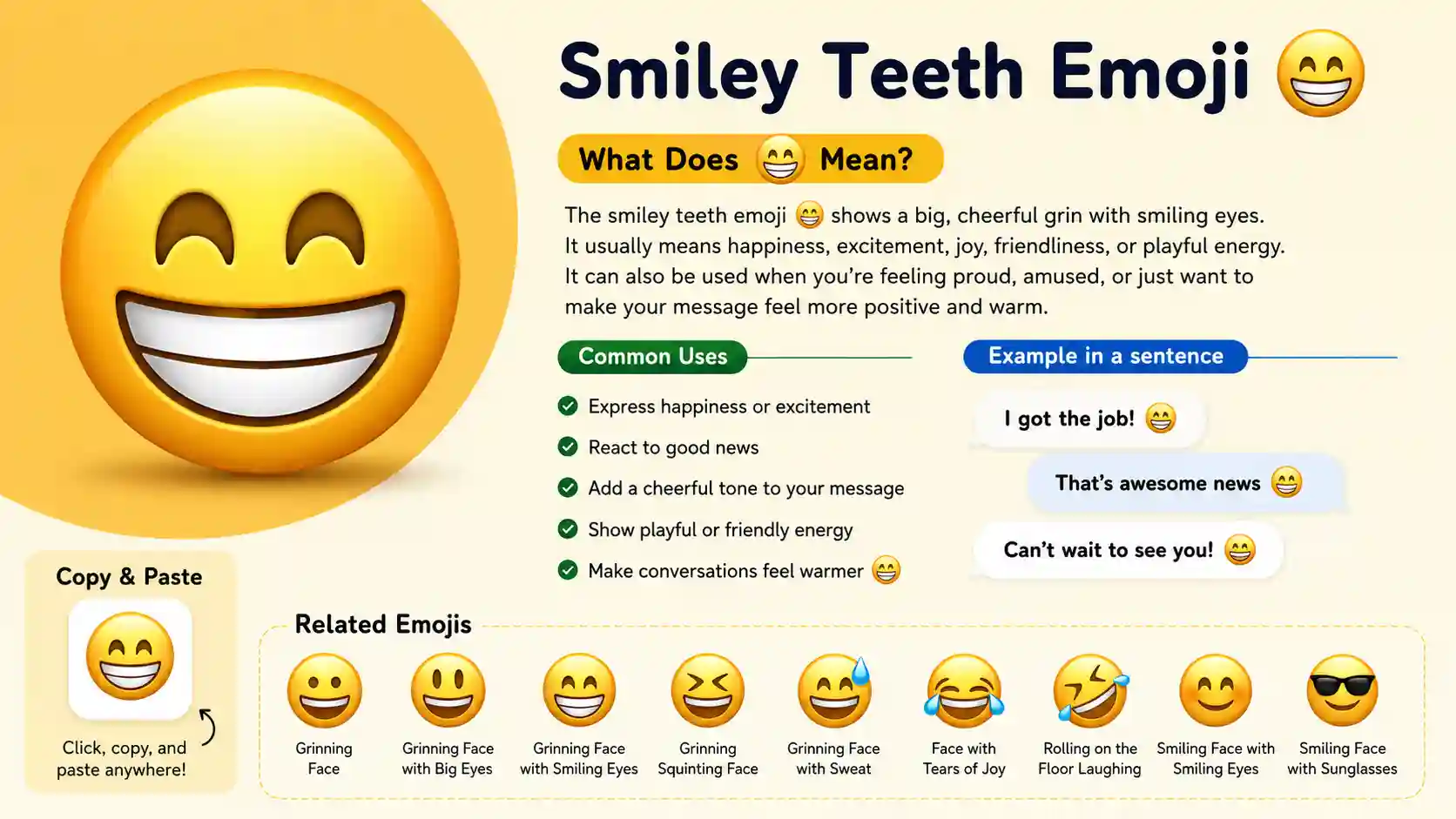
The emoji 😁 is officially known as Beaming Face with Smiling Eyes, and its everyday nickname, “smiley teeth emoji,” comes from its obvious toothy grin.
But what does 😁 mean in texting? Is it always happy? Can it be flirty? What does it mean on WhatsApp, Instagram, or TikTok? The answer depends on context. The words around the emoji, your relationship with the other person, the subject of the conversation, and even the platform can influence how it feels.
That makes 😁 more flexible than it first appears. It can be sincere, playful, cheeky, excited, or occasionally awkward.
Sometimes a big smile says “I’m happy!” while the conversation tells you exactly why. 😁
What Does the Smiley Teeth Emoji Mean?
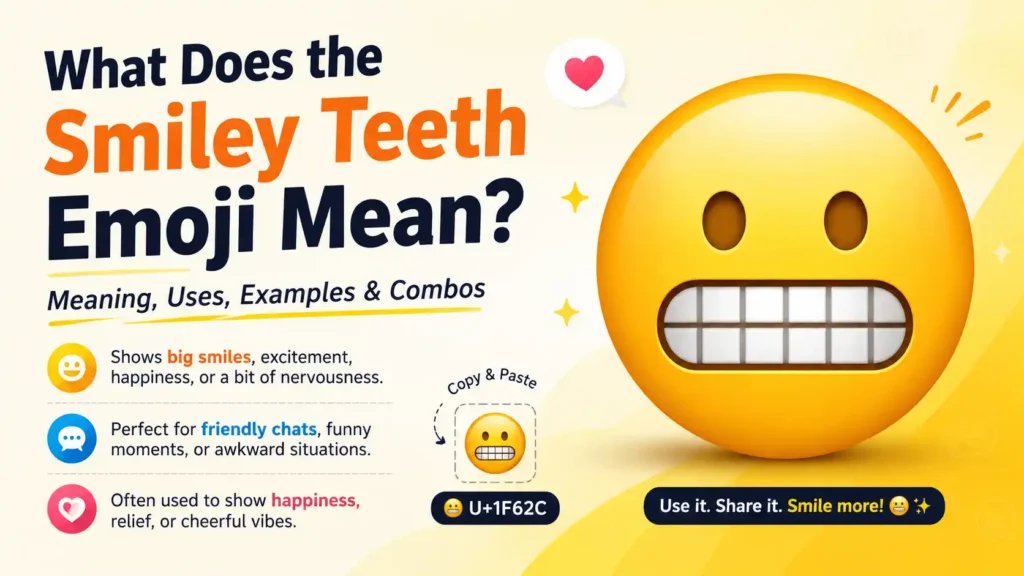
The smiley teeth emoji 😁 generally represents a big, cheerful grin. It is commonly used to communicate happiness, excitement, friendliness, amusement, satisfaction, or positive energy. The visible teeth and smiling eyes give it a more energetic feeling than a restrained smile such as 🙂.
In texting, 😁 can effectively stand for phrases such as “That’s great!”, “I’m so happy!”, “I’m excited!”, or “Haha, yes!” For example, “I finally finished my project 😁” clearly communicates satisfaction. “You are actually coming? 😁” can suggest enthusiastic excitement.
The emoji can also become playful. Someone might write, “Okay, you caught me 😁” after being teased. In another conversation, “I definitely did not eat the last cookie 😁” can sound deliberately cheeky.
In romantic chats, 😁 may add warmth or playful excitement, but it does not automatically mean flirting or romantic interest. A friend, sibling, coworker, or partner could all use it. The relationship and surrounding words matter more than the emoji alone.
On social media, the smiley teeth emoji works naturally in captions, comments, replies, and reactions. It can make a short response feel enthusiastic instead of flat.
It is also useful to distinguish 😁 from visually similar smileys. 😀, 😃, and 😄 all communicate positive emotions, while 😅 introduces nervousness or relief, and 😂 focuses much more strongly on laughter.
| Emoji | Core meaning | Possible misread | Best used when |
|---|---|---|---|
| 😁 | Big cheerful grin | Forced or cheeky | Excitement and happiness |
| 😀 | General grin | Very neutral | Simple positive reactions |
| 😃 | Energetic happiness | Extra enthusiasm | Exciting news |
| 😄 | Warm happiness | Slightly overly cheerful | Friendly messages |
| 😆 | Strong amusement | Very playful | Something is hilarious |
| 😅 | Nervous relief | Embarrassment | Awkward or relieved moments |
| 😂 | Intense laughter | Casual overreaction | Something is genuinely funny |
| 🤣 | Extreme laughter | Dramatic reaction | Very funny situations |
| 😊 | Warm, gentle happiness | Shy or sweet | Kind personal messages |
| 😎 | Cool confidence | Showing off | Confident or playful moments |
Emoji Cards:
😁 Beaming Face with Smiling Eyes:
Meaning: A big, cheerful grin showing happiness, excitement, or positive energy.
Example 1: We finally made it! 😁
Example 2: I knew you would say yes 😁
😀 Grinning Face:
Meaning: A straightforward smile that communicates general happiness or friendliness.
Example 1: Good morning, everyone! 😀
Example 2: Glad you enjoyed it 😀
😃 Grinning Face with Big Eyes:
Meaning: An energetic smile often used for enthusiasm, excitement, or cheerful reactions.
Example 1: That sounds amazing! 😃
Example 2: We actually won! 😃
😄 Grinning Face with Smiling Eyes:
Meaning: A warm grin that can express genuine happiness and good-natured amusement.
Example 1: Thanks for helping me today 😄
Example 2: That was such a fun day 😄
😆 Grinning Squinting Face:
Meaning: Strong amusement, playful laughter, or an especially funny reaction.
Example 1: You really said that? 😆
Example 2: I cannot stop laughing at this 😆
😅 Grinning Face with Sweat:
Meaning: Nervous happiness, relief, embarrassment, or laughter after an awkward moment.
Example 1: I almost forgot the deadline 😅
Example 2: That was way too close 😅
😂 Face with Tears of Joy:
Meaning: Strong laughter when something is genuinely very funny.
Example 1: Your story had me crying 😂
Example 2: I cannot believe you did that 😂
🤣 Rolling on the Floor Laughing:
Meaning: An exaggerated reaction to something extremely funny.
Example 1: That video was ridiculous 🤣
Example 2: Your impression is too good 🤣
😊 Smiling Face with Smiling Eyes:
Meaning: Gentle warmth, kindness, appreciation, or soft happiness.
Example 1: That was really sweet of you 😊
Example 2: I am glad everything worked out 😊
😎 Smiling Face with Sunglasses:
Meaning: Cool confidence, playful self-assurance, or a relaxed attitude.
Example 1: Done before lunch 😎
Example 2: We have this handled 😎
How to Use the Smiley Teeth Emoji the Right Way:
The best way to use 😁 is to match its energetic smile with the emotional tone of your message. It works especially well when you want to sound happy without making your response feel overly serious.
WhatsApp 💬
On WhatsApp, 😁 fits naturally into personal chats, family groups, friend conversations, and status-related messages. It can celebrate good news, soften a playful tease, or make an enthusiastic response feel warmer.
“Dinner is ready 😁” feels more cheerful than simply “Dinner is ready.”
In a friendship, “You actually remembered! 😁” can communicate genuine delight. In a family group, “Everyone is coming this weekend 😁” gives the announcement positive energy.
Instagram 📸
Instagram users can place 😁 in captions, comments, replies, DMs, and casual posts. A creator might use it after sharing exciting news, while a friend may comment “Looking great 😁” on a photo.
It also works well when a caption is intentionally lighthearted. Because Instagram communication is often visual, the emoji can reinforce the cheerful mood without taking attention away from the content.
TikTok 🎵
On TikTok, 😁 can appear in comments, captions, reactions, and messages. It works especially well for humorous situations, playful embarrassment, reactions to trends, and enthusiastic responses.
For example, “Okay, I tried the trend 😁” sounds playful rather than overly serious.
On Facebook, the emoji can work in posts, comments, Messenger conversations, and casual replies. A comment such as “That looks like so much fun 😁” communicates enthusiasm without needing a longer response.
The main rule across all platforms is simple: let the surrounding message establish the tone. The emoji should support your words, not replace them completely.
Why Does the Smiley Teeth Emoji Look Different on iPhone and Android?
If 😁 looks slightly different on an iPhone compared with an Android phone, that does not necessarily mean you are seeing a different emoji. Unicode provides the underlying character, while individual companies and platforms create their own artwork for displaying it.
That is why Apple, Google, Samsung, Microsoft, and other platforms can give the same emoji slightly different visual designs. Differences can appear in the shape of the mouth, eyes, teeth, shading, proportions, or overall style.
For the smiley teeth emoji, the central idea remains recognizable: a broad grin with smiling eyes. However, small visual details may influence how expressive the emoji feels. One version might appear especially bright and cheerful, while another could look slightly more exaggerated.
This is normal with emoji symbols. Unicode standardization helps devices understand that the character is the same, but it does not require every company to draw it identically.
The same thing can happen with other smileys. 😄, for example, is described as a yellow face with smiling eyes and a broad open smile showing the upper teeth, but its artwork can vary between platforms.
There is therefore no single visual design that every device must reproduce. If someone sends 😁 from an iPhone and you receive it on Android, the character itself is still intended to represent the same Unicode emoji.
This matters when interpreting messages because people sometimes judge the visual expression they see rather than the underlying character. A slightly different mouth or eye shape can make an emoji feel warmer, sillier, or more intense.
When in doubt, focus on the conversation rather than tiny design differences. The words, relationship, and situation usually provide much stronger clues about what the sender intended.
Best Smiley Teeth Emoji Combos, Copy & Paste:
Romantic ❤️
1.👉 😁❤️: Use this when you want to combine cheerful energy with affection.
2.👉 😄❤️: Use this for a warm and genuinely happy romantic message.
3.👉 😊❤️: Use this for a softer, sweeter expression of affection.
Cute 🥰
1.👉 😁😊: Use this for a happy, friendly, and adorable reaction.
2.👉 😄😊: Use this when responding warmly to something sweet.
3.👉 😂😊: Use this after laughing at something that still feels wholesome.
Flirty 😉
1.👉 😁😎: Use this for confident, playful flirting.
2.👉 😁😍: Use this when showing happy admiration.
3.👉 😄❤️: Use this for a warm message with a gentle romantic edge.
Missing Someone 💭
1.👉 😁❤️: Use this when thinking about someone you care about while keeping the tone positive.
2.👉 😊❤️: Use this for a softer “thinking of you” feeling.
3.👉 😄❤️: Use this when missing someone but wanting the message to remain cheerful.
Good Night 🌙
1.👉 😊❤️: Use this for a sweet good-night message.
2.👉 😄❤️: Use this when saying good night in an upbeat way.
3.👉 😁😊: Use this for a playful, cheerful good-night exchange.
Trending Smiley Teeth Emoji in 2026:
The smiley teeth emoji 😁 continues to fit naturally into casual digital communication because it expresses a recognizable emotion without requiring much explanation. It is particularly useful when people want their messages to feel energetic, friendly, or playful.
In 2026, emoji usage continues to depend heavily on the culture of individual conversations and platforms rather than one universal interpretation. 😁 can appear in WhatsApp chats, Instagram comments, TikTok reactions, Facebook posts, and everyday text messages.
Its popularity is also helped by its flexibility. A person can use it after genuinely good news, while another person may use it after a cheeky joke. The same visual smile can therefore support different conversational tones.
Similar positive-face emojis such as 😄, 😊, and 😅 also appear frequently in casual online communication, although each carries a somewhat different emotional shade. Emoji references describe 😁 as a smiling, tooth-revealing face associated with happiness and satisfaction, while also noting that platform appearance can vary.
| Emoji | Why trending | Who uses it | Platform |
|---|---|---|---|
| 😁 | Energetic, cheerful reaction | Friends and casual users | WhatsApp, Instagram, TikTok |
| 😄 | Warm positive response | General audiences | Messaging and social media |
| 😊 | Gentle and friendly tone | Friends, families, creators | Instagram, WhatsApp |
| 😅 | Awkward or relieved humor | Casual online users | TikTok, chats, comments |
Creators may use these faces in captions or comments because a single emoji can quickly signal the intended mood. Everyday users similarly use them to make short responses feel less dry.
Still, “trending” does not mean everyone interprets the emoji identically. Online language changes through communities, humor, trends, and personal habits, so the same emoji can gradually pick up new shades of meaning without losing its basic visual association.
Smiley Teeth Emoji Meaning in Different Contexts:
The same 😁 can feel noticeably different depending on who sends it and what they are saying.
In a romantic conversation, 😁 can communicate excitement or playful affection. “Can’t wait to see you 😁” sounds enthusiastic, but the emoji alone does not prove romantic interest.
Between friends, it often feels much more casual. “You really did that 😁” might be an amused reaction or harmless teasing.
In a family conversation, the emoji can make announcements and everyday messages feel cheerful. “We’re all coming over Sunday 😁” adds enthusiasm without changing the basic meaning.
In professional or workplace communication, context matters more. With familiar coworkers, 😁 may be perfectly natural in an informal chat. In a formal email or serious business situation, however, it can feel unnecessarily casual. Choosing whether to use an emoji should depend on the relationship and communication style.
In texting, the smiley teeth emoji often works as an emotional signal. Since text does not provide facial expressions or vocal tone, 😁 can help show that a statement is intended to be cheerful or playful.
In social media comments, it can be a quick reaction to something funny, exciting, impressive, or simply enjoyable. “This is amazing 😁” is straightforward, while “You actually posted this 😁” could be teasing depending on the relationship.
In captions, 😁 can emphasize happiness about an event, achievement, trip, or personal moment.
The important point is that emoji meanings in chat are contextual. An emoji is not a complete sentence with one permanent interpretation. Look at the surrounding words, the sender’s usual communication style, your relationship, and the situation before deciding what the smile means.
How to Copy and Paste the Smiley Teeth Emoji:
Want to use the smiley teeth emoji right away? Here it is:
😁
You can select 😁, copy it, and paste it wherever you want.
It works for messages such as:
“Good news! 😁”
“See you soon 😁”
“I finally finished it 😁”
You can paste it into WhatsApp chats and status updates, Instagram captions and comments, TikTok captions and comments, Facebook posts, Messenger conversations, and many other apps that support Unicode emojis.
If you regularly use copy paste emojis, saving frequently used combinations can also make messaging faster. Just remember that the appearance may change slightly between devices, even though the underlying emoji character remains the same.
FAQs:
1. What is the most popular smiley teeth emoji?
The primary emoji associated with the phrase “smiley teeth emoji” is 😁, officially called Beaming Face with Smiling Eyes. It commonly expresses a big, cheerful grin, happiness, excitement, or playful energy.
2. What does 😁 mean when someone sends it?
When someone sends 😁, it usually adds a cheerful, friendly, excited, or playful tone. The meaning depends on the conversation rather than gender stereotypes. A friend, family member, romantic partner, or coworker could all use it differently.
3. Why do emojis look different on iPhone vs Android?
Unicode identifies the underlying emoji character, while companies create their own visual artwork. As a result, Apple, Google, Samsung, Microsoft, and other platforms can display the same emoji with slightly different facial details, proportions, or styling.
4. Are smiley teeth emojis used differently in other countries?
Emoji interpretation can vary between communities, cultures, age groups, and online spaces. However, it is safer not to assume that everyone in a particular country interprets 😁 in exactly the same way. The immediate conversation is usually the strongest clue.
Conclusion:
The smiley teeth emoji 😁 is a cheerful, energetic way to add a big grin to digital conversations. It commonly communicates happiness, excitement, friendliness, amusement, and playful energy.
Its exact tone depends on context, so consider the words, relationship, and situation before interpreting it. 😁
Whether you are chatting on WhatsApp, commenting on Instagram, reacting on TikTok, or simply texting a friend, use it when you want your message to feel brighter and more expressive.

Nasrullah — Emoji Strategist & Content Writer
Nasrullah is a passionate emoji enthusiast and content writer who loves exploring the meanings, uses, and cultural context behind emojis. He creates simple, helpful, and easy-to-understand guides that help readers choose the right emoji for WhatsApp, Instagram, Facebook, texting, and everyday conversations.
With a focus on emoji meanings, combinations, social media usage, and modern digital communication, Nasrullah aims to make every emoji easier to understand and use with confidence. His content combines practical examples with clear explanations so readers can quickly find the meaning and usage they are looking for.
When he’s not researching emojis, Nasrullah enjoys exploring digital trends, writing useful online content, and learning about how people communicate in the digital world. 😊