You send a simple “I’m thinking about you,” add a 🦋, and suddenly the message feels a little more personal. That is part of why the emoji butterfly has become such a recognizable symbol in everyday digital conversations. People use it in WhatsApp chats, Instagram captions, TikTok comments, Facebook posts, bios, and casual texts to add a feeling that words alone may not capture.
The butterfly emoji 🦋 commonly suggests beauty, transformation, freedom, lightness, nature, or a fresh emotional beginning. It can also make a message feel cute, dreamy, peaceful, or aesthetic. However, there is no single meaning that applies in every conversation. A friend may use it playfully, while someone you like may use it to create a softer or more affectionate tone.
The best way to understand 🦋 is to look at the words around it, your relationship with the sender, and the overall mood of the conversation.
What Does Emoji Butterfly Mean?
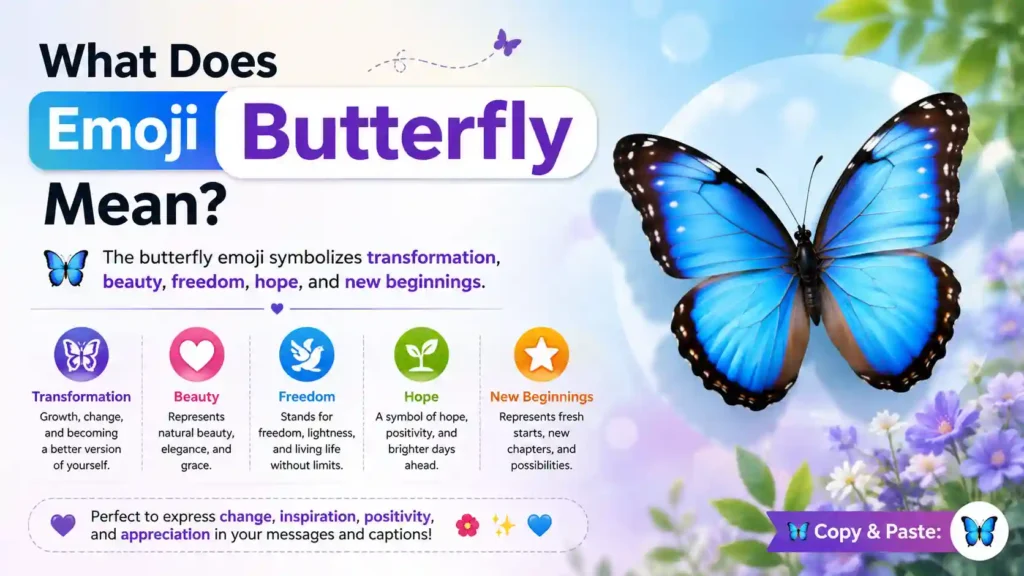
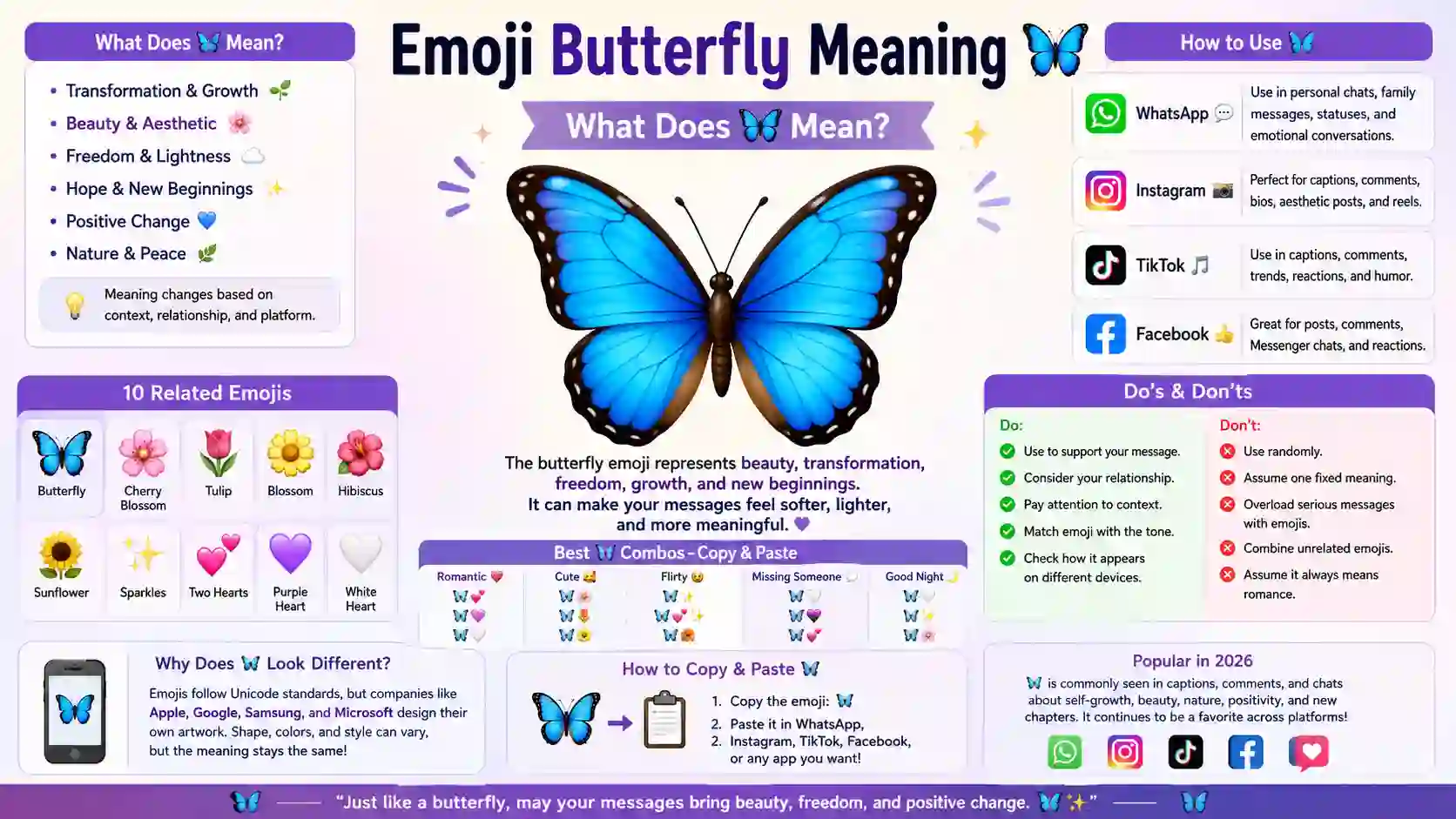
The emoji butterfly 🦋 is most commonly associated with beauty, transformation, freedom, nature, and positive change. Because butterflies develop through a dramatic transformation, people often use this emoji when talking about personal growth, a new chapter, confidence, or leaving something difficult behind. In a casual chat, it can simply make a sentence look softer and more cheerful.
In texting, 🦋 may communicate “this feels beautiful,” “I love this,” “I feel free,” or “something is changing.” For example, “New chapter 🦋” can suggest personal growth without explaining the entire story. In a romantic conversation, the same emoji can feel gentle and affectionate, especially alongside words about missing someone, happiness, or attraction. It does not automatically mean romantic love, though.
On Instagram and TikTok, the butterfly emoji is especially natural in aesthetic captions, nature content, fashion posts, self-growth messages, and soft or dreamy content. It often appears with 🌸, ✨, or 💜 when someone wants a delicate visual mood.
The surrounding emoji can influence the interpretation. 🌸 can make 🦋 feel more floral and cute, while ✨ can make it feel magical or celebratory. 💜 can add affection, while 🌈 may suggest positivity or individuality.
Context still matters most. A message such as “You finally did it 🦋” sounds encouraging. “Good night 🦋” feels soft and sweet. “I can’t stop thinking about you 🦋” may feel more emotionally intimate. The relationship between sender and receiver matters too. An emoji from a close friend may have a very different tone from the same emoji sent by a romantic interest.
| Emoji | Core meaning | Possible misread | Best used when |
|---|---|---|---|
| 🦋 | Change, beauty, freedom | Romantic signal | Growth or a soft mood |
| 🌸 | Beauty, freshness | Too childish | Cute or aesthetic posts |
| 🌷 | Gentleness, affection | Romantic by default | Warm messages |
| 🌼 | Cheerfulness, positivity | Decorative only | Friendly encouragement |
| 🌺 | Beauty, vibrancy | Flirty tone | Bright, expressive posts |
| 🌻 | Happiness, optimism | Strong positivity | Encouraging messages |
| ✨ | Sparkle, excitement | Overly dramatic | Highlighting something special |
| 💕 | Affection, closeness | Romantic assumption | Sweet personal messages |
| 💜 | Affection, support | Relationship signal | Caring conversations |
| 🤍 | Peace, sincerity | Emotional distance | Gentle support |
Emoji Cards:
🦋 Butterfly:
Meaning: Transformation, freedom, beauty, and a fresh emotional feeling.
Example 1: New beginnings feel good 🦋
Example 2: Finally becoming myself 🦋
🌸 Cherry Blossom:
Meaning: Freshness, beauty, softness, and a delicate aesthetic mood.
Example 1: Such a beautiful morning 🌸
Example 2: Keeping life simple and sweet 🌸
🌷 Tulip:
Meaning: Gentleness, beauty, affection, and a warm springtime feeling.
Example 1: Sending you something beautiful today 🌷
Example 2: A little reminder that you matter 🌷
🌼 Blossom:
Meaning: Cheerfulness, friendliness, and a bright positive mood.
Example 1: Hope your day is lovely 🌼
Example 2: Keep smiling through it all 🌼
🌺 Hibiscus:
Meaning: Vibrant beauty, warmth, and an expressive tropical feeling.
Example 1: Vacation mood activated 🌺
Example 2: Feeling colorful today 🌺
🌻 Sunflower:
Meaning: Happiness, optimism, warmth, and encouragement.
Example 1: Keep looking toward better days 🌻
Example 2: You bring so much light 🌻
✨ Sparkles:
Meaning: Excitement, magic, beauty, or emphasis.
Example 1: Tonight was absolutely magical ✨
Example 2: You made my whole day better ✨
💕 Two Hearts:
Meaning: Affection, closeness, sweetness, and caring feelings.
Example 1: Always happy talking to you 💕
Example 2: Sending lots of love your way 💕
💜 Purple Heart:
Meaning: Care, affection, support, and emotional warmth.
Example 1: Proud of you for getting through it 💜
Example 2: I’m always here for you 💜
🤍 White Heart:
Meaning: Gentle affection, sincerity, peace, and quiet support.
Example 1: Thinking of you today 🤍
Example 2: Sending you peaceful thoughts 🤍
How to Use Emoji Butterfly the Right Way:
WhatsApp 💬
On WhatsApp, 🦋 works naturally when you want to soften the tone of a personal message. In a friendship, it can accompany encouragement such as “You deserve a fresh start 🦋.” In family chats, it can add warmth to congratulations, supportive messages, or everyday updates. It also works well in a WhatsApp status when the goal is to express growth, peace, beauty, or a new chapter without writing a long explanation.
For emotional conversations, consider the surrounding words carefully. “I’m proud of you 🦋” feels supportive, while “Wish you were here 🦋” can sound more intimate. The emoji adds atmosphere, but the sentence carries the main meaning.
Instagram 📸
Instagram is a natural home for the butterfly emoji because visual aesthetics matter heavily on the platform. You might see 🦋 in captions about nature, fashion, self-confidence, travel, personal growth, photography, or peaceful moments. It can also appear in comments when someone wants to compliment a photo without writing a full sentence.
A caption such as “Becoming the version of me I always wanted 🦋✨” creates a transformation-focused mood. A shorter caption such as “Soft season 🦋” is more open to interpretation.
TikTok
On TikTok, 🦋 can work in captions and comments ranging from sincere to playful. Creators may use it with transformation videos, glow-up content, lifestyle clips, beauty posts, or reflective stories. Viewers may also place it in comments as a quick positive reaction.
Because TikTok trends change quickly, context matters especially strongly. The same 🦋 can feel sincere in one video and ironic in another.
On Facebook, the butterfly emoji fits posts, comments, and Messenger conversations. It can add warmth to congratulations, encouragement, family updates, inspirational posts, and personal reflections. Compared with a simple text-only message, it can make a short response feel more expressive without becoming overly dramatic.
Dos and Don’ts:
Do:
- Use 🦋 when its soft, positive, or transformative feeling fits the message.
- Consider your relationship with the receiver.
- Pay attention to the words surrounding the emoji.
- Match 🦋 with related symbols such as ✨ or 🌸 when you want a specific mood.
- Check how the emoji appears on your device before sending something important.
Don’t:
- Assume 🦋 automatically means romance.
- Use a long chain of decorative emojis when one or two will work.
- Expect everyone to interpret the symbol identically.
- Add unrelated emojis simply to make a message look colorful.
- Use a soft emoji to disguise an otherwise confusing or serious message.
The simplest rule is to let your words carry the message and let 🦋 support the tone.
Why Do Emoji Butterfly Look Different on iPhone and Android?
If you send 🦋 from an iPhone to an Android phone and notice that it looks slightly different, nothing has necessarily gone wrong. Emojis are standardized through Unicode, which gives compatible devices a common character to recognize. However, Unicode does not require every company to draw that character in exactly the same way.
Apple, Google, Samsung, Microsoft, and other technology companies can create their own emoji artwork. As a result, the butterfly may have differences in shape, wing details, color balance, outline, shading, or overall visual style. One version may look brighter or more detailed, while another may appear flatter or more minimalist.
These differences can matter when someone is trying to understand an emoji visually. A person may prefer the appearance on their own phone and assume another design is a different symbol, even though both devices are displaying the same underlying Unicode character.
The same principle applies to many emoji symbols. Their appearance can also change slightly because of operating-system updates, app design, font rendering, or screen size. The underlying character remains the important part.
For example, if you copy 🦋 from one device and paste it into WhatsApp on another device, the recipient’s phone generally displays the version designed for that platform. You are not necessarily sending Apple’s artwork or Google’s artwork as a fixed picture. You are sending an emoji character that the receiving system renders.
So if your friend’s butterfly looks a little different from yours, focus on the context rather than the artwork. A visual difference does not automatically create a different meaning.
Best Emoji Butterfly Combos, Copy & Paste:
Romantic ❤️
1.👉 🦋💕, Use this for a soft affectionate message.
2.👉 🦋💜, Use this when affection feels gentle and personal.
3.👉 🦋🤍, Use this for quiet, sincere romantic warmth.
Cute 🥰
1.👉 🦋🌸, Use this for a sweet and delicate mood.
2.👉 🦋🌷, Use this with a gentle compliment or thoughtful message.
3.👉 🦋🌼, Use this for cheerful, wholesome energy.
Flirty 😉
1.👉 🦋✨, Use this when you want a playful, dreamy tone.
2.👉 🦋💕✨, Use this for a noticeably sweeter message.
3.👉 🦋🌺, Use this when the conversation feels bright and expressive.
Missing Someone 💭
1.👉 🦋🤍, Use this for a soft “thinking of you” message.
2.👉 🦋💜, Use this when you want to show care from a distance.
3.👉 🦋💕, Use this when missing someone has an affectionate tone.
Good Night 🌙
1.👉 🦋🤍, Use this for a peaceful good-night message.
2.👉 🦋✨, Use this for a dreamy bedtime wish.
3.👉 🦋🌸, Use this for a gentle, cute good-night text.
Trending Emoji Butterfly in 2026:
In 2026, 🦋 continues to fit the visual language of casual online communication because it can express several moods without requiring a long explanation. It appears naturally in conversations about personal growth, beauty, lifestyle, nature, fashion, emotional reflection, and fresh starts.
🦋On WhatsApp, people can use 🦋 to make everyday messages feel softer or more encouraging. On Instagram, it fits aesthetic captions, photography, beauty content, and posts about personal change. On TikTok, it can accompany transformation-focused videos, comments, jokes, or reflective content. Facebook users may use it in supportive posts and personal conversations.
The important point is that popularity does not mean everyone uses it identically. One creator may use 🦋 for an aesthetic look, while another person may use it to represent emotional growth. These flexible interpretations help explain why the symbol works across different communities.
Related symbols such as 🌸, ✨, and 💜 often appear alongside it because they reinforce a soft, positive, or expressive mood. Rather than treating any one combination as an official trend, it is more useful to look at how people use the symbols together in real conversations.
| Emoji | Why trending | Who uses it | Platform |
|---|---|---|---|
| 🦋 | Flexible, aesthetic, positive | General users | Instagram, TikTok |
| 🌸 | Soft visual appeal | Creators and friends | Instagram, WhatsApp |
| ✨ | Adds emphasis and excitement | General users | TikTok, Instagram |
| 💜 | Adds warmth and affection | Friends and couples | WhatsApp, Facebook |
Emoji usage continues to evolve as online communities create new tones, combinations, and inside meanings around familiar symbols.
Emoji Butterfly Meaning in Different Contexts:
The meaning of 🦋 becomes much easier to understand when you look at the situation in which it appears. In a romantic conversation, it can add softness to an affectionate message. For example, “You make me smile 🦋” may feel sweet or lightly flirty, especially if the conversation is already romantic. Still, the emoji itself does not prove romantic interest.
Between friends, 🦋 can represent encouragement, change, happiness, or a shared aesthetic. A friend saying “You’ve come so far 🦋” is probably emphasizing personal growth rather than flirting.
In family conversations, it can make congratulations or supportive comments feel warm. “So proud of you 🦋” may accompany news about graduation, a new job, a move, or another positive life change.
In professional or casual communication, caution is useful. In a relaxed workplace chat, 🦋 may be harmless decoration, but a formal business message usually benefits from a simpler tone. The appropriateness depends on the relationship and communication culture.
In texting, context can change quickly because there are fewer visual clues than in face-to-face conversation. The sentence matters more than the emoji alone.
Social media comments often use 🦋 as a quick reaction to beauty, transformation, creativity, or an appealing visual. In captions, it can establish an aesthetic mood without explaining exactly what the writer feels.
The same symbol can therefore move from supportive to romantic, playful to peaceful, depending on the surrounding language. Instead of asking, “What does 🦋 always mean?” ask, “What feeling is this person adding to this particular message?”
How to Copy and Paste Emoji Butterfly:
If you simply want the butterfly emoji for a message, copy it here:
🦋
On most phones or computers, select the emoji, copy it, and paste it wherever you want. You can use it in WhatsApp chats, Instagram captions, TikTok comments, Facebook posts, Messenger conversations, bios, or ordinary text messages.
You can also copy an entire combination, such as 🦋✨ or 🦋💕, when you want to communicate a specific mood without writing a long explanation.
If the emoji looks slightly different after you paste it, that is usually because the receiving platform uses its own emoji artwork. The character itself can still be the same.
FAQs:
1. What is the most popular emoji butterfly?
The standard butterfly emoji is 🦋, and it is commonly used to represent beauty, transformation, freedom, nature, and positive change. Its exact tone depends on the surrounding message.
2. What does 🦋 mean when someone sends it?
It can suggest beauty, growth, freedom, softness, excitement, or affection. The meaning depends on the conversation and relationship, rather than the sender’s gender or a fixed romantic rule.
3. Why do emojis look different on iPhone vs Android?
Unicode provides the underlying emoji character, while companies such as Apple and Google design their own visual versions. That is why the same 🦋 can have slightly different artwork across devices.
Conclusion:
The emoji butterfly 🦋 is a flexible symbol for beauty, transformation, freedom, softness, and positive change. Its meaning can shift with the conversation, relationship, and platform.
Use it when you want to add a little visual emotion without overwhelming your message. Whether it is a caption, friendship text, supportive note, or affectionate chat, context is what gives 🦋 its real meaning. 💜✨

Nasrullah — Emoji Strategist & Content Writer
Nasrullah is a passionate emoji enthusiast and content writer who loves exploring the meanings, uses, and cultural context behind emojis. He creates simple, helpful, and easy-to-understand guides that help readers choose the right emoji for WhatsApp, Instagram, Facebook, texting, and everyday conversations.
With a focus on emoji meanings, combinations, social media usage, and modern digital communication, Nasrullah aims to make every emoji easier to understand and use with confidence. His content combines practical examples with clear explanations so readers can quickly find the meaning and usage they are looking for.
When he’s not researching emojis, Nasrullah enjoys exploring digital trends, writing useful online content, and learning about how people communicate in the digital world. 😊